This manual is for NURS FPX 4015 Assessment 3, start to submission. In the current version of the course, Assessment 3 is a concept map for a mental health diagnosis in one of the course's patient scenarios, with a written explanation: the diagnosis and the criteria it meets, risk factors, signs and symptoms, diagnostic findings, medications, possible complications, and nursing diagnoses with evidence-based interventions. The map is graded on connections. Boxes that list facts score lower than a map where each arrow says why one element leads to another. Below is the method our tutors use, a structure for the map and narrative, and an annotated sample excerpt. Prefer to hand it off? A premium original sample for this exact assessment comes back in 24 to 48 hours, revised free until it meets the guide. Capella's catalog lists the course as NURS-FPX4015, and some courserooms print NURS4015; both point to this same Assessment 3.
One honesty note before the manual: Capella revises courses and scoring guides over time, so always write to the exact scoring guide attached to your assessment in the courseroom. The course identity above is verified on capella.edu; the method and structure below are our tutors' approach to it, not Capella's official rubric text.
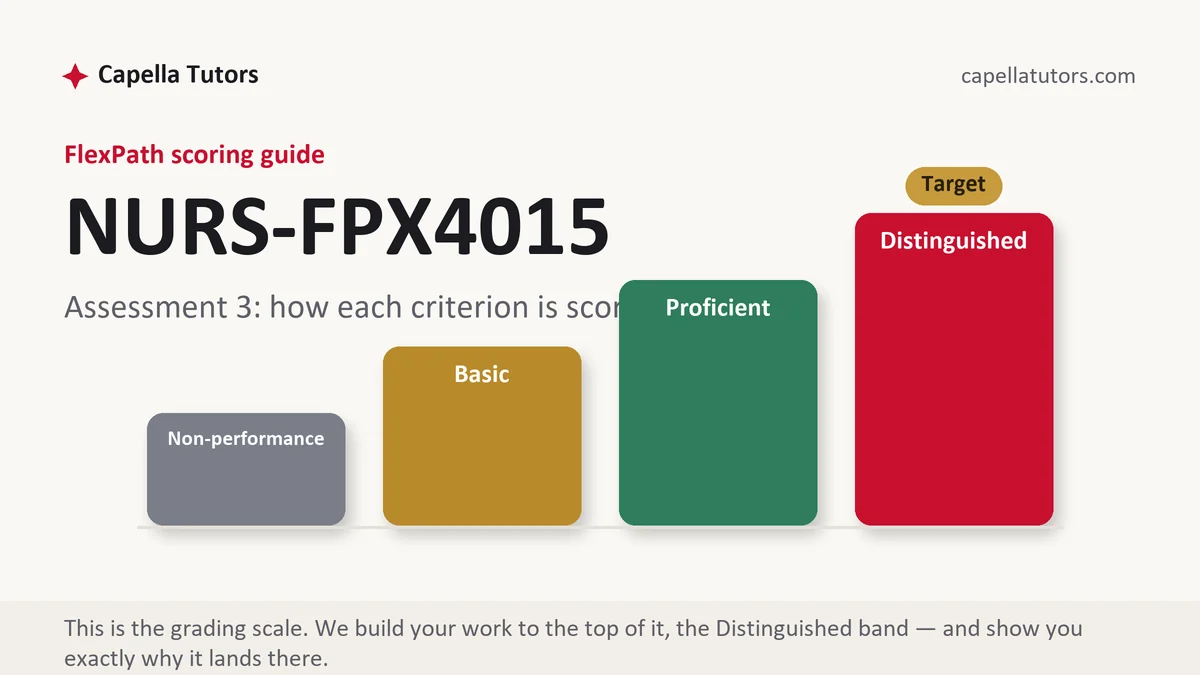
How NURS FPX 4015 Assessment 3 is scored
FlexPath does not use letter grades. Each criterion in the scoring guide lands on one of four levels, and the level descriptions are the real writing brief:
| Level | What it means on a mental health concept map |
|---|---|
| Distinguished | Every required element appears, each link is explained, the diagnosis is supported by the scenario's findings against DSM-5 criteria, interventions are evidence-based and tied to specific nursing diagnoses, and the narrative explains the reasoning. |
| Proficient | All elements are present and accurate, but links are drawn without explanation and interventions are generic. |
| Basic | The map lists information about the disorder rather than this patient, and some elements are missing. |
| Non-performance | The concept map or the written explanation is missing. |
Use the template the course provides if there is one. Evaluators read the map against its own boxes, and a homemade layout that drops a required box costs the criterion.
The NURS FPX 4015 Assessment 3 method, step by step
-
Read the scenario like a chart
List the patient's history, presenting symptoms, vital signs, labs and social context. These are the facts every box on your map must come from.
-
Confirm the diagnosis
Show which DSM-5 criteria the scenario meets, with the duration and functional impact the criteria require. Cite the source.
-
Map risk factors and symptoms
Separate biological, psychological and social risk factors, then link each symptom to the mechanism that explains it where you can.
-
Add diagnostics, medications and complications
Screening tools and labs used to support or rule out the diagnosis, the medication class and its monitoring needs, and the complications to watch for, including safety risk.
-
Write nursing diagnoses and interventions
Two or three prioritized nursing diagnoses, each with interventions supported by current evidence and a measurable outcome.
-
Explain the map in the narrative
Walk the reader through the links in a short written section, so the reasoning behind each arrow is on the page.
A structure that maps to the criteria
Word counts are planning targets our tutors use for the narrative, not Capella rules; follow your scoring guide and template.
| Section | What it must do | Guide |
|---|---|---|
| Introduction and scenario | The patient, the presenting picture and the diagnosis to be mapped. | ~150 words |
| Diagnosis | DSM-5 criteria matched to the scenario findings. | ~150 words |
| Risk factors, signs and symptoms | Grouped and linked to the diagnosis on the map. | ~200 words |
| Diagnostics, medications, complications | Tools, drug class, monitoring and risks. | ~250 words |
| Nursing diagnoses and interventions | Prioritized, evidence-based, with outcomes. | ~250 words |
| Concept map and conclusion | The map itself, then a short close and references. | map plus ~100 words |
Annotated sample excerpt
An original model excerpt from our team, written to show the register that reaches the top of the guide. Learn the moves, then write your own version.
The priority nursing diagnosis is risk for self-directed violence related to persistent depressed mood and recent loss, because the scenario documents hopelessness and withdrawal from family two weeks after a bereavement.1 Interventions begin with a direct, validated suicide risk screen at admission and each shift, a safety check of the room and belongings, and scheduled one-to-one conversations that invite the patient to describe her mood in her own words.2 The expected outcome is that the patient identifies two people she would contact and agrees to a safety plan before discharge, which links the intervention box on the map to a measurable result.3
- 1Prioritizes the diagnosis by safety and ties it to findings in the scenario.
- 2Uses specific, evidence-based interventions rather than general support.
- 3States a measurable outcome and points back to the map, which is the connection the criteria reward.
The full premium sample for your exact assessment, written fresh to your scoring guide and topic, is free to request. Study it, revise it into your own voice, and submit work you understand.
The five mistakes that cost Distinguished
- A map about the disorder, not the patient. Every box should come from the scenario.
- Unexplained arrows. The narrative must say why each link exists.
- Missing safety assessment. For mood disorders, risk screening belongs in the interventions.
- Generic interventions. "Provide emotional support" needs a specific, evidence-based action.
- Dropping a template box. Evaluators check the required elements one by one.
Pre-submission checklist
- Scenario facts listed before mapping
- Diagnosis supported against DSM-5 criteria
- Risk factors, symptoms, diagnostics, medications and complications all mapped
- Prioritized nursing diagnoses with evidence-based interventions and outcomes
- Narrative explains the links
- Current APA references
Want the concept map and narrative done together?
Send the scoring guide, the template and the scenario you were given. Our team returns a premium original concept map with its written explanation in 24 to 48 hours, revised free until it meets the guide.