This manual is for NURS FPX 4015 Assessment 1, start to submission. In the current version of Pathophysiology, Pharmacology, and Physical Assessment: A Holistic Approach to Patient-Centered Care, Assessment 1 is preparation for the comprehensive head-to-toe assessment you record at the end of the course: you choose an adult volunteer to act as your standardized patient, complete the participant waiver the course provides, and match the volunteer to one of the course's patient scenarios. The final recorded exam will not be graded without the completed waiver, so this small assessment protects the largest one. Your volunteer should be a friend or family member, not a patient, and not anyone under 18. Below is how to plan it, what to check, and how it sets up the rest of the course. Prefer to hand it off? A premium original sample for this exact assessment comes back in 24 to 48 hours, revised free until it meets the guide. Capella's catalog lists the course as NURS-FPX4015, and some courserooms print NURS4015; both point to this same Assessment 1.
One honesty note before the manual: Capella revises courses and scoring guides over time, so always write to the exact scoring guide attached to your assessment in the courseroom. The course identity above is verified on capella.edu; the method and structure below are our tutors' approach to it, not Capella's official rubric text.
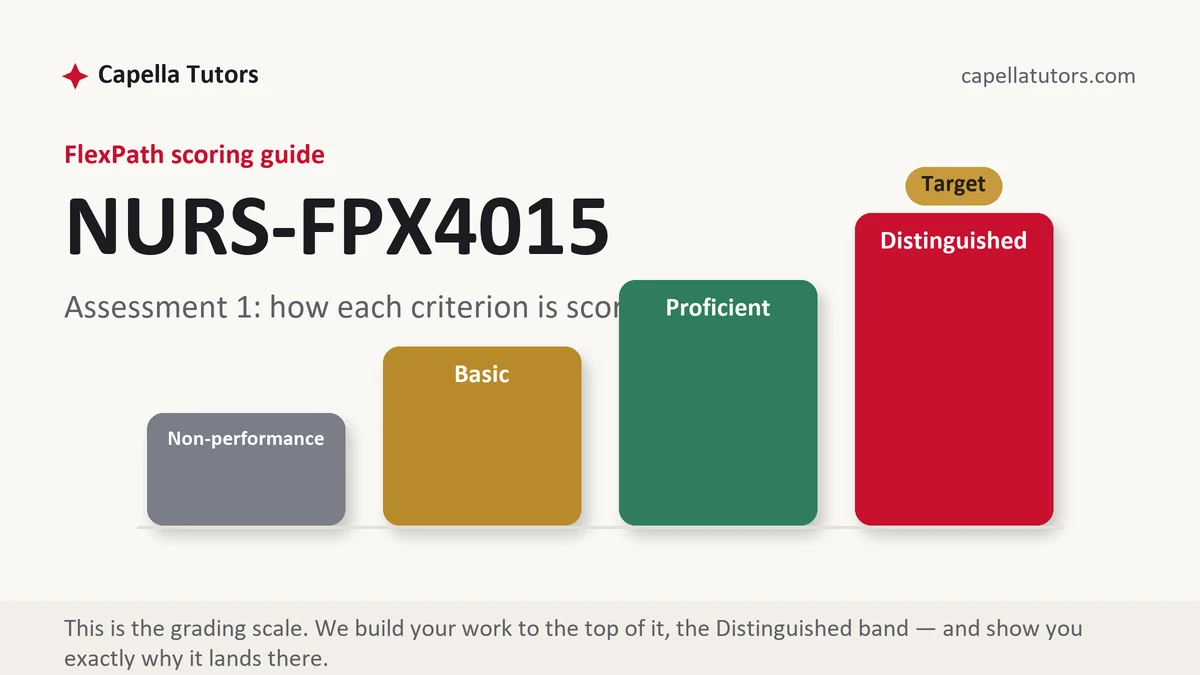
How NURS FPX 4015 Assessment 1 is scored
FlexPath does not use letter grades. Each criterion in the scoring guide lands on one of four levels, and the level descriptions are the real writing brief:
| Level | What it means on the volunteer waiver |
|---|---|
| Distinguished | The waiver is complete and signed by both parties, the volunteer meets the course rules, the chosen patient scenario is identified, and any planning notes show you have thought through privacy, setting and equipment for the recording. |
| Proficient | The waiver is complete and correct, with little evidence of planning for the recorded exam. |
| Basic | A signature, date or required field is missing, or the volunteer does not meet the rules. |
| Non-performance | No waiver was submitted, or the document is not the course waiver. |
Check your scoring guide: some versions grade the waiver as a single requirement, others ask for short planning answers. Either way, a waiver returned for a missing signature delays the head-to-toe assessment that depends on it.
The NURS FPX 4015 Assessment 1 method, step by step
-
Read the head-to-toe instructions first
Before choosing a volunteer, read what the final comprehensive assessment requires: the body systems, the recording, and the SOAP note. You are choosing a partner for that task, so know what you will ask of them.
-
Choose an adult volunteer who fits the rules
A friend or family member, 18 or older, who is comfortable being recorded and examined in a simulated assessment. Never a real patient.
-
Match the volunteer to a course scenario
The volunteer plays one of the patient profiles from the course scenarios. Talk with them about which profile they are comfortable acting, since they will answer health history questions in character.
-
Complete the waiver with your volunteer
Use the waiver attached to your courseroom. Read it with the volunteer, including how the recording will be used for grading, and have both of you sign and date it.
-
Plan the recording
Choose a private, well-lit space, test your camera angle and audio, and list the equipment you will need for the exam. Doing this now saves a re-record later.
-
Submit and keep a copy
Attach the completed waiver, confirm every field is filled, and keep a copy for the final assessment.
A structure that maps to the criteria
This is a form and a plan rather than an essay; the parts below are what the evaluator checks.
| Section | What it must do | Guide |
|---|---|---|
| Course waiver | The current waiver from your courseroom, unedited. | every field |
| Participant details and signatures | Volunteer and student names, signatures and dates. | every field |
| Scenario choice | Which course patient profile the volunteer will portray. | one line, if asked |
| Recording plan | Space, privacy, equipment and timing, where the guide asks for it. | ~100 to 200 words, if asked |
| Submission check | Correct file attached and named as instructed. | before you submit |
Annotated sample excerpt
An original model excerpt from our team, written to show the register that reaches the top of the guide. Learn the moves, then write your own version.
My volunteer is my adult sister, who has agreed to portray one of the course's patient profiles and has read the waiver with me, including how the recording will be used for grading.1 We will record in a closed room at home with natural light from the side, the camera on a tripod at chest height so both of us stay in frame, and a test recording the day before to check the audio.2 I have listed the equipment I need for each body system, and we will rehearse the health history questions once so she can answer in character without reading from notes.3
- 1Confirms the volunteer meets the rules and understands the recording, which is what the waiver exists to protect.
- 2Plans privacy, framing and audio, the practical points that most often force a re-record.
- 3Links the plan to the final exam's requirements, so this assessment does its real job.
The full premium sample for your exact assessment, written fresh to your scoring guide and topic, is free to request. Study it, revise it into your own voice, and submit work you understand.
The five mistakes that cost Distinguished
- Choosing a real patient or a minor. Both are ruled out; use an adult friend or family member.
- An unsigned waiver. The final recorded exam is not graded without it.
- Using a waiver from another source. Use the version attached to your courseroom.
- No scenario conversation. A volunteer who has not chosen a profile cannot answer history questions in character.
- Leaving the recording setup to the last day. Lighting and audio problems are the usual reason for a second recording.
Pre-submission checklist
- Head-to-toe assessment instructions read first
- Adult volunteer who is not a patient
- Course patient scenario chosen with the volunteer
- Waiver complete, signed and dated by both of you
- Recording space and equipment planned
- Copy of the waiver kept for the final assessment
Want the written work in this course covered?
The waiver and the recording are yours to do, but the holistic care paper, the concept map and the teaching presentation are written assessments we support. Send the scoring guides for premium original samples in 24 to 48 hours, revised free.