This manual is for NURS FPX 4015 Assessment 4, start to submission. The Caring for Special Populations Teaching Presentation asks you to teach other nurses about one special population: who they are, the cultural values and beliefs that affect their care, the health disparities and social determinants they face, and the culturally competent strategies and resources that improve outcomes. It is delivered as a presentation, usually slides with speaker notes or a recorded talk; check what your courseroom asks for. The grade turns on specificity about the population and evidence behind every strategy. Below is the method our tutors use, a structure that maps to the criteria, and an annotated sample excerpt. Prefer to hand it off? A premium original sample for this exact assessment comes back in 24 to 48 hours, revised free until it meets the guide. Capella's catalog lists the course as NURS-FPX4015, and some courserooms print NURS4015; both point to this same Assessment 4. In current courserooms this assessment typically appears as "Caring for Special Populations Teaching Presentation".
One honesty note before the manual: Capella revises courses and scoring guides over time, so always write to the exact scoring guide attached to your assessment in the courseroom. The course identity above is verified on capella.edu; the method and structure below are our tutors' approach to it, not Capella's official rubric text.
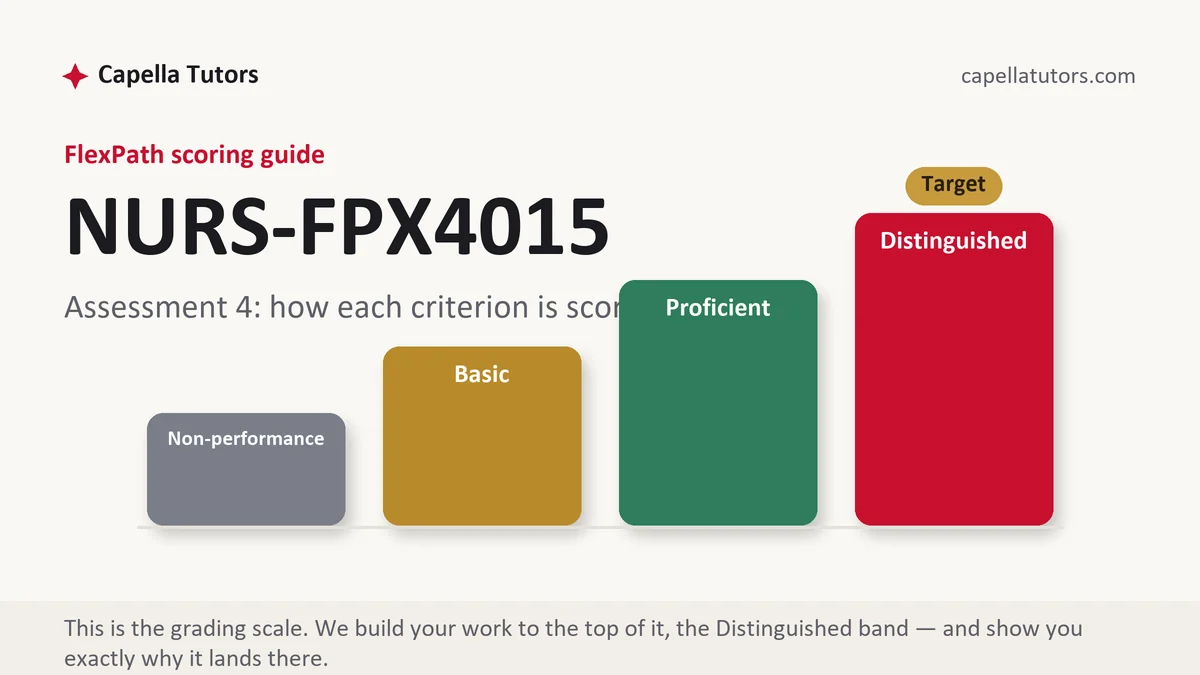
How NURS FPX 4015 Assessment 4 is scored
FlexPath does not use letter grades. Each criterion in the scoring guide lands on one of four levels, and the level descriptions are the real writing brief:
| Level | What it means on a special populations teaching presentation |
|---|---|
| Distinguished | The population is defined with current data, cultural values are described without stereotype, disparities and social determinants are supported by evidence, strategies are specific and evidence-based, resources are real and current, and the notes teach. |
| Proficient | All parts are present and accurate, but strategies and resources stay general. |
| Basic | The presentation describes the population broadly, with little evidence and few concrete nursing actions. |
| Non-performance | A required part, such as disparities, strategies or resources, is missing. |
Choose a population you can describe precisely: people experiencing homelessness, rural older adults, a specific immigrant community, veterans. Broad labels lead to generic slides.
The NURS FPX 4015 Assessment 4 method, step by step
-
Define the population with data
Who is in it, how many, where, and why they count as a special population for nursing care. Use a current national or state source.
-
Describe cultural values and beliefs carefully
Values that affect care decisions, communication or trust, described as tendencies supported by sources, never as rules for every person.
-
Show disparities and social determinants
Two or three measurable gaps in access or outcomes, linked to determinants such as housing, income, language or transportation.
-
Teach culturally competent strategies
Specific nursing actions: interpreter use, trauma-informed communication, flexible scheduling, outreach. Tie each to evidence.
-
List real resources
Named programs, agencies or services nurses can refer to, with what each provides.
-
Write notes that teach
Speaker notes should read like you are teaching a room of nurses, with citations, so the evaluator can score each slide.
A structure that maps to the criteria
Slide counts and timing vary by version; follow your scoring guide. The note lengths below are planning targets our tutors use.
| Section | What the slide and notes must do | Guide |
|---|---|---|
| Title and objectives | The population and what nurses will learn. | 1 to 2 slides |
| The population | Definition, size and why it is a special population. | 1 to 2 slides, ~150 words of notes |
| Cultural values and beliefs | Values that affect care, described without stereotype. | 1 to 2 slides, ~150 words |
| Disparities and social determinants | Measurable gaps and their causes. | 2 slides, ~250 words |
| Culturally competent strategies | Specific nursing actions with evidence. | 2 slides, ~250 words |
| Resources and close | Named services, summary and references slide. | 2 slides, ~150 words |
Annotated sample excerpt
An original model excerpt from our team, written to show the register that reaches the top of the guide. Learn the moves, then write your own version.
For patients experiencing homelessness, the most useful thing a nurse can do at discharge is plan around the patient's real circumstances rather than an address they do not have.1 That means asking where the patient will sleep tonight, whether they can store medication that needs refrigeration, and which clinic or shelter they can reach without transportation, then adjusting the plan to fit.2 Trauma-informed communication supports this, because many people in this population have had negative experiences in health care, and a calm explanation of each step, with choices offered where possible, makes it more likely they return for follow-up.3
- 1Speaks directly to nurses, which is the teaching format the presentation calls for.
- 2Gives concrete actions grounded in the population's circumstances.
- 3Connects a recognized approach to an outcome, which is what the strategy criterion rewards.
The full premium sample for your exact assessment, written fresh to your scoring guide and topic, is free to request. Study it, revise it into your own voice, and submit work you understand.
The five mistakes that cost Distinguished
- A population defined too broadly. "Minorities" or "the elderly" lead to generic content.
- Stereotyping. Describe values as patterns supported by sources, not as traits of every person.
- Strategies without evidence. Each recommended action needs a source.
- Resources that do not exist locally. Name real programs and what they provide.
- Slides with no notes. The notes carry the teaching and the citations.
Pre-submission checklist
- One precisely defined special population
- Current data on size and characteristics
- Cultural values described without stereotype
- Disparities and social determinants supported by evidence
- Specific, evidence-based nursing strategies and real resources
- Speaker notes on every content slide with current APA citations
Want the teaching presentation built for you?
Send the scoring guide and the population you want to teach about. Our team returns a premium original slide deck with full speaker notes in 24 to 48 hours, revised free until it meets the guide.