This manual is for NURS FPX 4015 Assessment 2, start to submission. Enhancing Holistic Nursing Care with the 3Ps asks you to explain holistic nursing care and its benefits for patients and nurses, then show how the three Ps of this course, pathophysiology, pharmacology and physical assessment, each support holistic care and how they work together when you apply them to a clinical situation. The grade turns on integration: three good sections that never meet score lower than a paper that shows one patient's pathophysiology shaping both the assessment and the medication plan. Below is the method our tutors use, a structure that maps to the criteria, and an annotated sample excerpt. Prefer to hand it off? A premium original sample for this exact assessment comes back in 24 to 48 hours, revised free until it meets the guide. Capella's catalog lists the course as NURS-FPX4015, and some courserooms print NURS4015; both point to this same Assessment 2. In current courserooms this assessment typically appears as "Enhancing Holistic Nursing Care with the 3Ps".
One honesty note before the manual: Capella revises courses and scoring guides over time, so always write to the exact scoring guide attached to your assessment in the courseroom. The course identity above is verified on capella.edu; the method and structure below are our tutors' approach to it, not Capella's official rubric text.
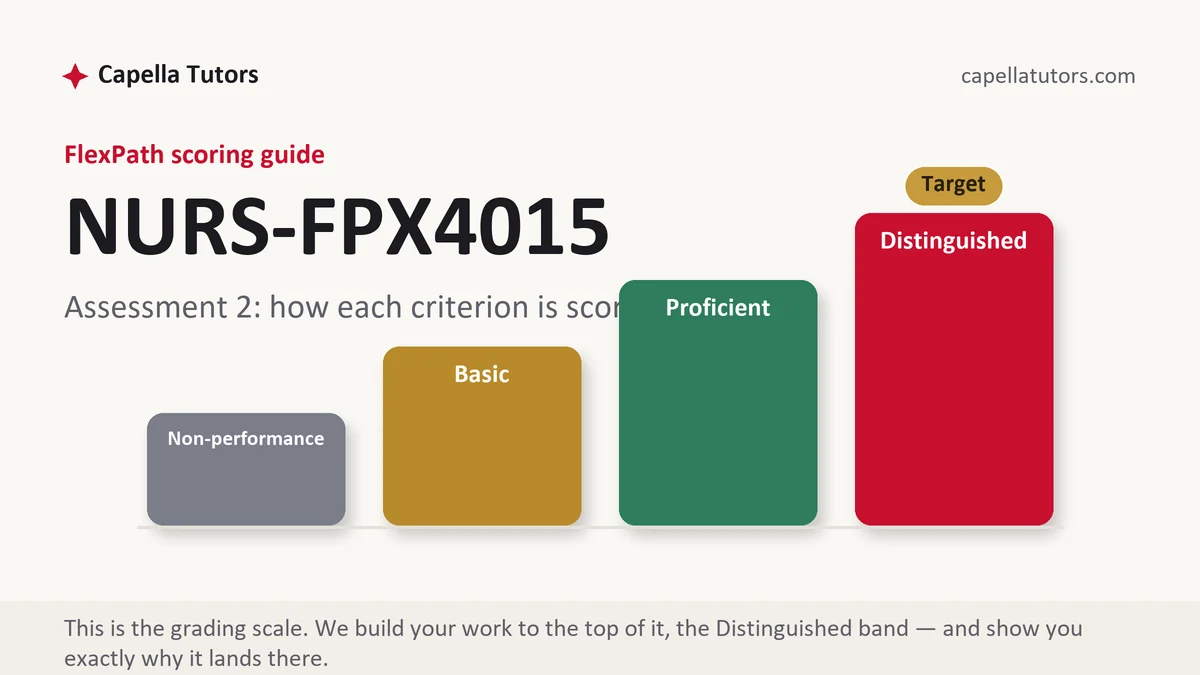
How NURS FPX 4015 Assessment 2 is scored
FlexPath does not use letter grades. Each criterion in the scoring guide lands on one of four levels, and the level descriptions are the real writing brief:
| Level | What it means on a holistic care and 3Ps paper |
|---|---|
| Distinguished | Holistic care is defined from a credible source and its benefits are supported with evidence, each P is explained with a clinical example, and the integration section uses one scenario to show the three working together. |
| Proficient | Each part is accurate and supported, but the integration stays general and the examples change from section to section. |
| Basic | Definitions dominate, the 3Ps are described as textbook topics, and the benefits are asserted. |
| Non-performance | One of the 3Ps or the integration section is missing. |
Use one patient example throughout if you can. A patient with heart failure, for instance, lets you show the mechanism, the physical findings it produces and the medications that answer it, all as one line of reasoning.
The NURS FPX 4015 Assessment 2 method, step by step
-
Define holistic care from a credible source
The American Holistic Nurses Association and current nursing literature describe care of the whole person: physical, emotional, social and spiritual. Use one clear definition and cite it.
-
Show the benefits for patients and nurses
Patients: adherence, satisfaction, outcomes. Nurses: job satisfaction and stronger therapeutic relationships. Support each with a source rather than a general claim.
-
Explain pathophysiology in practice
Show how knowing the disease mechanism helps a nurse anticipate findings and complications, with one concrete example.
-
Explain pharmacology in practice
Show how understanding drug action, side effects and interactions supports safe, individualized care, using the same example where possible.
-
Explain physical assessment in practice
Show how systematic assessment confirms or questions what the mechanism predicts and how it guides the plan.
-
Integrate the three in one scenario
Walk one patient through: the mechanism, the findings you would look for, the medications and what you would monitor, and how the whole-person view changes the plan.
A structure that maps to the criteria
Word counts are planning targets our tutors use for this paper, not Capella rules; follow the length your scoring guide states.
| Section | What it must do | Guide |
|---|---|---|
| Introduction | Holistic care and the 3Ps, and what the paper will show. | ~125 words |
| Holistic care and its benefits | Definition and evidence-based benefits for patients and nurses. | ~250 words |
| Pathophysiology | Role in practice with a clinical example. | ~200 words |
| Pharmacology | Role in practice with a clinical example. | ~200 words |
| Physical assessment | Role in practice with a clinical example. | ~175 words |
| Integration in a clinical scenario | One patient showing the three Ps working together. | ~250 words |
| Conclusion and references | The argument closed, current APA references. | ~100 words |
Annotated sample excerpt
An original model excerpt from our team, written to show the register that reaches the top of the guide. Learn the moves, then write your own version.
A 72-year-old patient with heart failure reports two pillows becoming three and ankles that leave a dent when pressed.1 Pathophysiology explains both findings, because a weakened left ventricle backs fluid into the lungs and venous pressure pushes fluid into the tissues, so the nurse listens for crackles, checks for jugular venous distention and weighs the patient daily rather than waiting for breathlessness at rest.2 The same reasoning shapes the pharmacology: a loop diuretic removes the fluid, which means monitoring potassium and blood pressure, and asking about the patient's worry over nighttime bathroom trips is part of whether the dose is actually taken at home.3
- 1Starts from a patient's own words, which keeps the paragraph clinical and whole-person.
- 2Uses the mechanism to explain the assessment choices, which is the integration the criterion asks for.
- 3Links the medication to monitoring and to a psychosocial concern, closing the holistic loop.
The full premium sample for your exact assessment, written fresh to your scoring guide and topic, is free to request. Study it, revise it into your own voice, and submit work you understand.
The five mistakes that cost Distinguished
- Three separate essays. The integration criterion rewards connection, not coverage.
- Benefits without evidence. Claims about outcomes need a source.
- Textbook definitions of each P. Show the P being used in practice.
- Changing examples every section. One patient carried through makes the integration visible.
- Ignoring the non-physical. Holistic care includes emotional and social needs; show one.
Pre-submission checklist
- Holistic care defined from a credible source
- Benefits for patients and for nurses supported with evidence
- Pathophysiology, pharmacology and physical assessment each shown in practice
- One scenario integrates all three
- At least one psychosocial or cultural need addressed
- Current APA, citations matched both ways
Want the 3Ps paper built around one patient?
Send the scoring guide and the condition you want to use. Our team returns a premium original sample that integrates the three Ps in one scenario in 24 to 48 hours, revised free until it meets the guide.