Nursing Leadership: Focusing on People, Processes, and Organizations runs as NURS FPX 4005 at Capella, 3 pts / 6 qcr, available in both FlexPath and GuidedPath in the RN-to-BSN path. In Capella's catalog the course code is written NURS-FPX4005.
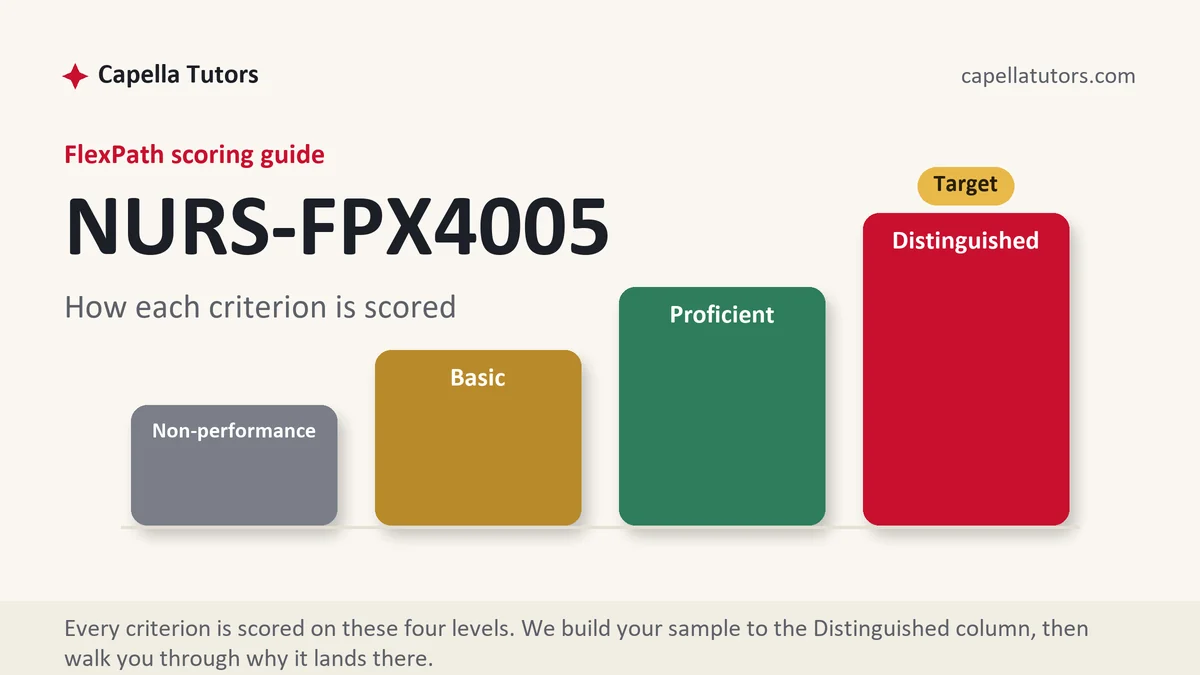
What NURS FPX 4005 actually grades
The leadership course asks bedside nurses to write like charge nurses: conflict analyses, team assessments, and change proposals grounded in an organization you actually know. Its criteria consistently reward specificity about your own unit, real processes, real friction, real stakeholders, over textbook leadership theory recited back. The trap is writing generically about leadership when the Distinguished column wants leadership applied to a named context.
How we help in this course
Send a paragraph about your unit with the order and the draft comes back built around it: your staffing pattern, your handoff process, your committee, threaded through the framework the criterion names. That local grounding is usually the whole distance between Proficient and Distinguished in this course.
The service terms are the same ones the whole site runs on: 24 to 48 hour delivery per deliverable, Distinguished or A targets matched to your format, two independent QA passes before anything reaches you, and free revisions until the target is met.
Assessment manuals for this course
Every assessment in NURS FPX 4005 has its own manual now: the walkthrough, the structure that maps to the criteria, an annotated sample excerpt, and the done-for-you door. Open Assessment 1, Assessment 2, Assessment 3, Assessment 4, or start from the list in the sidebar.
In NURS FPX 4005 right now?
Send the assessment number and the scoring guide from your courseroom. First premium sample free, back in 24 to 48 hours.
What separates Proficient from Distinguished in leadership writing
The 4005 criteria consistently pay for application to a named context: your unit, your staffing pattern, your handoff friction, threaded through the framework each criterion names. Proficient answers the criterion; Distinguished adds the extra the column spells out, usually a limitation, an implication, or analysis grounded in the specific organization. Generic leadership theory, however accurate, reads as Basic because it summarizes rather than applies. That is the whole grading physics of this course, and it is why we ask for a paragraph about your workplace before drafting begins.
Sending this course for a same-day scope
Two attachments and one paragraph do it: the assessment number, the scoring guide out of the courseroom, and a few sentences about your unit. The reply names the criteria that carry the assessment, the Distinguished moves the draft will make, and the delivery slot inside 24 to 48 hours. GuidedPath students should mention which deadline is nearest, Thursday or Sunday night Central, so the plan lands on the right side of it. Scopes stay honest: when an assessment is light, the reply says so.
The cadence this course fits into
On FlexPath, 4005 is a 3-point course that closes the way every FlexPath course closes: submit an assessment, take the evaluation, submit the next. With each deliverable back in 24 to 48 hours written to the Distinguished column, the course keeps pace with the flat-rate billing session instead of quietly spending it, which is the entire economics of the pathway. Momentum, not haste, is the product.
The assessments, one by one
Assessment 1: Collaboration and Leadership Reflection
One interdisciplinary experience, the leadership in it, and your own leadership style. Read the full Assessment 1 manual.
Assessment 2: Interview and Interdisciplinary Issue Identification
Interview a colleague, identify an issue for an interdisciplinary team, apply change theory. Read the full Assessment 2 manual.
Assessment 3: Interdisciplinary Plan Proposal
The plan to address the issue, with objectives, roles, resources and evaluation. Read the full Assessment 3 manual.
Assessment 4: Stakeholder Presentation
The plan presented to decision-makers, with PDSA implementation and resources. Read the full Assessment 4 manual.
How to actually write NURS FPX 4005: where to begin
Open the scoring guide before anything else and copy its criteria into a blank document as headings, Distinguished descriptions underneath. In 4005 those criteria typically ask you to analyze a leadership or collaboration problem, apply a named leadership approach to it, propose an interprofessional strategy, and connect the whole thing to organizational outcomes. That outline is the assessment; the instructions only supply the scenario.
Then gather the raw material the criteria will spend, and gather it from your own unit. In current courserooms the assessments include "Collaboration and Leadership Reflection", "Interview and Interdisciplinary Issue Identification", "Interdisciplinary Plan Proposal" and "Stakeholder Presentation" among others, and your scoring guide decides the exact format of each. Before drafting, write down the specifics you are allowed to use, your staffing pattern, the committee that owns the process, the friction point you have watched recur, with names and identifiers stripped. A paragraph that applies transformational leadership to "a hospital unit" scores Proficient at best; the same paragraph applied to your named context, night-shift med-surg with a three-month vacancy problem, is what the Distinguished column is written to reward.
Pick the framework last, not first. Read the criterion, see what it asks the framework to do, then choose the leadership or change model that actually fits the problem: a stalled change wants Lewin or Kotter, a disengaged team wants transformational leadership, a quality argument wants a collaboration model with evidence behind it. A framework chosen before the problem tends to get recited; a framework chosen for the problem gets applied, and applied is what the guide pays for.
| Section | What goes in it | What Distinguished looks like |
|---|---|---|
| Introduction | The problem, the setting, and what the analysis will argue, in three or four sentences. | A named context and a preview the rest of the paper actually delivers. |
| The problem or conflict | What happened, who was involved by role, what it cost the unit or the patients. | Consequences made concrete: turnover, delays, errors, morale, not "communication issues". |
| Leadership approach applied | The chosen framework, defined once, then worked through the problem step by step. | The framework visibly doing analysis, plus an acknowledged limit of the approach. |
| Interprofessional strategy | Who collaborates, through what structure, and what the evidence says about that structure. | Roles and mechanisms named: huddles, briefings, shared rounds, with cited outcomes. |
| Change and outcomes | How the change gets implemented and how anyone would know it worked. | Outcomes stated as measures with a timeframe, and one anticipated barrier answered. |
| Conclusion and references | The argument closed, current APA, citations matched both ways. | An implication a director could act on next quarter. |
Developing the synthesis
Leadership literature disagrees with itself constantly, and the disagreement is your best material. One study links transformational leadership to lower turnover, another finds the effect washes out once staffing is controlled; a structured-communication trial shows fewer handoff errors, a replication in a different setting shows none. Put those pairs in the same paragraph and adjudicate: which design is stronger, which setting is closer to yours, which finding is newer. Then tie the verdict to the criterion it serves. Reciting what a framework says is Basic, showing where its evidence holds and where it thins is Distinguished. End the analysis by naming what the evidence cannot settle, usually whether the leadership style causes the outcome or travels with better-resourced units, because that admission is the extra the top column keeps asking for.
Citations that survive faculty review
The evidence criterion in 4005 is graded as strictly as the leadership one. Sources come from the Capella library, CINAHL and PubMed first, with the nursing leadership journals well represented there, peer-reviewed and inside roughly five years. Give every source a named job: one establishes the cost of the problem, one carries the framework's evidence base, one supports the collaboration structure you propose. Fold the citation into the working sentence, "Alsadaan et al. (2023) tied leadership style to nurse-reported safety climate" does argumentative work that a trailing parenthetical does not. Textbook definitions of leadership theories are fine for the definition sentence and nothing else; the analysis has to stand on studies. Finish with the two-way check between citations and reference list, in current APA.
The mistakes that land Basic instead of Distinguished
- Theory recital. Defining transformational leadership for half a page is summary; the criterion wanted it applied to your problem.
- The unnamed unit. "A healthcare organization" is a Proficient ceiling; the guide pays for specifics only you could write.
- Story without analysis. A vivid conflict narrative that never reaches roles, systems, or evidence reads as anecdote.
- A framework bolted on. Naming Kotter in the introduction and never using his steps scores as if he were never there.
- Hero leadership. Casting one person as the fix ignores the people-processes-organizations frame the whole course is named for.
NURS FPX 4005 questions students actually ask
Which leadership theory should I choose?
The one the problem needs, chosen after you read the criterion. Stalled or resisted change points to Lewin or Kotter, disengagement and turnover point to transformational leadership, cross-discipline friction points to a collaboration framework. Any of them can score Distinguished; what cannot is a theory picked for familiarity and then left unapplied.
I have never held a leadership title. What do I write about?
The course grades leadership analysis, not leadership rank. Every bedside nurse has watched a handoff fail, a policy rollout stall, or two disciplines talk past each other. Analyze one of those from the floor: what the formal and informal leaders did, what the process allowed, what the organization rewarded. That vantage point is exactly the material the criteria ask for.
How much detail about my workplace is safe to include?
Roles, processes, and patterns, yes; names, facility identifiers, and anything traceable to a specific patient or colleague, no. "A 32-bed med-surg unit with agency coverage on nights" gives the evaluator everything the criterion needs. When in doubt, describe the pattern rather than the incident, and strip dates that could identify an event.