This manual is for NURS FPX 4005 Assessment 1, start to submission. Collaboration and Leadership Reflection asks you to look back at one real interdisciplinary collaboration from your practice, explain what made it work or fail, compare effective and ineffective leadership in it, and connect evidence-based leadership and collaboration strategies to the leader you want to become. Many versions deliver it as a recorded video reflection with a script or notes; check the format your courseroom names. The grade lives in specificity: one experience, honestly examined, with the evidence doing the explaining. Below is the method our tutors use, a structure that maps to the criteria, and an annotated sample excerpt. Prefer to hand it off? A premium original sample for this exact assessment comes back in 24 to 48 hours, revised free until it meets the guide. Capella's catalog lists the course as NURS-FPX4005, and some courserooms print NURS4005; both point to this same Assessment 1. In current courserooms this assessment typically appears as "Collaboration and Leadership Reflection".
One honesty note before the manual: Capella revises courses and scoring guides over time, so always write to the exact scoring guide attached to your assessment in the courseroom. The course identity above is verified on capella.edu; the method and structure below are our tutors' approach to it, not Capella's official rubric text.
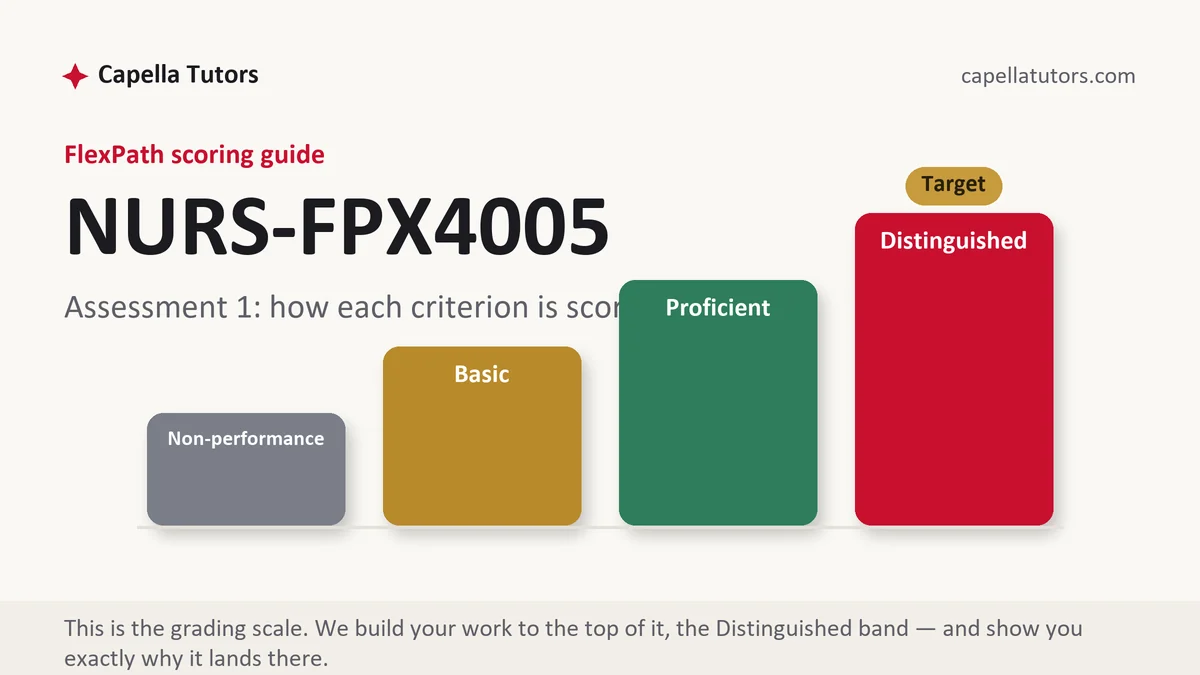
How NURS FPX 4005 Assessment 1 is scored
FlexPath does not use letter grades. Each criterion in the scoring guide lands on one of four levels, and the level descriptions are the real writing brief:
| Level | What it means on a collaboration reflection |
|---|---|
| Distinguished | One specific experience is described with roles and outcome, the leadership in it is analyzed against evidence, best-practice strategies are tied to what would have changed the result, and your own style is named with a plan to develop it. |
| Proficient | The experience and the strategies are covered accurately, but the analysis stays at the level of what happened rather than why. |
| Basic | A general reflection on teamwork with no single experience at its center and little evidence. |
| Non-performance | A required element, such as the comparison of effective and ineffective leadership or your own leadership style, is missing. |
Choose an experience you can describe without naming anyone. A difficult collaboration often makes a stronger reflection than a smooth one, because the leadership lesson is clearer.
The NURS FPX 4005 Assessment 1 method, step by step
-
Pick one interdisciplinary experience
A discharge that needed nursing, pharmacy and case management to agree; a rapid response where roles were unclear. Choose one with an outcome you can state.
-
Describe it in roles, not names
Who was involved by discipline, what each needed, what happened and how it ended. Keep it to a paragraph; the analysis matters more than the story.
-
Contrast effective and ineffective leadership
Identify a leadership behavior that helped or hurt: a charge nurse who clarified roles, a meeting where no one owned the decision. Explain the effect on the team and the patient.
-
Bring in evidence-based strategies
Cite current sources on leadership approaches such as transformational leadership and on collaboration tools such as structured huddles or SBAR. Say how each would have changed your experience.
-
Name your own leadership style
Describe the style you use now and the one you are working toward, with one concrete habit you will practice.
-
Match the format
If your version asks for a video, write a script that hits each criterion in order, rehearse it, and keep to the time the guide sets. If it asks for a paper, use headings that mirror the criteria.
A structure that maps to the criteria
Word counts are planning targets our tutors use for the script or paper, not Capella rules; if your version is a video, follow its time limit.
| Section | What it must do | Guide |
|---|---|---|
| Introduction | Purpose of the reflection and the experience you will examine. | ~100 words |
| The collaboration experience | Setting, disciplines involved, what happened and the outcome. | ~175 words |
| Effective and ineffective leadership | Specific behaviors, their effect on the team and the patient. | ~200 words |
| Best-practice leadership strategies | Evidence-based approaches and how they apply. | ~150 words |
| Best-practice collaboration strategies | Evidence-based tools and how they would change the result. | ~150 words |
| Your leadership style and close | Current style, target style, one habit, then references. | ~125 words |
Annotated sample excerpt
An original model excerpt from our team, written to show the register that reaches the top of the guide. Learn the moves, then write your own version.
The discharge stalled for six hours because pharmacy, case management and nursing each assumed another discipline was confirming the home infusion order.1 What changed the outcome was the charge nurse calling a five-minute huddle at the bedside, naming who would confirm the order, who would call the family and who would sign off, and setting a time to check back.2 Before that huddle, leadership on the unit had been reactive, with each discipline solving its own piece; afterward, a single owner for each task made the plan visible to everyone, which is the shift from parallel work to collaboration the literature on team-based care describes.3
- 1States the failure and its cost in one sentence, so the reflection starts from a concrete problem.
- 2Shows an effective leadership behavior in action rather than labeling it.
- 3Contrasts the before and after and ties it to evidence, which is the analysis the top column rewards.
The full premium sample for your exact assessment, written fresh to your scoring guide and topic, is free to request. Study it, revise it into your own voice, and submit work you understand.
The five mistakes that cost Distinguished
- No single experience. A reflection about teamwork in general cannot be analyzed against the criteria.
- Names or identifiers. Refer to roles and disciplines, never people or patients.
- Strategies without sources. Best-practice criteria need current evidence, not opinion.
- Overrunning the video time. If the format is a recording, the time limit is part of the brief.
- Skipping your own style. The last criterion asks about you as a leader; answer it directly.
Pre-submission checklist
- One real interdisciplinary experience, de-identified
- Effective and ineffective leadership compared
- Leadership and collaboration strategies supported by current sources
- Your own leadership style named with a development habit
- Format matches the courseroom: video, script or paper
- Current APA references
Want the reflection scripted to the guide?
Send the scoring guide and a short note on the experience you want to use. Our team returns a premium original script or paper that hits every criterion in order in 24 to 48 hours, revised free until it meets the guide.