This manual is for NURS FPX 4005 Assessment 4, start to submission. The Stakeholder Presentation takes the interdisciplinary plan from Assessment 3 and presents it to the leaders who would approve it: the organizational issue and why it matters, why an interdisciplinary team is needed and what each role does, the plan and how it would be implemented and evaluated, the resources it requires, and what happens if the organization does nothing. It is delivered as slides with detailed speaker notes, and in most versions the notes carry the evidence the evaluator scores. Below is the method our tutors use, a slide structure that maps to the criteria, and an annotated sample of speaker notes. Prefer to hand it off? A premium original sample for this exact assessment comes back in 24 to 48 hours, revised free until it meets the guide. Capella's catalog lists the course as NURS-FPX4005, and some courserooms print NURS4005; both point to this same Assessment 4. In current courserooms this assessment typically appears as "Stakeholder Presentation".
One honesty note before the manual: Capella revises courses and scoring guides over time, so always write to the exact scoring guide attached to your assessment in the courseroom. The course identity above is verified on capella.edu; the method and structure below are our tutors' approach to it, not Capella's official rubric text.
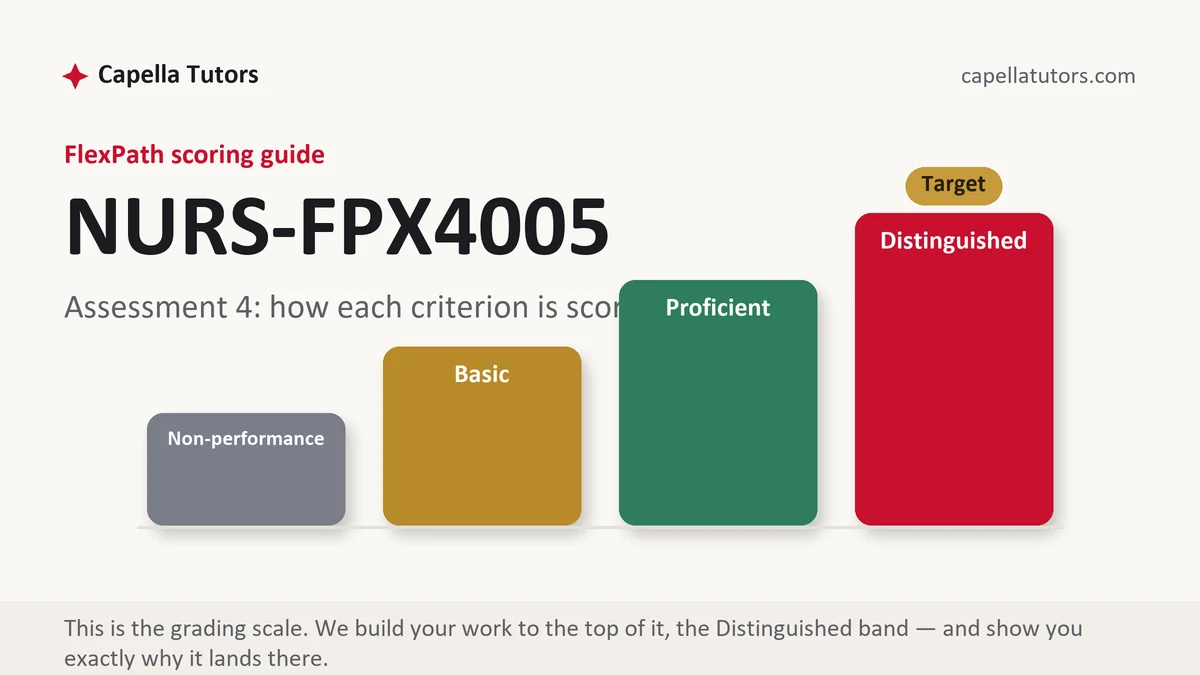
How NURS FPX 4005 Assessment 4 is scored
FlexPath does not use letter grades. Each criterion in the scoring guide lands on one of four levels, and the level descriptions are the real writing brief:
| Level | What it means on a stakeholder presentation |
|---|---|
| Distinguished | The issue is framed in the organization's own terms, roles are specific, the implementation follows a named model such as PDSA with timelines, resources are costed, evaluation is measurable, and the notes cite evidence for each claim. |
| Proficient | All parts are present and the plan is clear, but resources and evaluation stay general and some slides lack evidence in the notes. |
| Basic | Slides restate the earlier paper with little adaptation for decision-makers, and the notes are thin. |
| Non-performance | A required element, such as resource management, team roles or the consequences of inaction, is missing. |
Write for an audience with authority over budgets and staffing. They want the problem in a sentence, the ask in a sentence, and the evidence that the plan will work.
The NURS FPX 4005 Assessment 4 method, step by step
-
Open with the issue and the ask
The first content slide states the organizational issue with one figure and the decision you want from the stakeholders. Everything after it supports that ask.
-
Show why a team is needed
Explain why the issue crosses disciplines, then give each role a specific responsibility in the plan: nursing, pharmacy, case management, IT or whoever the issue requires.
-
Summarize the plan
Carry forward the objectives and interventions from Assessment 3 in plain terms, with the evidence behind each one cited in the notes.
-
Lay out implementation with a model
Plan, Do, Study, Act works well: what happens in each phase, who leads it and when. A short timeline slide helps decision-makers see the commitment.
-
Cost the resources and state the measures
Staff time, training, technology and any budget item, then the measures that will show success and when they will be read.
-
End with consequences of inaction
What continues to cost the organization in safety, money or reputation if nothing changes, supported by evidence. Close with the ask restated.
A structure that maps to the criteria
Slide counts and timings vary by version; follow your scoring guide. The note lengths below are planning targets our tutors use so each criterion has enough evidence behind it.
| Section | What the slide and notes must do | Guide |
|---|---|---|
| Title and purpose | Who is presenting, to whom, and the decision requested. | 1 slide, short notes |
| The organizational issue | The problem with a figure and why it matters now. | 1 to 2 slides, ~150 words of notes |
| Interdisciplinary team and roles | Why a team is needed and what each role does. | 1 to 2 slides, ~150 words |
| The plan | Objectives and interventions with evidence. | 1 to 2 slides, ~200 words |
| Implementation (PDSA) and timeline | Phases, leads and dates. | 2 to 4 slides, ~250 words |
| Resources and evaluation | Costs, staffing, measures and review points. | 1 to 2 slides, ~200 words |
| Consequences of inaction and close | The cost of doing nothing, the ask restated, references slide. | 2 slides, ~150 words |
Annotated sample excerpt
An original model excerpt from our team, written to show the register that reaches the top of the guide. Learn the moves, then write your own version.
If we leave discharge medication reconciliation as it is, we should expect the pattern we saw last quarter to continue: patients returning within thirty days with medication errors that a pharmacist review would have caught.1 Each of those readmissions is a cost we absorb under readmission penalties, and each is a patient who leaves less confident in our care.2 The plan asks for one pharmacist hour per weekday and a revised discharge checklist; against the cost of even a few avoidable readmissions, that is a modest commitment, and the PDSA cycle lets us stop if the first month's data does not show improvement.3
- 1Speaks to decision-makers in the organization's own terms, with a concrete consequence.
- 2Connects inaction to cost and patient trust, which is the case stakeholders weigh.
- 3Restates the ask with its size and a built-in review point, which lowers the risk of saying yes.
The full premium sample for your exact assessment, written fresh to your scoring guide and topic, is free to request. Study it, revise it into your own voice, and submit work you understand.
The five mistakes that cost Distinguished
- Slides that copy the paper. Decision-makers need the argument condensed, not pasted.
- Thin speaker notes. The notes carry the evidence the evaluator scores.
- Roles left vague. "The team will collaborate" does not answer the roles criterion.
- No resource figures. Stakeholders approve budgets; give them something to approve.
- Skipping inaction. The consequences of doing nothing is its own criterion.
Pre-submission checklist
- Issue and ask stated on the first content slides
- Each team role given a specific responsibility
- Implementation follows a named model with a timeline
- Resources and evaluation measures stated
- Consequences of inaction supported by evidence
- Speaker notes on every content slide with current APA citations
Want the deck and notes built for you?
Send the scoring guide and your Assessment 3 plan. Our team returns a premium original slide deck with full speaker notes mapped to every criterion in 24 to 48 hours, revised free until it meets the guide.