This manual is for NURS FPX 4005 Assessment 3, start to submission. Assessment 3 of NURS FPX 4005, Nursing Leadership: Focusing on People, Processes, and Organizations, turns the analysis into an ask: a change or improvement proposal argued to the stakeholders who would have to approve it and live with it. The criteria typically want a defined change, a case built on evidence and on your organization's own numbers, an implementation plan carried by a named change model, and an evaluation plan that says how anyone would know it worked. Scoring runs criterion by criterion across the four FlexPath levels. Below is the method our tutors use for proposals, a structure that follows the criteria, and an annotated excerpt. Want it drafted first? A premium original sample arrives in 24 to 48 hours, revised free until the guide is met. Capella's catalog lists the course as NURS-FPX4005, and some courserooms print NURS4005; both point to this same Assessment 3. In current courserooms this assessment typically appears as "Interdisciplinary Plan Proposal".
One honesty note before the manual: Capella revises courses and scoring guides over time, so always write to the exact scoring guide attached to your assessment in the courseroom. The course identity above is verified on capella.edu; the method and structure below are our tutors' approach to it, not Capella's official rubric text.
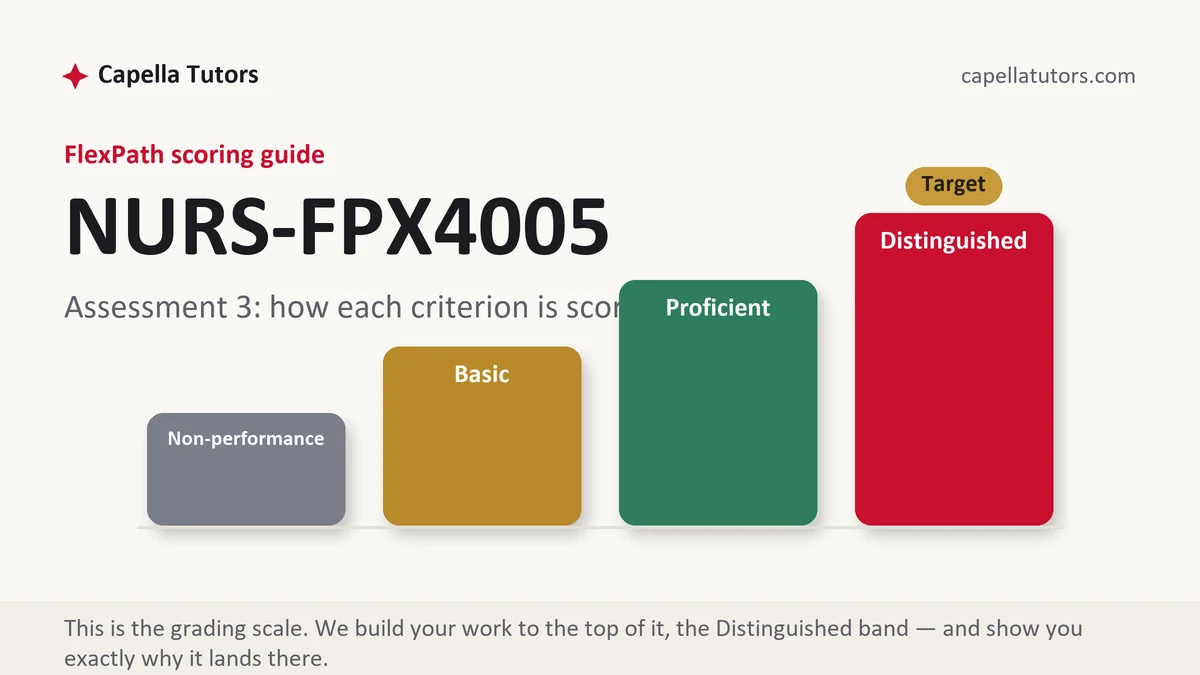
How NURS FPX 4005 Assessment 3 is scored
Each criterion is placed on one of four levels by an evaluator holding the guide, and the level wording tells you precisely what to write:
| Level | What it means on a change proposal |
|---|---|
| Distinguished | It reads like something a director could actually approve: the problem priced in the organization's own numbers, one change scoped to a real unit, a change model doing implementation work instead of decorating the introduction, measures with dates on them, and the strongest objection answered inside your own text. |
| Proficient | A sound recommendation with evidence behind it and a plan attached. What is usually missing is the decision: the reader finishes without knowing what they are being asked to approve, or when. |
| Basic | A literature review with a suggestion stapled to the end. Everything true, nothing operational, and no stakeholder in sight. |
| Non-performance | A required element absent, most often the evaluation plan or the stakeholder analysis, both of which look optional and are not. |
The audience shift is the part students underestimate. The first two assessments were written for an evaluator; this one is written for a nurse manager, a director, or a committee, with an evaluator reading over their shoulder. Persuasion is being graded here alongside evidence, and the two have different habits.
The NURS FPX 4005 Assessment 3 method, step by step
-
Write to the person who can say yes
Name your primary stakeholder before you draft a sentence, and know what that role is measured on: throughput, retention, regulatory readiness, budget. A proposal aimed at "the organization" persuades nobody, and the criteria that grade audience awareness can tell the difference immediately.
-
Price the problem before you propose anything
Open with what the current state costs, using numbers you can defend from your own unit or from published rates for a comparable setting. Decision makers approve solutions to quantified problems and defer everything else, so the cost paragraph is doing the real persuasive work in the whole document.
-
Propose one change, scoped small enough to be real
One intervention, one unit, one shift to start. A proposal that redesigns everything invites a no, while a pilot on nights on one wing invites a yes with conditions. Scope is not modesty here, it is the strategy that gets change approved.
-
Pick the change model the resistance calls for
Read what kind of pushback you are actually facing, then choose accordingly: entrenched routine and comfortable habit point toward Lewin's unfreezing work, a change that will need political cover and visible wins points toward Kotter's sequence. Then run your plan through the model's stages by name. A model mentioned once is a model that scored nothing.
-
Attach measures, a timeline, and an honest ask
Say what will be measured, by whom, at what interval, and what number would count as success. Then state what you need in resources: time, coverage, a champion, a slot on an agenda. Proposals that pretend to be free read as naive, and the implementation criterion is watching for the request.
-
Answer the objection out loud, then self-score
Write the sentence your busiest colleague will say at 0700 and answer it in the document, with evidence where you have it and with a concession where you do not. Then score every criterion D, P, B, or N against the guide, and submit early in the week so an evaluation cycle does not eat your pacing.
A structure that maps to the criteria
The targets below are our tutors' planning proportions for a typical 4005 proposal; they are not Capella rules, and your scoring guide decides which sections carry the weight.
| Section | What it must do | Guide |
|---|---|---|
| Introduction and the ask | State the change, the unit, the start date, and who is being asked to approve it, inside the first paragraph. | ~150 words |
| The problem, priced | Current state in the organization's own numbers, with the consequence a stakeholder already cares about named. | ~250 words |
| The proposed change | What will be different in practical terms: who does what, when, and how it fits the existing workflow. | ~250 words |
| The evidence behind it | Current peer-reviewed support for this intervention in a comparable setting, with the weaker findings acknowledged. | ~300 words |
| Implementation and stakeholders | The change model applied stage by stage, roles assigned, resources requested, and the main objection answered. | ~300 words |
| Evaluation, conclusion, references | Measures, intervals, and a decision point, then the close and current APA matched both ways. | ~200 words |
Annotated sample excerpt
An original model opening from our team, written the way a proposal that gets approved actually sounds. Take the moves, not the words.
The unit practice council is asking the director to move change-of-shift report from the station to the bedside on all four wings, beginning with nights on wing C in October.1 The case is not that bedside report is a recommended practice; it is that our own handoff is where information stops moving: last quarter, sixteen of the thirty-one care delays our unit reported traced to something the outgoing nurse knew and the incoming nurse did not, with the patient in the room the entire time.2 We are asking for four things, and none of them is money: fifteen minutes of protected overlap, a one-page script, two council members released for the first two weeks of coaching, and a decision item on the November staff meeting agenda on whether it continues.3
- 1Leads with the ask, the scope, and the start date. Stakeholders read proposals to find the request, and burying it costs the audience criterion outright.
- 2Prices the problem in the unit's own reported numbers rather than in the literature's. Local data is what makes a proposal feel survivable to the person signing it.
- 3Names the resources concretely and sets the point at which the change gets judged. A proposal with no decision date is a wish, and the evaluation criterion reads it that way.
The full premium sample for your exact assessment, written fresh to your scoring guide and issue, is free to request. Study it, revise it into your own voice, and submit work you understand.
The five mistakes that cost Distinguished
- The review with a suggestion attached. Nine paragraphs of literature and one of recommendation inverts the deliverable and starves every implementation criterion.
- The house-sized pilot. Proposing a system-wide rollout in a course assessment reads as untested; one unit, one shift, one quarter reads as a leader who has done this before.
- The free lunch. A plan that requires nobody's time and nobody's coverage is not a plan, and every manager reading it knows within one sentence.
- Feelings as measures. An evaluation plan built only on how staff feel about the change misses the outcome criterion; pair perception with something countable.
- The unanswered objection. The person who has to do this at 0700 has a reason not to. Say it in your own document, then answer it, or the evaluator will note that you did not.
Pre-submission checklist
- The ask, the unit, and the start date all appear in the first paragraph
- The problem is priced with numbers from your own setting where possible
- One intervention, scoped to a pilot with a defined end point
- A named change model applied stage by stage, not cited once and dropped
- Measures, intervals, and a decision date, with at least one countable outcome
- The strongest objection answered in the text, current APA both ways, every criterion self-scored at D
Want the proposal built to be approved?
Send the scoring guide, the change you have in mind, and whatever numbers your unit already reports. A team of eight, including a research analyst on the evidence base and two QA reviewers on the implementation logic, returns a premium original sample in 24 to 48 hours, revised free until every criterion reads Distinguished. Proposals are the one thing in this course that people actually take to work with them.