This manual is for NURS FPX 4005 Assessment 2, start to submission. Interview and Interdisciplinary Issue Identification asks you to interview a health care professional about their organization, identify one issue the interview reveals that an interdisciplinary team could address, and explain how a change theory, a leadership strategy and a collaboration approach would support a solution. The interview is the evidence base for the rest of the course, because the issue you identify here becomes the interdisciplinary plan in Assessment 3 and the stakeholder presentation in Assessment 4. Below is the method our tutors use, a structure that maps to the criteria, and an annotated sample excerpt. Prefer to hand it off? A premium original sample for this exact assessment comes back in 24 to 48 hours, revised free until it meets the guide. Capella's catalog lists the course as NURS-FPX4005, and some courserooms print NURS4005; both point to this same Assessment 2. In current courserooms this assessment typically appears as "Interview and Interdisciplinary Issue Identification".
One honesty note before the manual: Capella revises courses and scoring guides over time, so always write to the exact scoring guide attached to your assessment in the courseroom. The course identity above is verified on capella.edu; the method and structure below are our tutors' approach to it, not Capella's official rubric text.
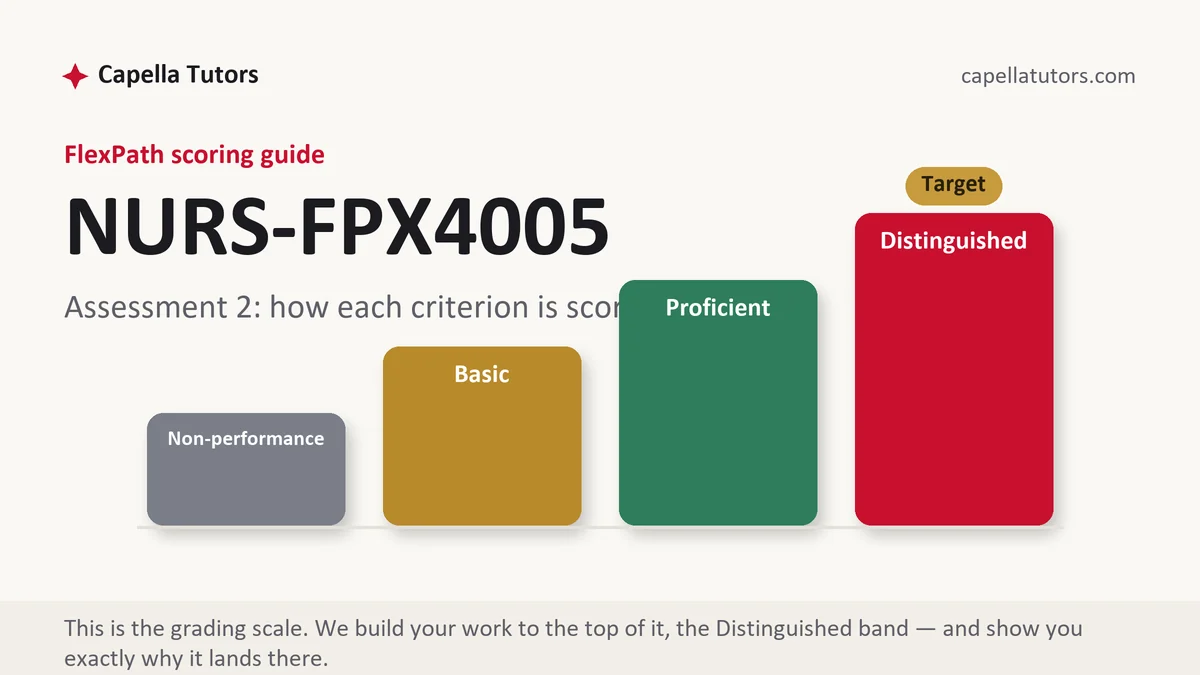
How NURS FPX 4005 Assessment 2 is scored
FlexPath does not use letter grades. Each criterion in the scoring guide lands on one of four levels, and the level descriptions are the real writing brief:
| Level | What it means on an interview and issue paper |
|---|---|
| Distinguished | The interview is summarized with the questions that mattered and the answers that revealed the issue, the issue is supported by evidence beyond the interview, and change theory, leadership strategy and collaboration approach are each applied to this issue. |
| Proficient | The interview and issue are clear and the theories are named correctly, but they are described rather than applied. |
| Basic | The interview summary reads as a transcript and the issue is stated without evidence of why it matters. |
| Non-performance | The interview, the issue or one of the three solution elements is missing. |
Interview someone in a role that sees the issue from a different angle than yours, a pharmacist, a case manager, a unit manager. Keep the organization and the interviewee anonymous in the paper.
The NURS FPX 4005 Assessment 2 method, step by step
-
Plan the interview around problems
Ask what slows care down, where handoffs fail, what the organization measures and misses. Six to eight open questions are enough, and one of them should ask what has already been tried.
-
Summarize, do not transcribe
Report the role of the person interviewed, the setting in general terms and the three or four answers that matter. A summary of themes reads better than a question-by-question record.
-
Identify one issue an interdisciplinary team could own
Choose an issue that needs more than one discipline to fix, such as medication reconciliation at discharge or delayed consults. Support it with at least one source showing the problem exists beyond this organization.
-
Apply a change theory
Lewin's unfreeze, change and refreeze, or Kotter's steps, applied to this issue: what would need to unfreeze, who would drive the change, how it would be sustained.
-
Apply a leadership strategy
Name a strategy such as transformational or servant leadership and show how it would help the team adopt the change, with a source.
-
Describe the collaboration approach
How the team would work together: shared goals, structured communication, defined roles. Close by stating why an interdisciplinary approach is needed for this issue.
A structure that maps to the criteria
Word counts are planning targets our tutors use for this paper, not Capella rules; follow the length your scoring guide states.
| Section | What it must do | Guide |
|---|---|---|
| Introduction | Purpose of the interview and the issue it surfaced. | ~100 words |
| Interview summary | Role of the interviewee, setting in general terms, key answers as themes. | ~250 words |
| Issue identification | The issue, why it needs an interdisciplinary team, evidence it matters. | ~250 words |
| Change theory | A named theory applied stage by stage to this issue. | ~175 words |
| Leadership strategy | A named strategy and how it supports adoption. | ~150 words |
| Collaboration approach and conclusion | How the team works together, then the close and references. | ~175 words |
Annotated sample excerpt
An original model excerpt from our team, written to show the register that reaches the top of the guide. Learn the moves, then write your own version.
The nurse manager described discharge medication lists that arrive at the community pharmacy with changes the inpatient team made but never explained, and patients who return within a week confused about which pills to stop.1 That pattern is not unique to this hospital: medication discrepancies at discharge are common in the literature and are linked to preventable readmissions, which makes the issue measurable as well as familiar.2 It is also an interdisciplinary problem by design, because the prescriber decides the change, the nurse teaches it, the pharmacist reconciles it and case management arranges follow-up, and no one discipline can close the gap alone.3
- 1Grounds the issue in what the interview revealed, in concrete terms.
- 2Shows the issue exists beyond one organization with evidence, which lifts it from anecdote.
- 3Argues why the solution must be interdisciplinary, which sets up the rest of the course.
The full premium sample for your exact assessment, written fresh to your scoring guide and topic, is free to request. Study it, revise it into your own voice, and submit work you understand.
The five mistakes that cost Distinguished
- A transcript instead of a summary. Evaluators want the themes that matter, not every question.
- An issue one discipline could fix. The course is about interdisciplinary solutions; choose accordingly.
- Theories named, not applied. Lewin or Kotter described in general earns Basic on an application criterion.
- Identifying the interviewee. Use role and setting only.
- No outside evidence. One interview is not proof the issue matters; cite a source.
Pre-submission checklist
- Interview completed with a professional from a different discipline or level
- Summary organized by themes, interviewee and organization anonymous
- One interdisciplinary issue supported by outside evidence
- Change theory applied to the issue
- Leadership strategy and collaboration approach applied
- Current APA references
Interview done and need the paper?
Send the scoring guide and your interview notes. Our team returns a premium original sample that turns your notes into the summary, the issue and the theory application in 24 to 48 hours, revised free until it meets the guide.