Help for every NURS FPX 4000 deliverable lives on this page — a premium original sample with a walkthrough, back in 24 to 48 hours. The course itself: Developing a Nursing Perspective, listed at 3 pts / 6 quarter credits in Capella’s RN-to-BSN catalog, offered in both FlexPath and GuidedPath. In Capella's catalog the course code is written NURS-FPX4000.
What NURS FPX 4000 actually grades
This is the program's front door, and its real job is teaching you to write the Capella way: position papers and perspective pieces that force you to argue as a professional rather than report as a student. The scoring guides here reward a clear stance on nursing practice questions, supported with credible sources, long before the clinical content gets heavy. Students who crack the scoring-guide method in 4000 coast through the next eight courses; students who muscle through on instinct meet the same wall again in every one.
How we help in this course
We treat 4000 orders as method-setting: the sample arrives with the walkthrough written like a private lesson in scoring-guide anatomy, criterion by criterion, so the course does what it was designed to do, just faster. Most 4000 clients need visibly less help by 4025, which is the outcome both of us want.
Every deliverable in the course follows our standard promise: a premium original draft in 24 to 48 hours, written to the Distinguished column on FlexPath or the A rubric row on GuidedPath, through the eight-person pipeline with both QA passes, revised free until it meets target.
Assessment manuals for this course
Every assessment in NURS FPX 4000 has its own manual now: the walkthrough, the structure that maps to the criteria, an annotated sample excerpt, and the done-for-you door. Open Assessment 1, Assessment 2, Assessment 3, Assessment 4, or start from the list in the sidebar.
In NURS FPX 4000 right now?
Send the assessment number and the scoring guide from your courseroom. First premium sample free, back in 24 to 48 hours.
Reading your first scoring guide like a contract
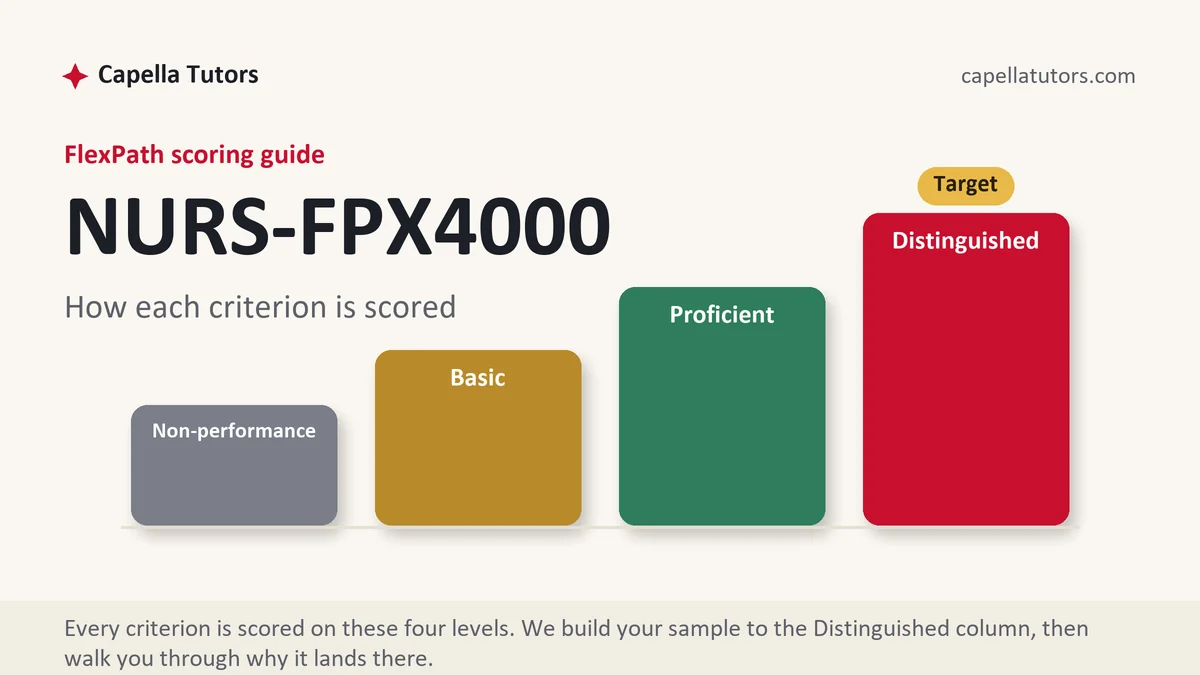
Because NURS FPX 4000 is the program's front door, it is also most students' first meeting with a Capella scoring guide, and the meeting sets the tone for eight more courses. The table is the assignment: each criterion carries four columns, Non-performance, Basic, Proficient, Distinguished, and the evaluator reads your submission against those descriptions and nothing else. A position paper that argues beautifully but skips a criterion earns Non-performance on it, while one that answers every criterion and adds each column's named extra collects Distinguished across the board. Learning to outline from the criteria here is the cheapest lesson the program sells.
How the free sample doubles as the method lesson
For this course the free first draft is deliberately pedagogical: it arrives with a walkthrough that dissects the scoring guide criterion by criterion, showing where the draft placed each Distinguished move and why. Students who study that walkthrough tend to need visibly less help by the middle of the program, which is an outcome we are happy to be graded on.
Does the pathway change how 4000 is supported?
Only the clock. FlexPath has no fixed deadlines, so drafts pace your submissions; GuidedPath work is planned around the Thursday and Sunday night Central cutoffs. Either way each deliverable returns in 24 to 48 hours.
What belongs in the opening message?
The assessment number and the scoring guide from your courseroom, plus a sentence on your nursing background so the writing sounds like you from the first page.
The assessments, one by one
Assessment 1: Pledge of Academic Honesty
Read, sign and submit the pledge with the BSN practicum acknowledgment. Read the full Assessment 1 manual.
Assessment 2: Applying Research Skills
Choose a health care problem, find and judge credible sources, and annotate them. Read the full Assessment 2 manual.
Assessment 3: Applying Ethical Principles
Autonomy, beneficence, nonmaleficence and justice applied to the same problem, with bias and the spheres of care. Read the full Assessment 3 manual.
Assessment 4: DEI and Ethics in Health Care
How DEI practice has changed care, bias and microaggressions, strategies and outcomes. Read the full Assessment 4 manual.
Assessment 5: Analyzing a Current Health Care Problem or Issue
The full analysis of the problem: description, causes, solutions, ethics and the sphere of care. No manual page for this one yet; ask in chat.
How to actually write NURS FPX 4000: where to begin
Start with the scoring guide, not the instructions. Open the assessment in your courseroom, click through to the scoring guide, and let the criteria write your outline, each one a section heading with its Distinguished description sitting underneath. In 4000 the criteria typically ask you to describe a professional issue in nursing, take a defensible position on it, support the position with credible current sources, and communicate in scholarly APA prose. That list is the paper. The instructions only supply the scenario and the deliverable format.
Choose the issue while the outline is still empty, because the choice decides how hard the paper is to write. In current courserooms the assessments include "Pledge of Academic Honesty", "Applying Research Skills", "Applying Ethical Principles", "DEI and Ethics in Health Care" and "Analyzing a Current Health Care Problem or Issue" among others, and your scoring guide decides the exact format of each. Pick one you have watched happen on a shift. A position grounded in something you have seen argues itself from the first paragraph; a position on an abstraction you searched for reads as a book report, and book reports score Basic.
Then turn the issue into one answerable question before drafting: which population, what practice or policy, what outcome. The full PICOT apparatus arrives later in the program, but the habit starts here, and the 4000 criteria quietly reward it. "Should nurses be required to report impaired colleagues" can be answered with evidence. "Nursing ethics" cannot, and a question that cannot be answered produces a paper that cannot be graded above Basic.
| Section | What goes in it | What Distinguished looks like |
|---|---|---|
| Introduction | The issue, why it matters to nursing now, your position stated plainly in the last sentence. | A specific, arguable position, not a summary of the topic. |
| The issue in context | What the problem is, who it affects, and the data or policy background that makes it current. | Scope drawn with numbers or named policy, not adjectives. |
| Evidence for your position | Three to five current peer-reviewed sources, each doing named work for the argument. | Sources weighed against each other for strength and fit, not listed in a row. |
| The counterargument | The strongest opposing view, stated fairly, then answered with evidence. | A real objection taken seriously, plus what the evidence still cannot settle. |
| Conclusion | The position restated as answered, one implication for practice. | An implication specific enough that a nurse manager could act on it. |
| References | Current APA, every citation matched both ways. | Nothing older than five years without a stated reason. |
Developing the synthesis
Synthesis is the criterion most 4000 papers miss, and it has a mechanical fix: never let two sources sit in adjacent sentences without a stated relationship. If one study finds mandatory ratios reduced adverse events and another finds no effect, that disagreement is the most valuable material in the paper. Compare their settings, their samples, their years, then say which you weight more and why. Listing what five studies said is Basic; weighing them against each other is Distinguished. Tie each judgment back to the criterion it serves, and close the evidence section by naming what the research cannot yet settle, because acknowledging the limit of the evidence is usually the exact extra the Distinguished column asks of a perspective paper.
Citations that survive faculty review
4000 is where Capella faculty start enforcing the habits, so build them correctly the first time. Sources come from the Capella library databases, CINAHL and PubMed for nursing questions, filtered to peer-reviewed and roughly the last five years. Every source earns its place by doing named work for a criterion: one establishes the scope of the problem, two or more support the position, one carries the counterargument. Write the citation into the argument rather than after it. "Smith and Chen (2024) found a 12 percent reduction" argues; a claim with the citation stapled to the end of the sentence only gestures. Before submitting, check the two-way match, every in-text citation in the reference list and every reference cited in the text, because mismatches are the most common revision trigger in this course.
The mistakes that land Basic instead of Distinguished
- Reporting instead of arguing. A survey of what the literature says, with no position, misses the central criterion of a perspective course.
- A topic instead of a question. "Nurse burnout" produces summary; "should this hospital cap consecutive shifts" produces argument.
- Skipping the opposing view. The Distinguished column in position writing usually pays for a counterargument handled fairly.
- Website sources. Blogs and consumer health pages read as Basic evidence; the library databases take the same ten minutes.
- First-draft APA. The communication criterion is scored as strictly as the content ones, and it is the easiest one to lose.
NURS FPX 4000 questions students actually ask
Can I write in first person?
Sparingly, and only where the assessment asks for your perspective or your practice experience. State the position and the experience in first person if the instructions invite it, then argue everything with third-person evidence. What reads as Basic is not the word "I", it is opinion doing work that citations should be doing.
How many sources does a 4000 paper actually need?
The scoring guide rarely fixes a number, so use the working floor: three to five current peer-reviewed sources, each with a job. One for the scope of the problem, at least two for your position, one for the counterargument. More sources without more jobs is padding, and evaluators recognize padding.
What if my position disagrees with the course readings?
Position papers are graded on support, not conclusion. The evaluator scores whether the criteria are met: a clear stance, credible evidence, a fair counterargument, scholarly delivery. A well-defended minority position outscores a limp consensus one, provided the evidence you cite actually says what you claim it says.