This manual is for NURS FPX 4000 Assessment 4, start to submission. In the current courseroom, Assessment 4 of Developing a Nursing Perspective asks you to examine diversity, equity and inclusion in health care: how DEI practice has changed care over time, how unconscious bias and microaggressions affect patients and staff, which strategies reduce them, and what the evidence says about outcomes and patient satisfaction. Some earlier versions of the course ended at Assessment 4 with the analysis of a current health care problem, which now sits in Assessment 5; check which one your courseroom shows. Below is the method our tutors use, a structure that maps to the criteria, and an annotated sample excerpt. Prefer to hand it off? A premium original sample for this exact assessment comes back in 24 to 48 hours, revised free until it meets the guide. Capella's catalog lists the course as NURS-FPX4000, and some courserooms print NURS4000; both point to this same Assessment 4. In current courserooms this assessment typically appears as "DEI and Ethics in Health Care".
One honesty note before the manual: Capella revises courses and scoring guides over time, so always write to the exact scoring guide attached to your assessment in the courseroom. The course identity above is verified on capella.edu; the method and structure below are our tutors' approach to it, not Capella's official rubric text.
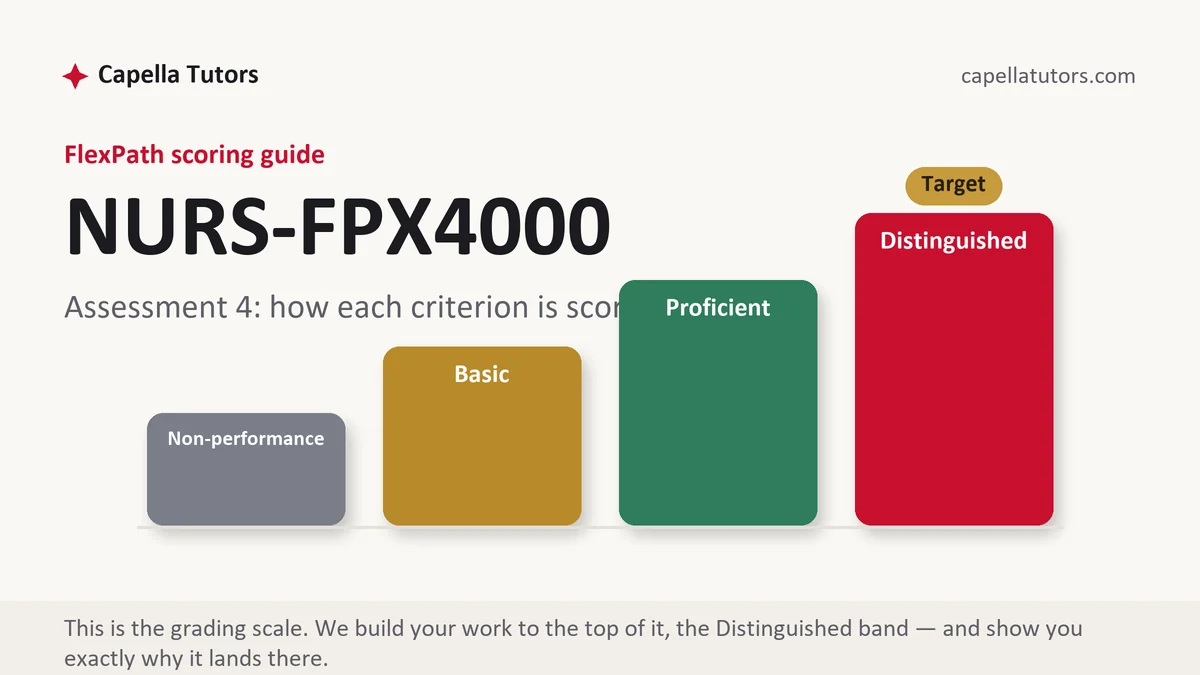
How NURS FPX 4000 Assessment 4 is scored
FlexPath does not use letter grades. Each criterion in the scoring guide lands on one of four levels, and the level descriptions are the real writing brief:
| Level | What it means on a DEI and ethics paper |
|---|---|
| Distinguished | The history of DEI in care is told through specific policies and their effects, bias and microaggressions are illustrated with realistic examples from practice, strategies are evaluated with evidence, and the link to outcomes is supported by data. |
| Proficient | All required parts are present and accurate, but examples stay general and strategies are listed rather than evaluated. |
| Basic | The paper argues that DEI matters without evidence of how it has changed care or what works. |
| Non-performance | A required part, such as the outcomes discussion or the strategies, is missing. |
Write from professional experience where the guide invites it. A short, de-identified example of a microaggression you saw handled well or badly carries more weight than a paragraph of definitions.
The NURS FPX 4000 Assessment 4 method, step by step
-
Trace the change through named policies
Anchor the history in things a reader can look up: the Affordable Care Act's nondiscrimination provisions, the National Standards for Culturally and Linguistically Appropriate Services (CLAS), language access requirements. One or two milestones, each with the change it made at the bedside.
-
Define bias and microaggression precisely
Unconscious bias is an automatic association that shapes judgment; a microaggression is a brief comment or act that communicates a slight. Give one realistic example of each in a care setting, de-identified.
-
Show the effect on care
Connect bias to a measurable consequence: undertreated pain in some patient groups, lower trust, missed follow-up. Cite the evidence rather than asserting it.
-
Evaluate strategies, do not just list them
Implicit bias training, interpreter access, diverse hiring, standardized protocols. For each one you choose, say what the evidence shows and where it falls short.
-
Connect DEI to outcomes and satisfaction
Use studies linking culturally competent care to adherence, satisfaction scores or readmissions. This is the criterion students most often answer with opinion.
-
Close with your own practice
End with one concrete change you will make in your own practice, tied to a strategy you evaluated.
A structure that maps to the criteria
Word counts are planning targets our tutors use for this paper, not Capella rules; follow the length your scoring guide states.
| Section | What it must do | Guide |
|---|---|---|
| Introduction | What DEI means in health care and what the paper will examine. | ~150 words |
| How DEI has changed care | Named policies and the practice changes they produced. | ~250 words |
| Bias and microaggressions | Definitions, one realistic example each, and the effect on care. | ~275 words |
| Strategies that work | Two or three strategies evaluated with evidence and limits. | ~275 words |
| Outcomes and satisfaction | Evidence linking DEI practice to measurable results. | ~200 words |
| Conclusion and references | Your own practice commitment, then current APA. | ~125 words |
Annotated sample excerpt
An original model excerpt from our team, written to show the register that reaches the top of the guide. Learn the moves, then write your own version.
A patient who arrives with severe abdominal pain and a history of substance use may be triaged with the assumption that the request for analgesia is drug-seeking, even before an assessment is complete.1 That assumption is an example of unconscious bias, and studies of emergency care have documented differences in pain treatment across patient groups that persist after clinical factors are controlled.2 The consequence is not only discomfort: delayed analgesia lengthens stays and erodes the trust patients need to report symptoms honestly at the next visit.3
- 1Opens with a realistic, de-identified scene so the bias is shown rather than defined.
- 2Names the concept and supports the pattern with evidence, which moves the paragraph out of opinion.
- 3Traces the bias to concrete consequences for care, which is what the criterion on impact rewards.
The full premium sample for your exact assessment, written fresh to your scoring guide and topic, is free to request. Study it, revise it into your own voice, and submit work you understand.
The five mistakes that cost Distinguished
- History without policies. A general story of progress cannot be checked; named policies and their effects can.
- Examples that identify someone. Keep every practice example de-identified.
- Strategies listed, not weighed. Naming training without its evidence or limits stays at Proficient.
- Outcomes asserted. The outcomes criterion needs data, not belief.
- No link to your practice. The course is about your nursing perspective; end with what you will do.
Pre-submission checklist
- Confirmed whether your courseroom shows DEI and Ethics or the problem analysis as Assessment 4
- At least one named policy and its effect on care
- Bias and microaggression defined with de-identified examples
- Strategies evaluated with evidence and limits
- Outcomes supported by data
- Current APA, citations matched both ways
Want the DEI paper written to your guide?
Send the scoring guide and any example from your practice you want used. Our team returns a premium original sample with policies, evidence and strategies matched to the criteria in 24 to 48 hours, revised free until it meets the guide.