This manual is for NURS FPX 4000 Assessment 1, start to submission. In the current RN-to-BSN courseroom, Assessment 1 of Developing a Nursing Perspective is the Pledge of Academic Honesty: you read the pledge, sign it, and acknowledge how the BSN practicum works in the program. It is short, but it is graded, and it decides the rules every later assessment is written under: your own words, every borrowed idea cited in APA, no reuse of a classmate's work, and a duty to report misconduct you see. Below is how to read it, what to check before you sign, and the habits worth taking from it. Prefer to hand it off? A premium original sample for this exact assessment comes back in 24 to 48 hours, revised free until it meets the guide. Capella's catalog lists the course as NURS-FPX4000, and some courserooms print NURS4000; both point to this same Assessment 1. In current courserooms this assessment typically appears as "Pledge of Academic Honesty".
One honesty note before the manual: Capella revises courses and scoring guides over time, so always write to the exact scoring guide attached to your assessment in the courseroom. The course identity above is verified on capella.edu; the method and structure below are our tutors' approach to it, not Capella's official rubric text.
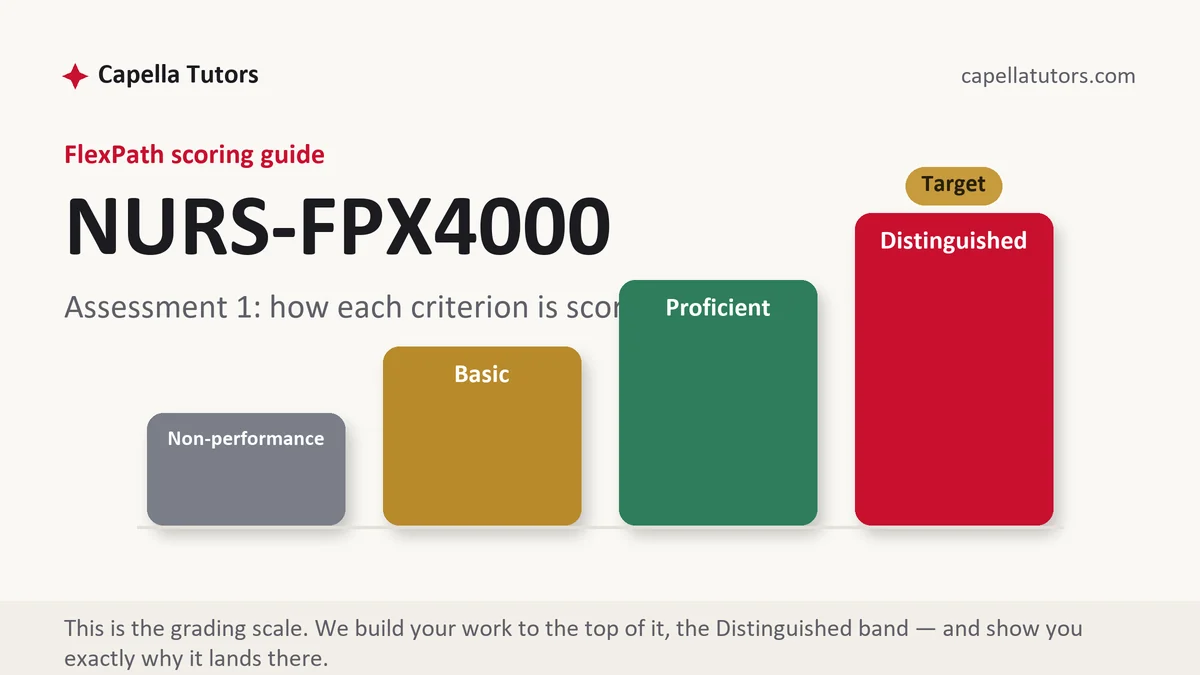
How NURS FPX 4000 Assessment 1 is scored
FlexPath does not use letter grades. Each criterion in the scoring guide lands on one of four levels, and the level descriptions are the real writing brief:
| Level | What it means on the pledge |
|---|---|
| Distinguished | The pledge is completed exactly as instructed, signed and dated, every acknowledgment answered, and any short written response shows you understand what the commitments mean in practice, citation, paraphrase and peer work included. |
| Proficient | The pledge is signed and submitted correctly, but a written response, where one is asked for, restates the policy instead of showing you can apply it. |
| Basic | Something is incomplete: an unsigned field, a missing date, or a practicum acknowledgment skipped. |
| Non-performance | The pledge was not submitted, or the file attached is not the pledge. |
Read the scoring guide attached to your version before you do anything else. Some versions treat the pledge as a single completion criterion; others add a short response about academic honesty or the practicum. Either way, an evaluator returns it for a missing field faster than for anything else.
The NURS FPX 4000 Assessment 1 method, step by step
-
Download the pledge from the courseroom, not a copy from elsewhere
Capella revises the pledge wording with the course. Use the file attached to your Assessment 1 so the commitments you sign match the version your evaluator holds. A form downloaded from a sample site can be out of date and earns a resubmission.
-
Read every commitment as a rule you will be held to
The pledge says your work is your own, that quoted words carry quotation marks and an APA citation, that paraphrase is rewritten in your own structure and still cited, and that copying or lightly editing a classmate's discussion post counts as dishonesty. It also asks you to report misconduct you notice. Read it slowly; these are the terms of the next nine courses.
-
Understand the consequences before you sign
The pledge sets out what happens if plagiarism is found: the instructor contacts you, you can respond, and penalties can run from a zero on the assessment to a failing course grade, with a report to the university. Knowing that now is cheaper than learning it in week six.
-
Complete the practicum acknowledgment carefully
The BSN program includes practicum work, and the capstone, NURS FPX 4905, requires 40 practicum hours in the current catalog. The acknowledgment confirms you understand that requirement and the documentation it involves. If anything in it is unclear, ask your faculty before signing rather than guessing.
-
Answer any written prompt in your own words
Where your version asks for a short response, show application, not repetition: how you will paraphrase a source, how you will cite a statistic, what you will do if a peer shares a finished paper with you. One concrete example per point is enough.
-
Check the file, then submit
Signature, printed name, date and every checkbox complete; file named the way the instructions ask; the right document attached. Then submit. The pledge is the fastest assessment in the course, so it should never be the one that stalls your FlexPath pace.
A structure that maps to the criteria
The pledge is a form, not an essay, so the parts below are what the evaluator checks rather than word targets. If your version includes a written response, keep it short and specific.
| Section | What it must do | Guide |
|---|---|---|
| The pledge text | Read in full from the courseroom version; nothing edited or removed. | read, not rewritten |
| Signature block | Signature, printed name and date completed exactly as the form asks. | every field |
| Practicum acknowledgment | Confirms you understand the BSN practicum requirement and its documentation. | every field |
| Short response, if required | Applies the honesty commitments to one or two concrete situations in your own words. | ~150 to 250 words |
| Citation example, if required | A quotation and a paraphrase each cited correctly in current APA. | one of each |
| Submission check | Correct file attached and named as instructed. | before you submit |
Annotated sample excerpt
An original model excerpt from our team, written to show the register that reaches the top of the guide. Learn the moves, then write your own version.
When I use a source, I will read the passage, close it, and write the idea in my own sentence structure before checking it against the original, then cite the author and year in the sentence.1 If I need the source's exact wording, for example a definition from a professional standard, I will quote it, mark it with quotation marks, and include the page or paragraph number in the citation.2 If a classmate offers me a finished paper from a course they have completed, I will decline it, and if I see work posted as someone's own that I know is not, I will tell the instructor, because the pledge makes reporting part of my commitment.3
- 1Describes a method for paraphrase rather than a promise to paraphrase, which is what shows the commitment is understood.
- 2Separates quotation from paraphrase and names the extra citation detail a quotation needs.
- 3Applies the peer-work and reporting commitments to a situation students actually meet.
The full premium sample for your exact assessment, written fresh to your scoring guide and topic, is free to request. Study it, revise it into your own voice, and submit work you understand.
The five mistakes that cost Distinguished
- Using an old copy of the pledge. Sample sites carry earlier versions; sign the one attached to your courseroom.
- Leaving a field blank. A missing date or unchecked acknowledgment sends the pledge back and costs you two business days.
- Restating the policy word for word. Where a response is asked for, copying the pledge back is the least convincing proof that you understand it.
- Skimming the practicum part. The practicum requirement shapes later courses and the capstone; read what you are acknowledging.
- Treating it as unimportant. It is graded, and it is the first thing an evaluator sees from you in the program.
Pre-submission checklist
- Pledge downloaded from your Assessment 1 instructions
- Every commitment read, consequences understood
- Signature, printed name and date complete
- Practicum acknowledgment complete
- Any written response in your own words with a concrete example
- Correct file attached and named as instructed
Want the first course of the BSN set up properly?
The pledge is yours to sign, but the rest of NURS FPX 4000 builds on one health care problem from Assessment 2 onward. Send the scoring guides and we plan the course with you, with premium original samples for the written assessments in 24 to 48 hours, revised free.