This manual is for NURS FPX 4000 Assessment 3, start to submission. Applying Ethical Principles takes the health care problem you researched in Assessment 2 and examines it through the four principles of health care ethics, autonomy, beneficence, nonmaleficence and justice, then asks where bias enters and which sphere of care the problem sits in. The grade turns on application. A paragraph that defines justice earns little; a paragraph that shows who loses access when the problem goes unaddressed earns the column. Below is the method our tutors use, a structure that maps to the criteria, and an annotated sample excerpt. Prefer to hand it off? A premium original sample for this exact assessment comes back in 24 to 48 hours, revised free until it meets the guide. Capella's catalog lists the course as NURS-FPX4000, and some courserooms print NURS4000; both point to this same Assessment 3. In current courserooms this assessment typically appears as "Applying Ethical Principles".
One honesty note before the manual: Capella revises courses and scoring guides over time, so always write to the exact scoring guide attached to your assessment in the courseroom. The course identity above is verified on capella.edu; the method and structure below are our tutors' approach to it, not Capella's official rubric text.
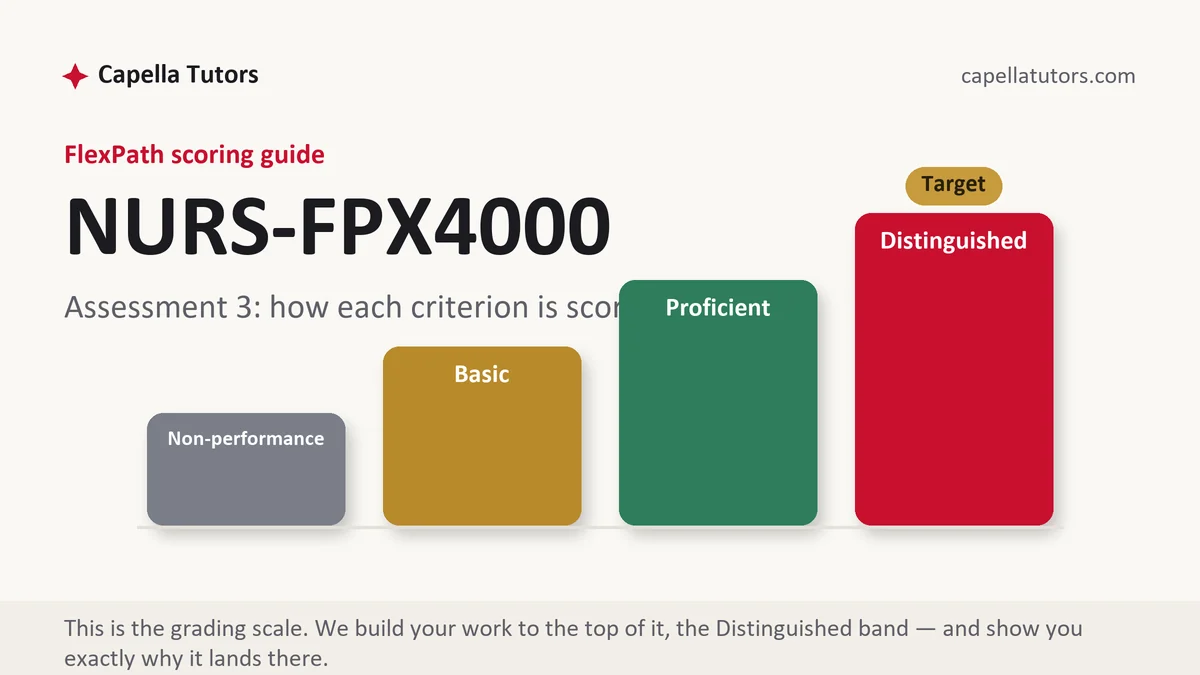
How NURS FPX 4000 Assessment 3 is scored
FlexPath does not use letter grades. Each criterion in the scoring guide lands on one of four levels, and the level descriptions are the real writing brief:
| Level | What it means on an ethics application paper |
|---|---|
| Distinguished | Each principle is applied to the specific problem with evidence, the tensions between principles are named, a source of bias is identified with its effect on care, and the problem is placed in a sphere of care with a reason. |
| Proficient | All four principles are covered accurately and tied to the problem, but each stands alone and the conflicts between them go unexamined. |
| Basic | Principles are defined in general terms with the problem mentioned in passing, usually from textbook definitions rather than evidence. |
| Non-performance | A principle, the bias discussion or the sphere of care is missing entirely. |
Keep the same problem you used in Assessment 2. The course is built as one thread: research skills, then ethics, then DEI, then a full analysis of the problem, and a change of topic here means rebuilding the evidence base.
The NURS FPX 4000 Assessment 3 method, step by step
-
Restate the problem in two sentences
Carry the problem forward from Assessment 2 with one figure that sizes it, for example a turnover rate or a staffing ratio, and the population it affects. The evaluator should know what you are applying ethics to before the first principle appears.
-
Apply autonomy to a real decision
Ask whose choices the problem limits: patients who cannot get a timely appointment, nurses whose scope is constrained by policy. Name the decision, the person and the limit, then cite evidence that the limit exists.
-
Pair beneficence and nonmaleficence
Show what good the obvious solution would do and what harm it could cause or prolong. Mandatory overtime may cover a shift and still raise error risk. Writing the two together is where the Distinguished extra move usually lives.
-
Make justice about distribution
Identify who bears the burden of the problem unevenly: rural patients, uninsured patients, night-shift staff. Justice paragraphs score when they name a group and a gap with a number.
-
Name a bias and its effect
Pick one bias that shapes the problem, such as staffing decisions that assume certain units can absorb shortages, or assumptions about patients who miss appointments. Describe how it changes care, not just that it exists.
-
Place the problem in a sphere of care
The AACN Essentials describe four spheres of care: wellness and disease prevention, chronic disease management, regenerative or restorative care, and hospice or palliative care. Choose the sphere where the problem does most harm and explain the choice in a short paragraph.
A structure that maps to the criteria
Word counts are planning targets our tutors use for this paper, not Capella rules; follow the length your scoring guide states.
| Section | What it must do | Guide |
|---|---|---|
| Introduction | The problem restated with one sizing figure and the population affected. | ~150 words |
| Autonomy | A specific decision the problem limits, with evidence. | ~175 words |
| Beneficence and nonmaleficence | The good and the harm of the likely response, weighed together. | ~250 words |
| Justice | Who carries the burden unevenly, with a figure. | ~175 words |
| Bias | One bias, how it shapes decisions, and its effect on care. | ~175 words |
| Sphere of care and conclusion | The sphere named and justified, then the ethical case closed. | ~175 words |
| References | Current APA, peer-reviewed sources from roughly the last five years. | as needed |
Annotated sample excerpt
An original model excerpt from our team, written to show the register that reaches the top of the guide. Learn the moves, then write your own version.
Mandatory overtime is the response most hospitals reach for when a unit runs short, and it does meet the immediate obligation of beneficence: the shift is covered and patients are not left without a nurse.1 The same policy works against nonmaleficence, because studies of shift length link twelve-hour-plus shifts to higher rates of medication error and missed care, so the harm it prevents tonight is partly moved to the next shift.2 A response that honors both principles would cap consecutive overtime hours and fund a float pool, accepting a higher short-term cost to avoid trading one risk for another.3
- 1Applies beneficence to a concrete response the reader recognizes rather than defining the principle.
- 2Sets nonmaleficence against it with evidence, which is the tension the top column rewards.
- 3Resolves the conflict with a proposal and states its cost, so the analysis ends in a position.
The full premium sample for your exact assessment, written fresh to your scoring guide and topic, is free to request. Study it, revise it into your own voice, and submit work you understand.
The five mistakes that cost Distinguished
- Definitions instead of application. Four paragraphs of what each principle means will sit at Basic however accurate they are.
- A new problem. Switching topics from Assessment 2 throws away your evidence and weakens the course thread.
- Principles in isolation. Missing the conflict between beneficence and nonmaleficence leaves the deepest criterion unanswered.
- Bias named but not traced. Saying bias exists is not the same as showing what it changes in care.
- A sphere of care chosen without a reason. One sentence of justification is the difference between naming and analyzing.
Pre-submission checklist
- Same health care problem as Assessment 2, sized with a figure
- Autonomy, beneficence, nonmaleficence and justice each applied, not defined
- At least one conflict between principles discussed
- One bias identified with its effect on care
- Sphere of care named and justified
- Current APA, citations matched both ways
Want the ethics paper handled with the same problem?
Send the scoring guide and your Assessment 2 problem. Our team returns a premium original sample that applies all four principles, the bias criterion and the sphere of care to your topic in 24 to 48 hours, revised free until it meets the guide.