This manual is for NURS FPX 4000 Assessment 2, start to submission. Assessment 2 of NURS FPX 4000, Developing a Nursing Perspective, is the course's evidence deliverable: credible research located, appraised, and put to use on a nursing issue. This is where the health care problem you carry through the course gets its evidence base: what you can prove and where you found it. Grading is standard FlexPath, four levels per criterion against a scoring guide. This manual walks through the search and appraisal method our tutors teach for it, a structure that follows the criteria, and an annotated excerpt built on a real evidence question. Prefer it done first so you can study it? A premium original sample returns in 24 to 48 hours, revised free until it meets the guide. Capella's catalog lists the course as NURS-FPX4000, and some courserooms print NURS4000; both point to this same Assessment 2. In current courserooms this assessment typically appears as "Applying Research Skills".
One honesty note before the manual: Capella revises courses and scoring guides over time, so always write to the exact scoring guide attached to your assessment in the courseroom. The course identity above is verified on capella.edu; the method and structure below are our tutors' approach to it, not Capella's official rubric text.
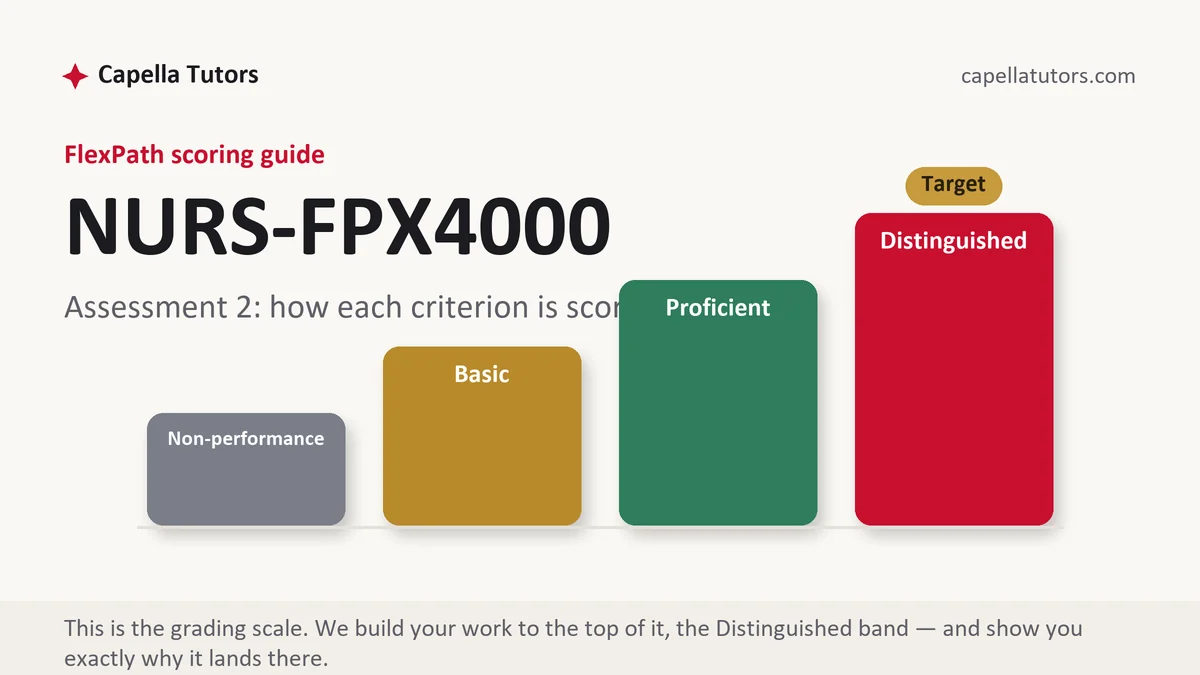
How NURS FPX 4000 Assessment 2 is scored
FlexPath never averages anything into a letter. The evaluator reads each criterion, places your work on one of four levels, and the level descriptions are the real writing brief:
| Level | What it means on an evidence deliverable |
|---|---|
| Distinguished | Sources are not just credible but appraised: the paper says why each deserves trust, compares their strength against each other, and admits where the evidence base runs thin. The comparison is usually the paid extra in an evidence criterion. |
| Proficient | Relevant peer-reviewed sources found, described accurately, and connected to the issue. Complete work, still missing the weighing move the top column names. |
| Basic | Sources listed and summarized with credibility asserted rather than demonstrated. The most common first-draft landing spot for this assessment. |
| Non-performance | A required element skipped outright, usually the credibility rationale or the link back to practice. Absent scores lower than weak, every time. |
This deliverable is also an investment. The habits it grades, database searching, credibility judgment, evidence with a job to do, are the exact machinery 4025 runs on and the capstone assumes. Students who fake their way through the source work here pay for it twice later.
The NURS FPX 4000 Assessment 2 method, step by step
-
Start in the scoring guide, not the search bar
Before touching a database, list the criteria as outline headings and copy each Distinguished description underneath. The criteria tell you what your sources must accomplish, and a search that starts without that list returns fifty results and no plan.
-
Frame a question a database can answer
"Nurse fatigue" retrieves eleven thousand hits and settles nothing. "Do consecutive twelve-hour shifts increase error rates among hospital nurses" retrieves a manageable set and hands you your keywords: fatigue, consecutive shifts, twelve-hour, patient safety, errors. The narrower question is also easier to write about, which is the quiet bonus.
-
Search the Capella library like it bills by the hour
Go through the library portal to CINAHL first, PubMed second. Filter to peer-reviewed and roughly the last five years, then run keyword pairs rather than full sentences. When a strong article surfaces, mine its subject headings and reference list for two more. Twenty focused minutes beats two scattered hours, and Google is not a step.
-
Appraise before you annotate
For each candidate, answer four questions in a note: what journal and is it peer reviewed, what design and sample, how recent, and how close to your question. Keep the answers; they become the credibility sentences your scoring guide typically asks for. A source you cannot appraise in four lines is a source you should not cite.
-
Put every source to work on the issue
Assign jobs. One source establishes that the problem is real and measurable, two or more carry the main findings, one covers the strongest contrary or complicating result. Then write each into the paper doing its job: "Okafor and Lin (2023) tracked 412 nurses and found error risk climbed after the third consecutive shift" works; the same study parked in a summary paragraph just sits there.
-
Check the draft against the guide, then submit early
Score yourself criterion by criterion, D, P, B, or N, with the guide open and no charity. Anything under D gets one more pass, usually to add a credibility rationale or a comparison between sources. Submit at the start of your week; evaluations can take two business days and the calendar does not care about your momentum.
A structure that maps to the criteria
The word targets below are the planning numbers our tutors use for a typical 4000 evidence paper. They are not Capella rules; your scoring guide decides the final shape.
| Section | What it must do | Guide |
|---|---|---|
| Introduction | Name the practice issue, say why it needs evidence rather than opinion, and preview the sources the paper will use. | ~150 words |
| The practice issue | Define the problem in measurable terms, who it affects and at what scale, framed by data rather than adjectives. | ~200 words |
| How the evidence was found | Databases, key terms, filters, and what was excluded and why, written as method, not diary. | ~150 words |
| The evidence, appraised | Each source presented with its finding and its credibility case, then weighed against the others for strength and fit. | ~450 words |
| What it means for practice | The findings translated into what a unit or a nurse should do differently, with the limits of the evidence stated. | ~250 words |
| Conclusion and references | The question answered as far as the evidence allows, current APA, every citation matched both ways. | ~100 words |
Annotated sample excerpt
Here is how the appraisal section sounds when it is scoring at the top of the guide. This is an original model from our team, written as study material: watch the moves, then make them in your own words.
Three of the five sources in this review pass every credibility test; two carry caveats worth naming out loud.1 The strongest is Okafor and Lin (2023), a prospective study that followed 412 medical-surgical nurses through logged schedules and found the odds of a self-reported error nearly doubled once a nurse worked a third consecutive twelve-hour shift, a finding two smaller replications point the same direction on.2 A 2024 integrative review supports the pattern but pools studies with incompatible definitions of fatigue, so it is weighted here as corroborating rather than primary, and the one industry white paper in the set is used only to describe scheduling norms, never to carry a safety claim.3
- 1Opens by sorting the sources into strong and caveated. Appraisal is announced as the paragraph's job, which is exactly what the criterion is paying for.
- 2The best study gets its design, its sample size, and its finding in one sentence, plus the note that it replicated. Credibility shown, not asserted.
- 3Weaker sources are kept but demoted, with the job each is allowed to do stated plainly. Policing your own evidence is the Distinguished move.
The full premium sample for your exact assessment, written fresh to your scoring guide and issue, is free to request. Study it, revise it into your own voice, and submit work you understand.
The five mistakes that cost Distinguished
- The source dump. Eight citations with no jobs assigned reads as effort, scores as Basic, and takes longer to write than five sources that each earn their place.
- Credibility by adjective. Calling a journal "reputable" is an assertion; naming its peer review, the study design, and the sample is a demonstration, and only one of those is graded.
- Consumer-grade evidence. Health websites and blogs cap the sourcing criterion at Basic. CINAHL costs the same ten minutes and reads as professional.
- Findings left in orbit. Evidence that never lands on practice misses the application criterion entirely, and that criterion is usually where this assessment hides its points.
- The one-way reference list. Citations missing from the references, or references never cited, are the most mechanical revision trigger in the course and the easiest to prevent.
Pre-submission checklist
- The practice question is specific enough that a database could answer it
- Every source is peer reviewed and inside five years, or its age is defended in the text
- Each source carries a stated credibility case: journal, design, sample, fit
- The strongest and weakest sources are named as such and weighted accordingly
- Every finding is translated into a practice implication with its limits admitted
- Citations and references match two ways, and every criterion self-scores at D
Want the search and appraisal done with backup?
Send the scoring guide and the topic you are leaning toward. A team of eight, with a dedicated research analyst running the database work and two QA reviewers checking the appraisal logic, returns a premium original sample in 24 to 48 hours, revised free until every criterion reads Distinguished. Evidence work is the skill this program reuses most; it is worth seeing done properly once.