This manual is for LEAD-FPX5220 Assessment 1, start to submission. The opening deliverable in LEAD-FPX5220 is the part most change plans skip: the contract with the sponsor, and a diagnosis designed so that it could contradict the person who commissioned it. Your scoring guide decides the format, and the criterion that quietly decides the grade is whether your sample was built to test the sponsor's theory or to confirm it. Below sits the method our tutors follow, a structure built from the criteria, and an annotated sample excerpt. Prefer to hand it over? A premium original sample returns in 24 to 48 hours, reworked free until the guide is satisfied. Your courseroom may print this as LEAD FPX 5220 Assessment 1 or LEAD5220 Assessment 1; it is the same deliverable, and LEAD-FPX5220 Assessment 1 is what this manual walks through.
One honesty note before the manual: Capella revises courses and scoring guides over time, so always write to the exact scoring guide attached to your assessment in the courseroom. The course identity above is verified on capella.edu; the method and structure below are our tutors' approach to it, not Capella's official rubric text.
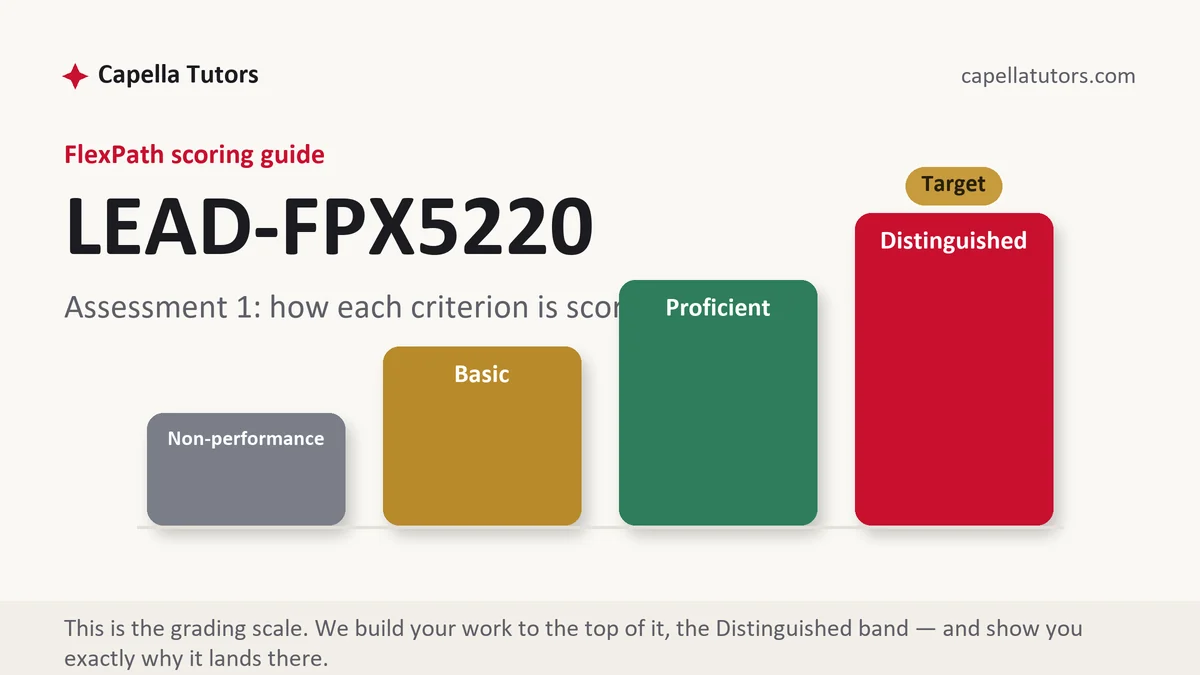
How LEAD-FPX5220 Assessment 1 is scored
Each criterion lands on one of four levels, and on a contracting and diagnosis deliverable the levels read like this:
| Level | What it means on a contracting and diagnosis design |
|---|---|
| Distinguished | The contract is written as terms either party could tell had been kept, the sample is stratified to reach the people who would disagree, the stopping rule is stated, and the disconfirming case is sought on purpose rather than met by accident. |
| Proficient | A sound agreement with the sponsor and a reasonable data collection plan. The selection logic stays implicit, and implicit selection is exactly what this course grades. |
| Basic | A plan built on enthusiasm, with interviews drawn from the names the sponsor supplied and themes reported without a count of sources. |
| Non-performance | A required element is absent, most often the contract itself, and every commitment in the plan then rests on access nobody actually agreed to. |
Remember what the role is. A change agent produces change in people who do not report to them, using influence, evidence and a sponsor's authority that can be withdrawn at any moment, which is why what was agreed at the start does so much work later.
The LEAD-FPX5220 Assessment 1 method, step by step
-
Write the contract before the plan, and put it in the document
One page: the change the sponsor is asking for stated in their words, the outcome you will be accountable for, the access you need to people and data, the deliverables and their dates, what you will not do, the decision points where the sponsor must choose, and what happens to the work if their priorities move. Everything after this can then be traced to something agreed, and a reader can see where the ask ended and your judgment began.
-
Record the ask in the sponsor's language, not yours
Consolidating three regional payroll teams of eleven, nine and seven into a single centre of eighteen roles is what the sponsor said. Improving payroll efficiency is what you would prefer they had said. Quote them, then write your own translation underneath and mark it as yours. The gap between the two versions is usually where the whole engagement will get into difficulty, and naming it in the contract costs nothing now.
-
Design the sample so it can contradict the sponsor
Stratify by the things that could produce different experience, which here is site, level and whether the person's own role survives the consolidation. Five deliberately chosen groups with four conversations in each gives twenty, and you stop adding groups when a new one produces no new theme. Then require at least three independent sources before a theme is written down as a finding rather than as an impression.
-
Set the aggregation rule before you hear anything
Decide now that no group smaller than five is reported separately, that themes are attributed to the pattern rather than the person, and what you will say when a senior manager asks who said it. Put your answer to the request to soften a finding into the contract at the start, because negotiating it after the finding exists is a conversation you will lose.
-
Run the threshold checks and record the answers
Nine roles disappear in this consolidation. The Worker Adjustment and Retraining Notification Act attaches notice obligations to mass layoffs and closings above defined size thresholds, and at this scale those thresholds are unlikely to be met, but the professional move is to run the calculation, record the conclusion and name who confirmed it rather than to assume either way. Say the same about any state statute with a lower threshold.
-
Declare the role conflict, then self-score
You are the sponsor's agent, a source of advice to people whose jobs are changing, and the person who will administer the consequences. Those three positions are not compatible, and the professional response is to say which one is active at which moment. Then mark your draft against each criterion at all four levels and submit early in the week, since an attempt can sit two business days before a reader opens it.
A structure that maps to the criteria
Word targets below are our tutors' planning ranges for a contracting and diagnosis deliverable, not Capella rules; expand whichever section your own guide weights hardest.
| Section | What it must do | Guide |
|---|---|---|
| The change and the sponsor | Who asked for what, in their words, with your translation marked as yours and the difference named. | ~200 words |
| The contract | Accountability, access, boundaries, deliverables, decision points, and what happens if sponsorship weakens. | ~300 words |
| Sampling design | The strata, why those, how many conversations, the stopping rule and the evidence threshold per theme. | ~300 words |
| Aggregation and confidentiality | The reporting floor, how themes are attributed, and the prepared answer to who said it. | ~250 words |
| Constraints checked | Notice thresholds, contractual obligations, who confirmed each answer and on what date. | ~200 words |
| Role and references | The three positions you hold and which is active when, then current APA with primary sources credited. | ~250 words |
Annotated sample excerpt
An original model excerpt from our team, published so the graded moves are visible rather than described. Take the shape and rebuild it around your own sponsor.
The sponsor's ask, in her words, is to bring the three regional payroll teams into one centre of eighteen roles by the start of the fiscal year; my accountability is the transition design and the diagnosis behind it, not the selection decisions, which remain hers.1 Access agreed: the position control extract, the current service level report, and twenty conversations across five groups selected by me rather than nominated, with two hours of each regional lead's time in weeks one and four.2 Two boundaries are recorded now: no group of fewer than five is reported separately, and if I am asked to remove a finding I will offer to add the sponsor's response beside it rather than delete it, which is stated here so the request does not have to be negotiated under pressure later.3
- 1The ask is quoted and the accountability is bounded in the same sentence, so nobody discovers in week six that they expected you to choose who stays.
- 2Access is specific and the sample is selected by the change agent. Nominated interviewees return the nominator's theory.
- 3Sets the aggregation floor and pre-answers the request to soften a finding, in writing, before either is tested.
The full premium sample for your exact assessment, written fresh to your scoring guide and issue, is free to request. Study it, revise it into your own voice, and submit work you understand.
The five mistakes that cost Distinguished
- A plan with no contract behind it. Access and sponsorship were assumed rather than agreed, so every date in the timeline is a guess about somebody else's priorities.
- Interviewees supplied by the sponsor. A sample selected by the person holding the theory will return the theory, and the criteria grade the design rather than the finding.
- Themes with no source count. One articulate complaint and a pattern across nine conversations look identical on the page unless you print the number.
- No stopping rule. Without one, data collection ends when the writer runs out of time, which is not a defensible reason to stop.
- The role conflict left unmentioned. Being adviser, agent and enforcer at once is the situation; pretending otherwise reads as a lack of self-awareness.
Pre-submission checklist
- A one-page contract in the document, with accountability, access, boundaries and decision points
- The sponsor's ask quoted, and your translation of it marked as yours
- Strata named and justified, with the conversation count and the stopping rule stated
- A minimum number of independent sources set before any theme becomes a finding
- An aggregation floor and a prepared answer to the request to identify a speaker
- Notice and contractual thresholds checked with the answer recorded, and the role conflict declared
Change plan due and the contract is not written?
Send the criteria, the change, who is sponsoring it and what has already been attempted there. Our eight-person pipeline returns a premium original sample inside 24 to 48 hours with the contract set out as terms, the sampling design defended and the aggregation rule fixed before the first finding exists.