How to write LEAD-FPX5220 Assessment 2

The short answer

This manual is for LEAD-FPX5220 Assessment 2, start to submission. This deliverable covers the two moments most change plans handle worst: giving an organization its own findings back, and getting a message to people who work at the far end of a chain of retellings. Your scoring guide decides the form, and the criterion that separates the columns is nearly always whether you treated communication as two separate problems with two separate fixes. The method below is the one our tutors use, with a criterion-keyed structure and an annotated sample excerpt. Rather hand it off? A premium original sample is back with you in 24 to 48 hours and reworked at no charge until the criteria are answered. Your courseroom may print this as LEAD FPX 5220 Assessment 2 or LEAD5220 Assessment 2; it is the same deliverable, and LEAD-FPX5220 Assessment 2 is what this manual walks through.

One honesty note before the manual: Capella revises courses and scoring guides over time, so always write to the exact scoring guide attached to your assessment in the courseroom. The course identity above is verified on capella.edu; the method and structure below are our tutors' approach to it, not Capella's official rubric text.
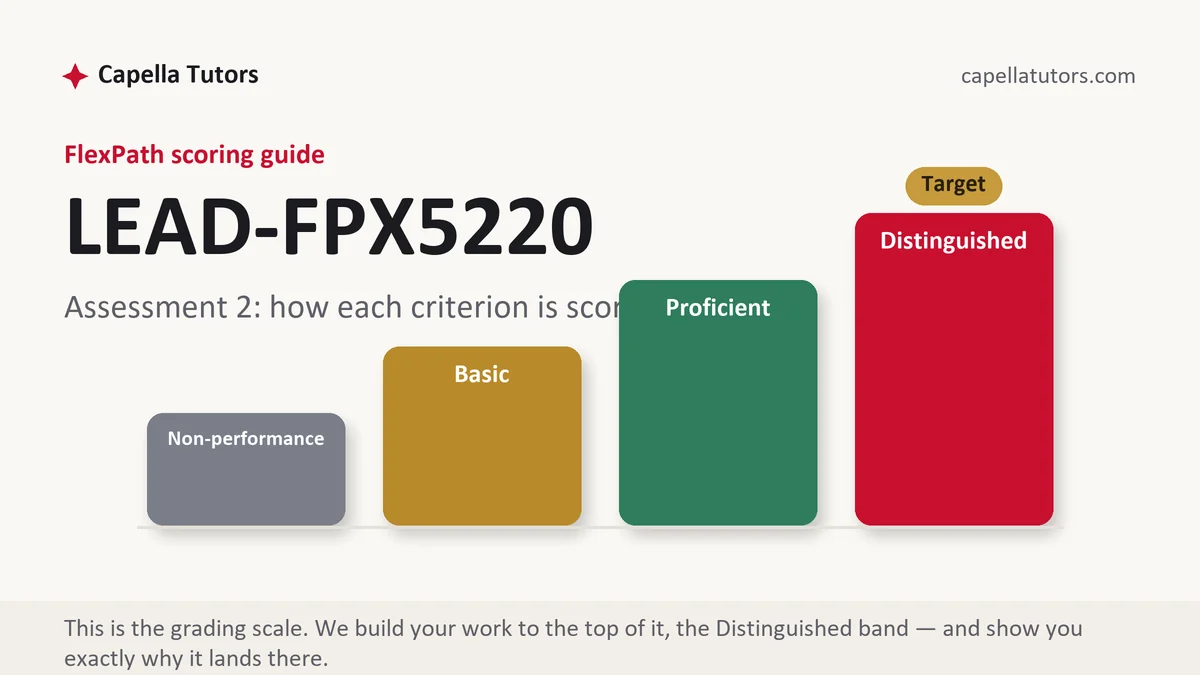
LEAD-FPX5220 Assessment 2 grading scale at Capella FlexPath, the criterion levels this assessment is scored on, from Capella Tutors
How Capella FlexPath grades LEAD-FPX5220 Assessment 2, visualized by Capella Tutors.

How LEAD-FPX5220 Assessment 2 is scored

The same four levels, applied to each criterion separately. On a feedback and communication design they translate this way:

LevelWhat it means on a feedback and communication design
DistinguishedThe feedback session is designed rather than improvised, with a room, an order and an aggregation rule; fidelity and coverage are computed separately because they have different fixes; and the time the plan spends from other people's calendars is counted in the plan itself.
ProficientA thoughtful session and a multi-channel plan. Communication is treated as one problem, so the answer is more enthusiasm at the top rather than an artifact that survives the journey.
BasicA list of channels, a cascade assumed to arrive intact, and a feedback meeting described as sharing the results with the team.
Non-performanceA required element never appears, most often the aggregation rule, which leaves the people who spoke to you exposed by the document that was supposed to represent them.

Keep one thing in view throughout: telling an organization what you heard changes it, because people learn from the telling what is sayable. That is why the design of this moment is graded as heavily as the findings themselves.

The LEAD-FPX5220 Assessment 2 method, step by step

  1. Design the feedback session as an event with a shape

    Decide who is in the room and who is not, the order the findings are presented in, what is on paper and what is only spoken, and how long is reserved for the sponsor's reaction rather than your presentation. Then rehearse the two sentences you will say if a senior person asks who said something, because you will be asked, and improvising an answer in that room damages every conversation you have afterwards.

  2. Sequence the findings so the room can actually hear them

    Lead with the finding that is least contested and most verifiable, so the method earns credibility before the uncomfortable material arrives. Put the finding that implicates the people present in the middle rather than at the end, and give it the largest number of independent sources you have. Close on what you are recommending, not on the worst thing anyone said, or the meeting will end on a defence instead of a decision.

  3. Compute fidelity, and stop trying to fix it with energy

    A message travels from the vice president through six regional managers, then 52 area supervisors, then to 900 technicians. At a generous 75 percent retention per retelling, three handoffs leave about 42 percent of the original content intact. No amount of executive conviction changes that arithmetic. What changes it is a written artifact that travels without being reworded, and the plan should name the artifact.

  4. Compute coverage, which is a different problem entirely

    If 73 percent of the 52 supervisors actually hold the conversation inside the three-week window, that is 38 of them, reaching about 657 technicians, and 243 people hear it from the intranet or from a colleague's version. Getting to 92 percent means 48 supervisors and 831 technicians, and it takes a scheduled event, a prepared toolkit and a completion record rather than a reminder email.

  5. Count the time you are spending from other people's calendars

    Two and a half hours each in preparation and delivery across 52 supervisors is 130 hours, roughly $5,980 at a loaded $46 an hour, and that figure belongs in the plan rather than in a footnote. A change agent who has priced the demand they are making on the line is treated differently from one who has assumed it is free.

  6. Keep the records lawful, then self-score

    If the new conversation template invites a technician to explain an absence, some supervisors will write down medical information, and the Americans with Disabilities Act requires that such information be kept confidential and separate from the personnel file. Design the template so it asks about work rather than diagnosis, and say who trained the supervisors on the boundary. Then mark every criterion yourself and submit early in the week.

A structure that maps to the criteria

These are the planning ranges our tutors use on a deliverable of this shape rather than Capella instructions; expand whichever section your guide weights most heavily.

SectionWhat it must doGuide
What was heardThemes with the number of independent sources behind each, kept apart from your interpretation of them.~250 words
The feedback session designedRoom, order, aggregation floor, what is on paper, and the prepared answer to who said it.~300 words
FidelityThe chain of retellings, the retention assumption, the arithmetic, and the artifact that travels intact.~250 words
CoverageWho must deliver it, the window, the completion record, and the reach at two different completion rates.~300 words
Cost to the lineHours consumed by role, priced, plus what those people will stop doing to create the time.~200 words
Records and referencesWhat the template captures, the confidentiality boundary, who trained whom, then current APA with primary sources credited.~200 words

Annotated sample excerpt

Original model work from our team, published so the arithmetic and the register are visible on the page. Learn the moves, then run them on your own chain.

Sample excerpt: fidelity and coverage Original model · Capella Tutors

The message passes from the vice president to six regional managers, then to 52 area supervisors, then to 900 technicians, and at a generous 75 percent retention per retelling roughly 42 percent of the original content survives the third handoff, which is a content problem no amount of leadership conviction repairs.1 Coverage is separate: at the 73 percent completion rate the last two rollouts achieved, 38 supervisors hold the conversation inside the window and about 657 technicians hear it from their own supervisor, leaving 243 to assemble a version from the intranet and a colleague.2 Reaching 92 percent means 48 supervisors and 831 technicians, and it costs 130 supervisor hours, about $5,980 loaded, which is stated here rather than discovered by the regional managers in week two.3

  • 1Names the retention assumption, does the arithmetic, and draws the conclusion about the fix. The fix follows from the number rather than from a preference.
  • 2Treats coverage as its own problem with its own denominator, and reports who is left assembling the message themselves.
  • 3Prices the demand the plan makes on other people's calendars, in the plan, before anybody has to ask what this will cost them.

The full premium sample for your exact assessment, written fresh to your scoring guide and issue, is free to request. Study it, revise it into your own voice, and submit work you understand.

Get the full sample free

The five mistakes that cost Distinguished

  • A cascade assumed to arrive intact. Content decays at every retelling, and the remedy is an artifact that travels unrewritten rather than a more inspiring launch.
  • Fidelity and coverage treated as one thing. They have different arithmetic and different fixes, and conflating them produces a plan that solves neither.
  • A feedback session improvised. Without a room, an order and an aggregation floor decided in advance, the first hard question decides all three for you.
  • A finding trimmed to suit the sponsor. Whatever standing makes the role useful is gone the moment a report is edited to please the person who commissioned it.
  • Line time treated as free. Two and a half hours across 52 supervisors is real money, and a plan that has not counted it will be resented by the people it depends on.

Pre-submission checklist

  • Themes reported with the count of independent sources behind each one
  • A feedback session with a room, an order, an aggregation floor and a rehearsed answer to who said it
  • Fidelity computed from a stated retention assumption, with the traveling artifact named
  • Coverage computed at two completion rates, with a completion record specified
  • Hours taken from other roles counted and priced inside the plan
  • The record-keeping boundary named, the training assigned, and the draft self-scored before submission

Communication plan due and the numbers are not done?

Send the criteria, the reporting chain and whatever you know about how the last rollout landed. Our eight-person pipeline returns a premium original sample in 24 to 48 hours with fidelity and coverage computed separately, the feedback session designed and the line cost priced, so the plan reads as something an operations director would actually agree to.

Keep going

Online now