This manual is for LEAD-FPX5220 Assessment 3, start to submission. The closing deliverable in LEAD-FPX5220 takes the change through implementation and out the other side: what happens in what order, what you do when the diagnosis contradicts the sponsor's plan, who owns each element once you leave, and what evidence would show it still running half a year later. Your scoring guide sets the format, and the criterion most often left unanswered is the handover, because a change agent who never defines the end of their own involvement has designed a dependency. Our tutors' method appears below, with a structure keyed to the criteria and an annotated sample excerpt. Want it built with backup? A premium original sample returns in 24 to 48 hours and is reworked free until the guide is met. Your courseroom may print this as LEAD FPX 5220 Assessment 3 or LEAD5220 Assessment 3; it is the same deliverable, and LEAD-FPX5220 Assessment 3 is what this manual walks through.
One honesty note before the manual: Capella revises courses and scoring guides over time, so always write to the exact scoring guide attached to your assessment in the courseroom. The course identity above is verified on capella.edu; the method and structure below are our tutors' approach to it, not Capella's official rubric text.
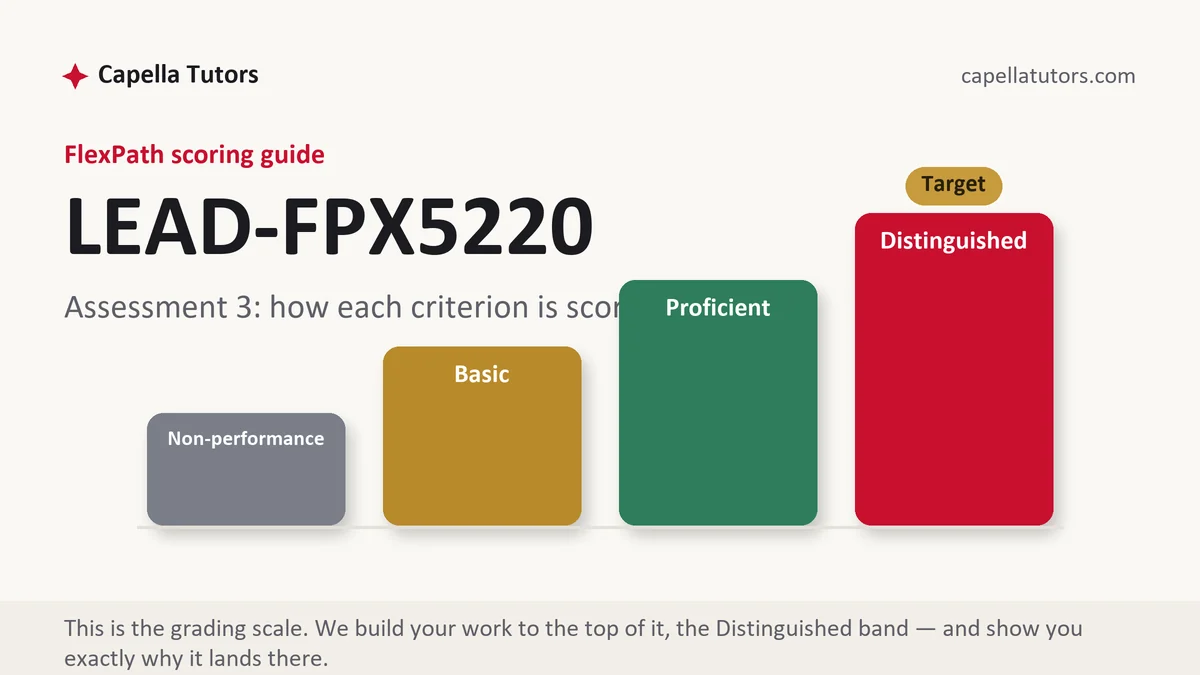
How LEAD-FPX5220 Assessment 3 is scored
Four levels, one criterion at a time. On an implementation and handover deliverable they come out like this:
| Level | What it means on an implementation and handover plan |
|---|---|
| Distinguished | The plan tests the sponsor's design against a constraint that could defeat it and reports the result, every element has a named owner after the change agent leaves, the six-month evidence is specified, and the writer's own position in the change is declared rather than hidden. |
| Proficient | A workable sequence with sensible governance. The handover is described in general terms, and general terms are what reverts the moment attention moves. |
| Basic | A timeline of activities, a communications line, and an assumption that the change persists because it was announced. |
| Non-performance | A required element is absent, most often the handover or the measure of persistence, and a change with nobody accountable afterwards is a change that will not be there in a year. |
Define failure for your own change in advance, in terms a reader could check, rather than reaching for the figure everybody repeats about how many change efforts fail. That figure circulates without a population, without a definition and without a study behind it, and quoting it as a statistic is one of the easier criteria to lose here.
The LEAD-FPX5220 Assessment 3 method, step by step
-
Test the sponsor's plan against a constraint that could defeat it
The ask is that 214 claims examiners attend the office four days a week. The building holds 168 desks, so four days requires 856 desk-days against 840 available across five days, and that is before anyone tries to avoid Friday. The plan is infeasible at full attendance before a single argument about culture or productivity begins, and putting that in front of the sponsor is the most valuable thing a change agent does in the first fortnight.
-
Convert the finding into options rather than objections
Give the sponsor three costed choices: three assigned days at 642 desk-days and 76 percent utilization, four days with two cohorts on fixed patterns, or four days conditional on capital work to add desks with a price and a date attached. A change agent who says no has spent their credibility; one who says here are the three shapes this can take, and here is what each costs, keeps it.
-
Route the individual exceptions instead of ruling on them
Forty-one people hold written flexible arrangements and twelve have accommodations on file. Do not resolve those inside the general rule. Name the route: requests go to human resources, each one gets an individualized conversation and a documented outcome, and the existing arrangements are reviewed rather than revoked by default. Say who owns that route and what the service standard is, because that is where the plan will meet its first real test.
-
Know what employees are protected in doing about it
Some examiners will organize. Section 7 of the National Labor Relations Act protects employees who act together over terms and conditions of employment even where no union is present, so a supervisor who disciplines somebody for circulating a petition about the schedule has created a second problem larger than the first. Brief the supervisors on that boundary before the announcement, not after the first incident.
-
Name the owner and the six-month evidence
Every element of the change gets a role that owns it once you leave, and the plan states what would show it is still operating in six months: the desk booking utilization report, the proportion of cohorts still on their assigned pattern, and the number of exception requests decided inside the service standard. Then define done for your own involvement, in a sentence, with a date.
-
Say which hat is on when, then self-score
You advise the sponsor, you advise the examiners, and you will administer the consequences if somebody refuses to comply. Write which of those is active at each stage, and say what you told people you would do with what they told you, then whether you did it. Mark the draft against every criterion at all four levels and submit early in the week, since a submitted attempt can wait two business days.
A structure that maps to the criteria
The word targets below are our tutors' planning ranges for an implementation and handover plan, not Capella rules; widen whichever section your own criteria weight most.
| Section | What it must do | Guide |
|---|---|---|
| The ask and the constraint | What the sponsor wants, the constraint tested against it, and the arithmetic that settles whether it is possible. | ~250 words |
| Options and costs | Two or three shapes the change could take, each priced, with the recommendation and the reason. | ~300 words |
| Sequence | What happens in what order, who does it, and which wave is deliberately first so it can teach you something. | ~250 words |
| Exceptions and rights | The individual route with its owner and service standard, plus the protections supervisors are briefed on. | ~250 words |
| Handover | Owner by role for each element, the six-month evidence, and the definition of done for the change agent. | ~250 words |
| Position and references | Which of your roles is active when, what you promised interviewees and whether you kept it, then current APA. | ~200 words |
Annotated sample excerpt
An original model excerpt from our team, published so the moves that reach the top of the guide are visible on the page. Learn them and rebuild from your own constraint.
Four onsite days for 214 examiners requires 856 desk-days a week against the 840 the building can supply across five days, so the sponsor's design fails on capacity before any behavioral question is reached, and it fails more sharply once Friday avoidance is assumed.1 Three assigned days needs 642 desk-days, a 76 percent utilization that leaves room for visitors and equipment failure, and it is the option recommended here; the alternatives are two fixed cohorts on four-day patterns, or four days conditional on the $214,000 fit-out quoted in Appendix C with a nine-week lead time.2 Existing arrangements are reviewed rather than revoked: the 41 written agreements and 12 accommodations on file each receive an individual decision owned by human resources within ten working days, and supervisors are briefed beforehand that employees acting together about the schedule are protected in doing so.3
- 1Tests the sponsor's plan against a constraint that can settle the question arithmetically, and reports the answer the sponsor did not want.
- 2Turns the refusal into costed options with a recommendation. This is how a change agent keeps influence while contradicting the person who hired them.
- 3Sends individual situations to a route with an owner and a service standard, and puts the rights briefing before the announcement rather than after the incident.
The full premium sample for your exact assessment, written fresh to your scoring guide and issue, is free to request. Study it, revise it into your own voice, and submit work you understand.
The five mistakes that cost Distinguished
- The sponsor's design never tested. A constraint that could have settled the question arithmetically gets discovered by the operation instead, in week three, in public.
- A refusal with no alternatives. Saying the plan cannot work spends your standing; saying here are three shapes and their prices keeps it.
- Individual situations decided by the general rule. Existing arrangements and accommodations need an owned route with a service standard, not a policy paragraph.
- Supervisors briefed after the first incident. Employees have protections when they act together about the terms of their work, and a disciplinary mistake here outlives the change itself.
- No handover owner and no persistence evidence. A change with nobody accountable after you leave reverts to whatever saved somebody time last quarter.
Pre-submission checklist
- The sponsor's plan tested against a hard constraint, with the arithmetic printed
- Two or three costed options, a recommendation, and the reason for it
- A first wave chosen deliberately, with what it is expected to teach you
- An exceptions route with a named owner and a stated service standard
- An owner by role for every element, six-month evidence, and a definition of done for your involvement
- Your own position in the change declared, promises to interviewees accounted for, and no unsourced failure-rate statistic anywhere in the paper
Implementation plan due and the sponsor's design is shaky?
Send the criteria, the change, the constraint you suspect will bite and what has already been tried. Our eight-person pipeline returns a premium original sample inside 24 to 48 hours with the constraint tested arithmetically, the options costed, the handover owned by role and the six-month evidence specified.