This manual is for LEAD-FPX5210 Assessment 2, start to submission. This deliverable puts the cultural evidence to work: you take published frameworks, use them at the level their data was collected, generate a hypothesis about the team you described, and then design how you will lead people whose assumptions about authority, disagreement and courtesy you did not set. Your scoring guide decides the format, and the criterion most often lost here is attribution, because a dimension score credited to the wrong research programme costs a rewrite. Below sit our tutors' method, a structure keyed to the criteria, and an annotated sample excerpt. Rather hand it over? A premium original sample returns in 24 to 48 hours, rewritten free until the guide is met. Your courseroom may print this as LEAD FPX 5210 Assessment 2 or LEAD5210 Assessment 2; it is the same deliverable, and LEAD-FPX5210 Assessment 2 is what this manual walks through.
One honesty note before the manual: Capella revises courses and scoring guides over time, so always write to the exact scoring guide attached to your assessment in the courseroom. The course identity above is verified on capella.edu; the method and structure below are our tutors' approach to it, not Capella's official rubric text.
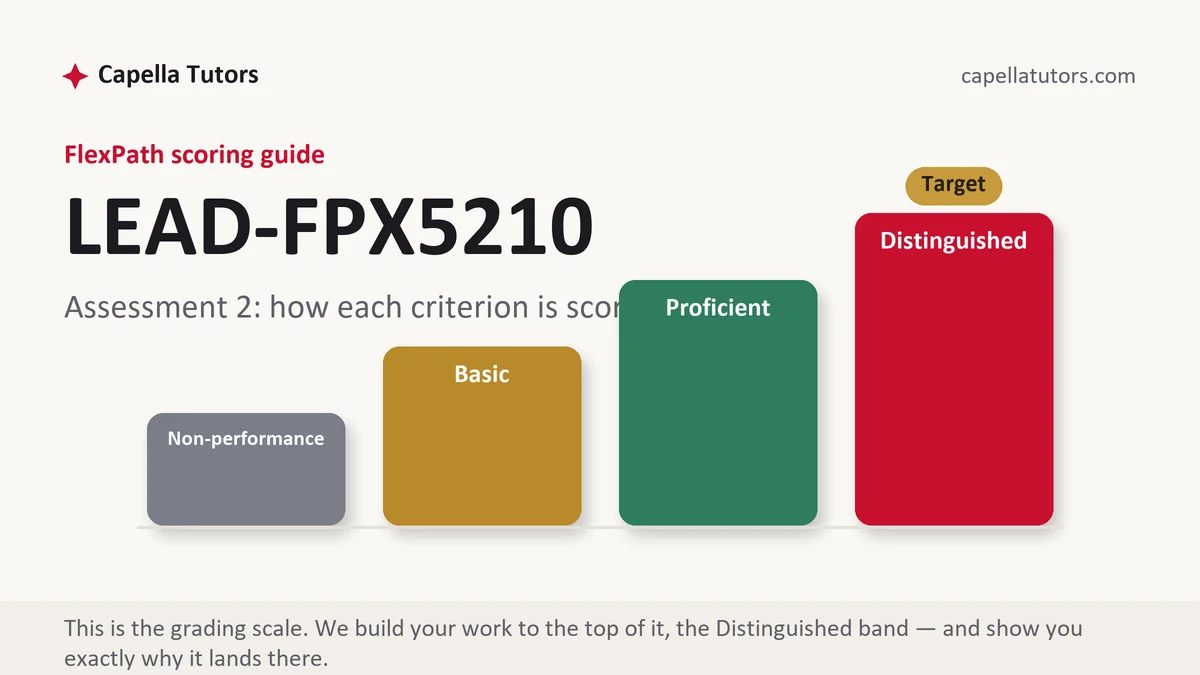
How LEAD-FPX5210 Assessment 2 is scored
Criterion by criterion, four levels, and on a cultural analysis with a leadership design attached they read this way:
| Level | What it means on a cultural analysis and leadership design |
|---|---|
| Distinguished | Each framework is credited to its own researchers and used at the level its data was gathered, a country finding is converted into a hypothesis and then tested against what the team actually did, and the meeting design changes something a participant would notice next week. |
| Proficient | Frameworks applied correctly and a reasonable plan built from them. The claims are not tested against observation, and untested application is where the middle column sits. |
| Basic | A country walked through dimension by dimension, then a colleague described as though the national average were their personality. |
| Non-performance | A required element is absent, most often the leadership response, since a cultural description with no decision attached answers half the prompt. |
The restraint is the skill. Variation inside a country routinely exceeds the gap between country averages on the same dimension, so a score is a useful hypothesis about a norm and never a description of the person in front of you.
The LEAD-FPX5210 Assessment 2 method, step by step
-
Turn a score into a hypothesis, then go and check it
Write the framework's expectation as a sentence you could be wrong about: engineers at the Nagoya site will raise objections privately after the meeting rather than during it. Then look at what happened in the last four design reviews and report whether it held. A paper that tests one prediction against its own team outranks any paper that applies six frameworks faithfully and checks none of them.
-
Credit each framework to the people who built it
National dimension scores go to Hofstede and the work extending them, the separation of societal practices from societal values and the leadership prototypes go to House and the GLOBE researchers, and cultural intelligence as a learnable capability with separable components goes to Earley and Ang. Add the measurement caveat where it belongs, which is that cultural intelligence is largely captured by self report and people who feel competent report competence.
-
Measure participation before you redesign it
In a 60-minute design review with 14 participants, nine people spoke at all, and the four engineers from the acquired Nagoya site accounted for roughly 6 minutes of the 52 minutes of speech. They were 29 percent of the room and 11.5 percent of the talking. That gap is the problem statement, and it is worth more in a graded paper than any amount of writing about inclusive culture.
-
Design so contribution is not a speed contest
In a discussion held in one person's first language and another's third, speaking time measures processing speed as much as insight. Circulate the agenda and the substantive material 48 hours ahead, require written input before the call so the quietest channel is not the only one, and call on people by name in a planned order rather than rewarding whoever interrupts fastest. Each of those is a decision a participant would notice, which is what the criterion is asking for.
-
Confirm understanding in the other person's words
The leader who reads hesitancy in a third language as a lack of conviction, or elaborate courtesy as agreement, will misjudge the plan and the person. Build in the check: the owner of each commitment restates it in writing, in their own words, within a day. It surfaces a misunderstanding while it is still cheap, and it gives you a record that does not depend on anyone's recollection of a call.
-
Route the boundary questions outward, then self-score
Moving performance review data from a Japanese site into a Canadian human resources system engages Japan's Act on the Protection of Personal Information, and the answer comes from local counsel or a regional lead rather than from your own reading. Name the role and the trigger in the plan. Then mark every criterion yourself and submit early in the week, since evaluation can take two business days.
A structure that maps to the criteria
The word targets below are our tutors' planning ranges for this kind of analysis, not Capella requirements; widen whichever section your guide weights hardest.
| Section | What it must do | Guide |
|---|---|---|
| Situation and stakes | The two groups, how they came together, what they are trying to produce and what is currently going wrong. | ~200 words |
| Frameworks selected | Two frameworks, what each measures, at what level its data was collected, and why these two rather than others. | ~250 words |
| Hypothesis and observation | The prediction each framework generates, what you actually observed, and whether it held. | ~300 words |
| Participation design | The meeting and input changes, in operational detail, with the reason each one addresses the observed gap. | ~300 words |
| Confirmation and record | How commitments are restated and stored, and how a misunderstanding is caught early rather than at delivery. | ~200 words |
| Boundaries and references | The questions routed to counsel or a regional lead, then current APA with each framework credited to its authors. | ~250 words |
Annotated sample excerpt
Original model work from our team, included so the register that reaches the top of the guide is visible rather than described. Take the sequence and fill it with your own observations.
Dimension scores of the kind Hofstede produced are country means, so the most they license is a hypothesis: that engineers at the acquired site will raise objections after the meeting rather than inside it.1 Checked against the last four design reviews, the pattern is narrower than the framework predicted; the four Nagoya engineers were 29 percent of a fourteen-person room and about 11.5 percent of the speaking time, but every objection they later raised in writing had been raised within a day, which suggests a channel problem rather than a reluctance to disagree.2 The design therefore changes the channel rather than the people: material circulated 48 hours ahead, written positions submitted before the call, and a named speaking order that does not reward interruption.3
- 1States the level the data was collected at and downgrades the claim to a hypothesis in the same sentence. This is the move the course exists to teach.
- 2Tests the prediction against observation and reports that it only partly held. Reporting a framework's miss outranks applying one cleanly.
- 3Intervenes on the channel rather than on personality, and every element is concrete enough that a participant would notice it next week.
The full premium sample for your exact assessment, written fresh to your scoring guide and issue, is free to request. Study it, revise it into your own voice, and submit work you understand.
The five mistakes that cost Distinguished
- A country mean applied to a named colleague. The data describes societies, within-country variation is large, and the error is visible to any faculty reader.
- Six dimensions listed, none used. Two dimensions chosen for the situation, with their data levels stated, beats a full tour of a framework every time.
- Practitioner culture books cited as evidence. They are readable heuristics with thin sampling, and labeling them as interpretation earns the credit that presenting them as research loses.
- Fluency mistaken for capability. Speaking time in a second or third language measures processing as much as judgment, and a design that ignores that measures the wrong thing.
- An inclusive plan with nothing to do on Monday. If a participant could not tell the difference, the leadership design criterion has not been answered.
Pre-submission checklist
- Two frameworks, each with what it measures and the level its data was gathered at
- One prediction written as a testable sentence and checked against what the team actually did
- Participation quantified, with the share of the room set against the share of the talking
- Meeting changes specific enough that a participant would notice them
- A confirmation step producing a written record in the owner's own words
- Boundary questions routed to a named role, frameworks credited to their researchers, current APA throughout
Cultural analysis due and the attribution has to be right?
Send the criteria, the two groups and whatever you can describe about how the last few meetings went. Our eight-person pipeline includes a reader who does nothing but check each framework against the source it is credited to, and the premium original sample returns inside 24 to 48 hours with the hypothesis tested rather than asserted.