How to write LEAD-FPX5210 Assessment 1

The short answer

This manual is for LEAD-FPX5210 Assessment 1, start to submission. The opening deliverable in LEAD-FPX5210 asks you to describe a real distributed team and analyze how you would lead it: the sites, the reporting lines, the working languages, what the team is accountable for, and what the geography does to the ordinary business of meeting and deciding. Your scoring guide decides the format, and the criterion that separates the columns is usually whether the burden of the arrangement was counted rather than regretted. The method our tutors use is below, along with a criterion-keyed structure and an annotated sample excerpt. Prefer to hand it over? A premium original sample comes back within 24 to 48 hours and is reworked at no cost until the guide is answered. Your courseroom may print this as LEAD FPX 5210 Assessment 1 or LEAD5210 Assessment 1; it is the same deliverable, and LEAD-FPX5210 Assessment 1 is what this manual walks through.

One honesty note before the manual: Capella revises courses and scoring guides over time, so always write to the exact scoring guide attached to your assessment in the courseroom. The course identity above is verified on capella.edu; the method and structure below are our tutors' approach to it, not Capella's official rubric text.
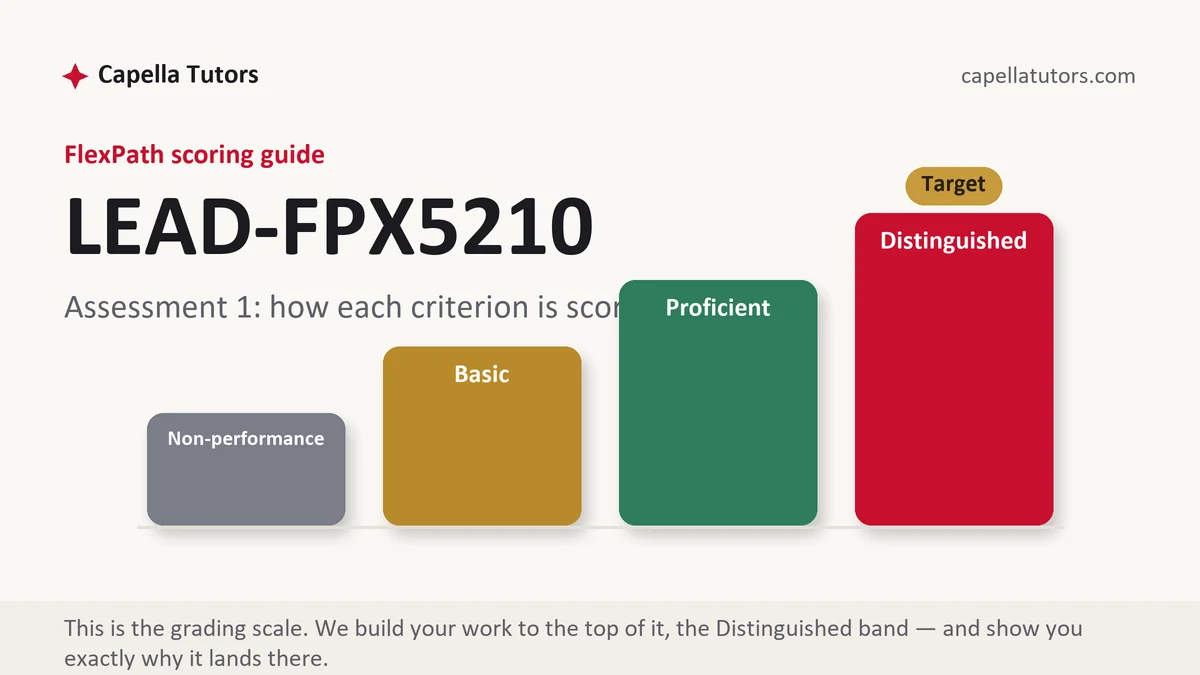
LEAD-FPX5210 Assessment 1 grading scale at Capella FlexPath, the criterion levels this assessment is scored on, from Capella Tutors
How Capella FlexPath grades LEAD-FPX5210 Assessment 1, visualized by Capella Tutors.

How LEAD-FPX5210 Assessment 1 is scored

No letter grades and no averaging. Each criterion sits on one of four levels, and on an analysis of a distributed team the levels translate like this:

LevelWhat it means on a distributed team analysis
DistinguishedThe team is described concretely enough that every later claim can be checked against it, the overlap between sites is computed rather than estimated, and the leader decides who carries the cost of the arrangement instead of letting the default decide. The extra move lives inside each criterion; find it and make it visible.
ProficientAn accurate description with sensible leadership responses. The burden is acknowledged qualitatively, and qualitative acknowledgement is where the top column stops.
BasicA global team in the abstract, described by adjectives, with recommendations that would fit any organization on earth. Abstraction removes the facts the criteria need.
Non-performanceA required element is missing, most often the analysis itself, since describing the difficulty is not the same as deciding what to do about it.

One habit carries through the whole course: the unit of analysis is the leader's behavior rather than the organization's policy. You are graded on how you run the meeting, assign the work and make the decision, not on whether the company has a good global strategy.

The LEAD-FPX5210 Assessment 1 method, step by step

  1. Describe the team before you reach for a framework

    Name the sites, the headcount at each, who reports to whom, the working languages, who the internal client is and what the team is accountable for delivering. A revenue-cycle and coding operation with 46 people in Nashville, 22 in Krakow and 61 in Manila is a team a reader can reason about. A global team is not, and every criterion afterwards will be weaker for it.

  2. Convert every site onto one clock

    Pick a reference site and rewrite the others into its time. Nashville works 08:00 to 16:30, Krakow works 08:30 to 17:00 local which is 01:30 to 10:00 in Nashville terms, and Manila works 09:00 to 18:00 local which is 19:00 to 04:00. Nashville and Krakow share two hours, Krakow and Manila share two and a half, Nashville and Manila share none at all. That last sentence is the finding, and it changes every recommendation that follows.

  3. Count the burden across a year, not across a week

    A single fixed weekly call at 08:30 Nashville time lands at 15:30 in Krakow and 22:30 in Manila, so all 46 of the year's calls fall outside one site's working day, and it is always the same site. Rotating three slots gives each site roughly 15. Moving the status portion to a written decision log with a 24-hour comment window and keeping one live call a month reduces it to four per site. Put those three numbers side by side and the recommendation argues itself.

  4. Choose the channel before you choose the time

    Most of what a weekly call carries is status, which is the part written text handles better than speech. Reserve synchronous time for the things that genuinely need it, which are disagreement, ambiguity and anything where somebody needs to hear a tone. The price of the written channel is one calendar day of latency, and for a team with no common working hours that is usually the right trade to make and to say you are making.

  5. Treat rest periods as a constraint, not an inconvenience

    A call scheduled at 23:00 in a European site is not only unpopular. The European Working Time Directive, as implemented in national law, entitles workers to a minimum daily rest of eleven consecutive hours, and a late call followed by an early start can cut into it. Name the obligation, say that local human resources confirms the position rather than you, and the criterion assessing judgment about boundaries is answered in three sentences.

  6. Pick measures that could expose the arrangement, then self-score

    Choose observations that would embarrass a comfortable conclusion: the distribution of out-of-hours attendance by site, the share of decisions closed asynchronously, and whether the same site keeps supplying the person who joins at midnight. Then mark your own draft against every criterion before submitting, and send it early in the week, since an attempt can sit for two business days.

A structure that maps to the criteria

These word targets are the planning ranges our tutors use on an analysis of this kind, not Capella rules; expand whichever section your own guide weights more heavily.

SectionWhat it must doGuide
The team describedSites, headcount, reporting lines, languages, the client, and what the team is accountable for delivering.~250 words
The overlap computedEvery site converted to one clock, the shared windows stated in hours, and the pairs that share nothing.~250 words
Meeting burden and its distributionThe annual count under each option, who bears it, and the option chosen with the reason stated.~300 words
Channel designWhat moves to writing, what stays live, the latency accepted, and how a decision is recorded.~250 words
Constraints and escalationRest periods, local employment obligations, and the named role who confirms the position locally.~200 words
Measures and referencesWhat you would observe, from which source, at what interval, then current APA with frameworks credited to their authors.~250 words

Annotated sample excerpt

An original model excerpt from our team, published so the graded moves are visible on the page. Learn the sequence, then rebuild it from your own team's clocks.

Sample excerpt: the overlap window Original model · Capella Tutors

Converted onto Nashville time, Krakow works 01:30 to 10:00 and Manila works 19:00 to 04:00, so Nashville shares two hours with Krakow, Krakow shares two and a half with Manila, and Nashville and Manila share none of their normal working day at all.1 The current fixed call at 08:30 Nashville time therefore falls at 22:30 in Manila every week, which is 46 occasions a year borne entirely by one site; rotating three slots would distribute those as roughly fifteen each.2 The recommendation is neither of those: status moves to a written decision log with a 24-hour comment window, one live call is held monthly on a rotating slot, and out-of-hours attendance falls to about four occasions per site per year at a cost of one calendar day of latency on routine decisions.3

  • 1One clock, three sites, the overlap stated in hours. The pair that shares nothing is the fact the rest of the analysis has to answer.
  • 2Counts the burden over a year and says who carries it. Annual figures make an invisible arrangement arguable.
  • 3Chooses a channel rather than a better time, and names the price being paid for it. Stating the trade is what the top column credits.

The full premium sample for your exact assessment, written fresh to your scoring guide and issue, is free to request. Study it, revise it into your own voice, and submit work you understand.

Get the full sample free

The five mistakes that cost Distinguished

  • A team described in the abstract. No headcount, no clocks, no client, and every recommendation that follows could apply to any organization anywhere.
  • Overlap estimated instead of computed. Converting the sites onto one clock takes four minutes and turns an impression into a finding.
  • A fixed weekly slot presented as fair. The cost does not vanish because nobody complains; it accumulates in one place, and the criteria expect the count.
  • Synchronous by default. Status is the part that belongs in writing, and holding a live call for it is how a team with no shared hours ends up meeting at midnight.
  • Legal boundaries crossed rather than recognized. Rest periods and local employment rules are answered by local counsel or a regional lead, and the graded skill is knowing to ask.

Pre-submission checklist

  • Sites, headcount, reporting lines, languages and accountability all named in the first section
  • Every site converted onto one clock, with each pairwise overlap stated in hours
  • Meeting burden counted across a year under at least two options
  • A channel decision made explicitly, with the latency it costs stated
  • Rest-period or local employment constraints named, with the role that confirms them
  • Measures that could reveal an unfair distribution, and every framework credited to its own researchers

Want the global analysis built with backup?

Send the scoring guide, the sites, the working hours and the languages your team actually uses. Our eight-person pipeline, analyst through double QA, returns a premium original sample aimed at the top descriptors in 24 to 48 hours, with the overlap computed, the meeting burden counted and every framework cited to the people who built it.

Keep going

Online now