This manual is for LEAD-FPX5210 Assessment 3, start to submission. The closing deliverable in LEAD-FPX5210 puts the leader in a situation where local practice, the organization's code and a home jurisdiction's law point in different directions, and asks for a decision procedure rather than a philosophical survey. Your scoring guide sets the format, and the criterion that decides this one is whether a manager under pressure could actually follow what you wrote. Below are the method our tutors use, a structure that maps to the criteria, and an annotated sample excerpt. Prefer it built with backup? A premium original sample comes back inside 24 to 48 hours and is revised free until every criterion clears. Your courseroom may print this as LEAD FPX 5210 Assessment 3 or LEAD5210 Assessment 3; it is the same deliverable, and LEAD-FPX5210 Assessment 3 is what this manual walks through.
One honesty note before the manual: Capella revises courses and scoring guides over time, so always write to the exact scoring guide attached to your assessment in the courseroom. The course identity above is verified on capella.edu; the method and structure below are our tutors' approach to it, not Capella's official rubric text.
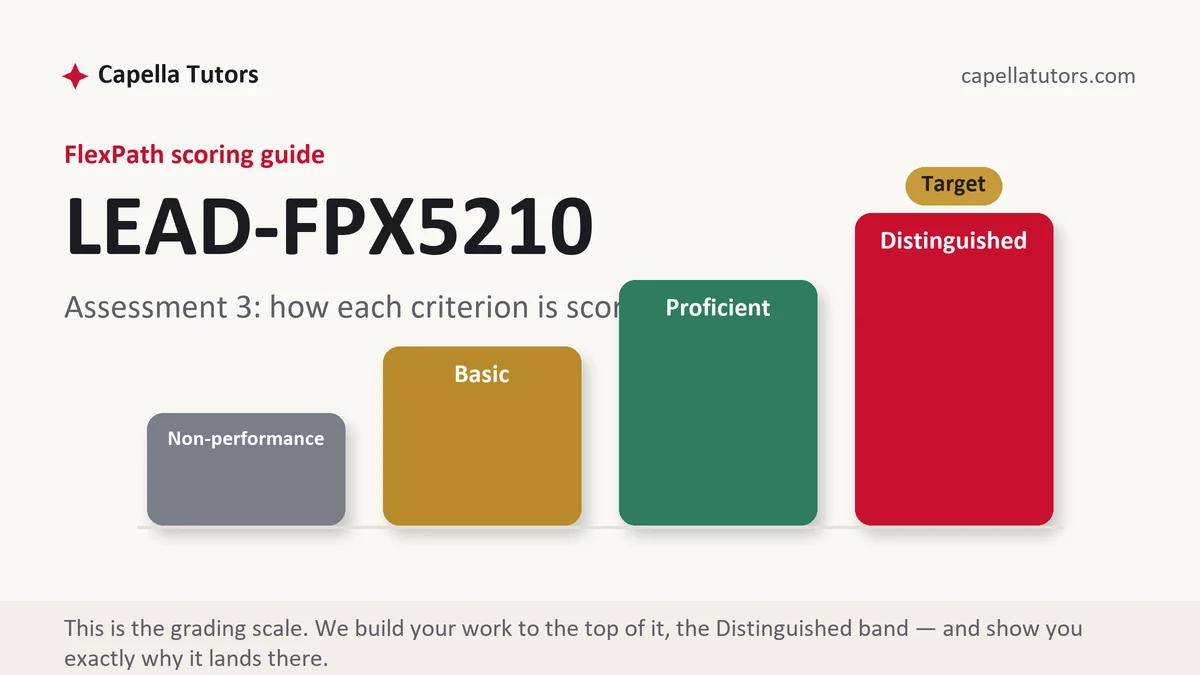
How LEAD-FPX5210 Assessment 3 is scored
Four levels, judged one criterion at a time, and on a cross-border ethical decision they translate like this:
| Level | What it means on a cross-border ethical decision |
|---|---|
| Distinguished | The applicable standards are ranked and the governing one named, the commercial pressure is quantified rather than waved at, and the procedure states what the person does, who they call, what is recorded and what protection the reporter has. The graded position is a procedure, not relativism. |
| Proficient | The conflict is analyzed accurately and the right conclusion reached. The procedure remains general, and a general procedure is not one a manager can follow at a counter. |
| Basic | A tour of ethical theory with cultural sensitivity attached, and no answer to the question the situation actually poses. |
| Non-performance | A required element is missing, most often the escalation route, because a decision with nobody to call is a decision the leader will improvise. |
This is also where the course's discipline about attribution meets legal material. Statutes and enforcement guidance are cited to the instrument itself, since a secondary description of a rule is not authority for what the rule requires.
The LEAD-FPX5210 Assessment 3 method, step by step
-
Rank the standards and name the one that governs
Work outward from the strictest. The Foreign Corrupt Practices Act contains a narrow exception for facilitating payments that secure routine governmental action, while the UK Bribery Act 2010 contains no equivalent exception and reaches organizations with a business presence there, so a payment that survives one regime can be an offense under the other. Company codes are frequently stricter than both. Say which standard governs your decision and why, in two sentences, before anything else.
-
Quantify the pressure so the analysis is honest
Three containers holding $840,000 of analyzers sit at the port, and an official asks for $2,400 in cash to move the paperwork. Fourteen staff are already hired at a loaded $61,000 a month, and the customer contract carries a $9,000 weekly penalty for late commissioning. Writing that out is not an argument for paying; it is what makes the refusal credible, because a paper that pretends the temptation is small has not analyzed the situation it was given.
-
Write what the person does in the first ten minutes
At the counter: decline politely without accusation, ask for the published schedule of official fees and an official receipt for any payment, state that approval sits above your level, and do not pay from petty cash. Then a named role is called inside one hour, and the request is written down while the wording is fresh. A procedure with verbs and a clock is the deliverable; a principle is not.
-
Decide the record before the money question arises
Books and records obligations attach to how a payment is described, so an entry reading expediting fee is a second exposure sitting on top of the first. Set the rule in advance: every demand is logged whether or not anything is paid, the log names the office, the date, the amount requested and the words used, and legal reviews it. Where a payment is genuinely made under threat to someone's safety, that is a different category and it is recorded as exactly what it was.
-
Protect the person who reports and say how
A procedure that exposes the reporter to a manager's displeasure will be used once. Name the non-retaliation commitment, the alternative channel that bypasses the local chain, and who reviews the outcome. Then say what the organization does for the person who refused and consequently missed a deadline, because the answer to that question is what the rest of the site will actually learn from the episode.
-
Give the position a measure, then self-score
The criteria treat leadership as observable, so state what you would watch: demands logged per quarter by port and office, the interval between demand and escalation, and whether shipments through one route consistently take longer than the others. Then mark every criterion against the four levels yourself and submit early in the week, since an attempt can wait two business days for a reader.
A structure that maps to the criteria
Word targets here are the planning ranges our tutors use for a decision procedure of this type, not Capella rules; expand whichever section your guide weights most.
| Section | What it must do | Guide |
|---|---|---|
| The situation | What was asked, by whom, in what setting, with the local practice described neutrally and without characterizing motive. | ~200 words |
| Standards ranked | The statutes, the code and the local rule set side by side, with the governing standard named and the reason given. | ~300 words |
| The pressure quantified | The cost of delay in money and in time, so the strength of the temptation is on the page rather than implied. | ~200 words |
| The procedure | What the person says and does, who is called and when, what is written down, and what is never done. | ~300 words |
| Reporting and protection | The channel that bypasses the local chain, the non-retaliation commitment, and who reviews the outcome. | ~250 words |
| Measures and references | What would be observed to know the position holds, then current APA with statutes and guidance cited to the instrument. | ~250 words |
Annotated sample excerpt
An original model excerpt from our team, published so the moves that earn the top column are visible. Learn the structure and write your own from the situation you were given.
The governing standard here is the company code read together with the UK Bribery Act 2010, which carries no facilitating-payments exception, rather than the narrower exception the Foreign Corrupt Practices Act allows for payments securing routine governmental action, and that choice is made before the commercial position is considered.1 The pressure is real and is stated rather than minimized: $840,000 of equipment held, fourteen staff already on payroll at $61,000 a month, and a $9,000 weekly penalty against a $2,400 request.2 At the counter the site manager declines without accusation, asks for the published fee schedule and an official receipt, states that approval sits above their level, calls the regional counsel within one hour, and logs the office, date, amount and exact words used whether or not anything is ever paid.3
- 1Ranks the instruments and names the governing one first, so the commercial argument arrives inside a decision that has already been framed.
- 2Quantifies the temptation. A refusal written as though the pressure were trivial persuades nobody who has stood at that counter.
- 3Verbs, a clock and a record. This is what a procedure looks like when somebody has to follow it under pressure.
The full premium sample for your exact assessment, written fresh to your scoring guide and issue, is free to request. Study it, revise it into your own voice, and submit work you understand.
The five mistakes that cost Distinguished
- Relativism offered as an answer. Some obligations follow the employee across borders, and local custom does not settle a question a statute settles.
- Statutes cited through a textbook. Legal requirements are cited to the instrument and the enforcement guidance, because a paraphrase is not authority for what the rule says.
- A principle where a procedure was required. Act with integrity gives the manager at the counter nothing to say and nobody to call.
- The record left out. How a payment is described creates its own exposure, and a log kept only when money changes hands captures the wrong half of the pattern.
- No protection for the reporter. A route that leaves the person exposed to the local chain is used once and then quietly abandoned.
Pre-submission checklist
- Applicable standards ranked, the governing one named, and the difference between the regimes stated accurately
- The commercial pressure quantified in money and in time
- A procedure with verbs, a named role and a stated interval for escalation
- A recording rule that applies whether or not a payment is made
- A reporting channel outside the local chain, with a non-retaliation commitment
- Statutes and guidance cited to the instrument, motive characterizations kept out, submitted early in the week
Ethics deliverable due and the standard has to be right?
Send the criteria, the situation and your organization's code if you can share it. Our eight-person pipeline returns a premium original sample inside 24 to 48 hours with the standards ranked, the pressure quantified and the escalation written as something a manager could follow, plus a separate pass confirming every legal source is cited to the instrument.