This manual is for HRM FPX 5402 Assessment 3, start to submission. The later work in Planning, Sourcing, and Developing Talent in Healthcare Organizations moves from buying coverage to building capability, and the deliverable usually asks for a plan that carries someone from hire to independent practice and then into a career structure. The scenario our tutors handle most often is a surgical technologist program: sixteen hires a year, an orientation that depends on preceptors who also have their own assignments, a progression path into first assist and team lead roles, and a claim about retention that has to be measured rather than asserted. The method, the structure and one annotated excerpt follow. Want a draft to work from? A premium original sample returns within 24 to 48 hours, rewritten free until every criterion is satisfied. Capella's catalog lists the course as HRM-FPX5402, and some courserooms print HRM5402; both point to this same Assessment 3.
One honesty note before the manual: Capella revises courses and scoring guides over time, so always write to the exact scoring guide attached to your assessment in the courseroom. The course identity above is verified on capella.edu; the method and structure below are our tutors' approach to it, not Capella's official rubric text.
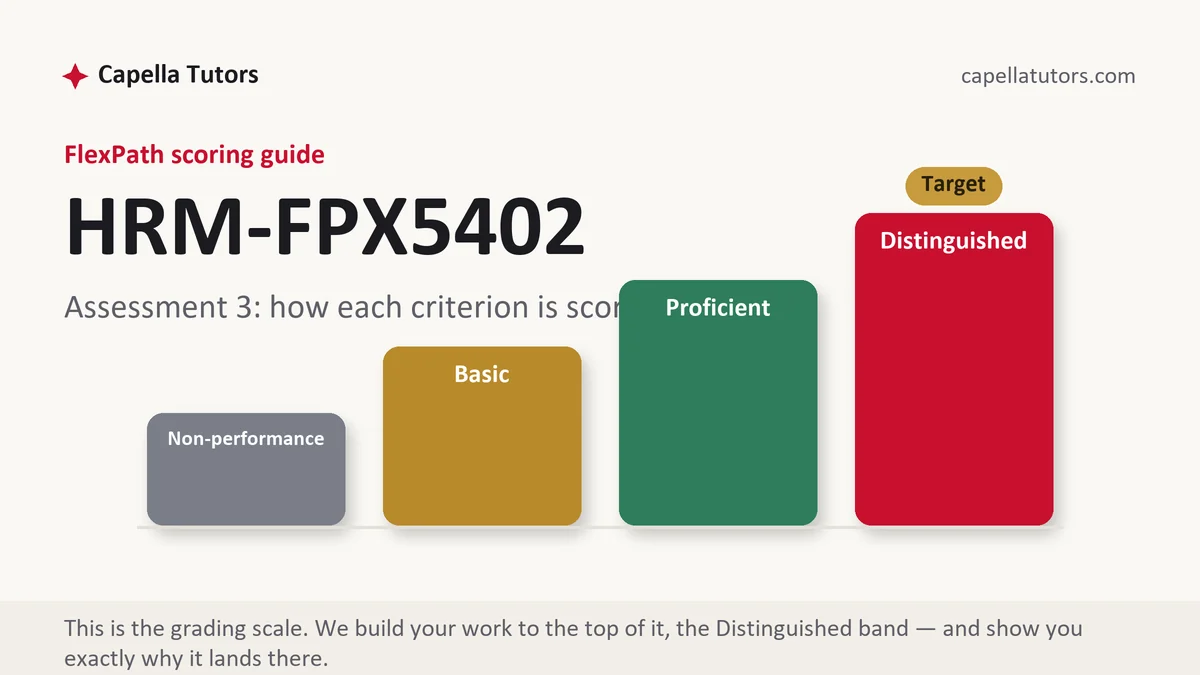
How HRM FPX 5402 Assessment 3 is scored
Four levels per criterion, no letter grade, and the top level description is the brief for the section beneath it:
| Level | What it means on a development and progression deliverable |
|---|---|
| Distinguished | Competency is validated by observation against a written standard, the capacity to deliver the program is costed in coverage hours, the outcome measure has a defined cohort and window, and the plan says what it does not pay for. |
| Proficient | A well built program with a sound curriculum and a stated outcome. Complete work that treats supervision as free. |
| Basic | A training schedule with modules and completion targets, no observed validation, and retention claimed rather than measured. |
| Non-performance | A required element is absent, most often the preceptor capacity constraint or any measurable outcome at all. |
A plan is graded on whether the reader can run it and tell afterwards whether it worked.
The HRM FPX 5402 Assessment 3 method, step by step
-
Write the competency standard before the schedule
Say what the person must be able to do, observed by whom, against what written criteria, at which point. A skills validation at week six and again at week twelve, signed by an assessor who watched it, is evidence. A completed learning module is attendance.
-
Count the capacity that actually delivers the program
Sixteen hires a year each need eight weeks with a preceptor, and a preceptor takes one orientee at a time. Seven staff are prepared to precept and each can realistically run two cycles a year once their own leave and education time is allowed for, which is fourteen cycles against a requirement of sixteen.
-
Cost the supervision that everyone assumes is free
A precepting technologist carries a reduced assignment, and at a 25 percent reduction across eight weeks that is 80 coverage hours per cycle, or 1,120 hours a year across fourteen cycles. Loaded at 44.20 dollars an hour on a 31.80 base, the program consumes 49,504 dollars of coverage capacity before a single dollar of course fees.
-
Build the ladder with criteria and a price
Three steps, each with written entry criteria rather than a manager's recommendation: the base step, a second step at a 1.60 dollar differential requiring certification and eighteen months of validated practice, and a third at 3.20 requiring first assist credentialing and lead responsibilities. If 22 of the 48 technologists reach step two and six reach step three, the annual cost is 73,216 plus 39,936, or 113,152 dollars. First assist credentialing adds 6,800 a person and 240 hours of documented case time.
-
Measure the outcome with a cohort, a window and a comparison
Retention at twelve months among the program cohort was 13 of 16, or 81.3 percent, against 24 of 37, or 64.9 percent, among technologists hired in the same period who did not go through it, a difference of 16.4 points. Then describe the design, because it matters: the comparison group was not randomised, participants self selected, and the program ran in the units with the more stable schedules. Report the figure and the weakness in the same paragraph.
-
Say what the plan does not pay for, then self-score
Each departure costs roughly 14,972 dollars once recruiting, preceptor time and premium coverage of the vacancy are counted, so four fewer departures saves 59,888 against a ladder costing 113,152. The program does not pay for itself on turnover alone. Say so, then make the rest of the case on internal first assist capability that would otherwise be contracted in. Then grade yourself against each criterion and rework whatever falls short.
A structure that maps to the criteria
Planning targets for a graduate development plan, not Capella rules; lengthen the section your guide weights most.
| Section | What it must do | Guide word target |
|---|---|---|
| Purpose and population | The role, the annual intake, the current retention position and the problem the plan exists to solve. | ~200 words |
| Competency standard | What must be demonstrated, to whom, against which written criteria, at which validation points. | ~250 words |
| Delivery capacity | Preceptor numbers, cycles available per preceptor, requirement against capacity and the shortfall. | ~250 words |
| Cost of supervision | Reduced assignment percentage, coverage hours consumed, loaded rate and the annual total. | ~250 words |
| Progression structure | Steps, written entry criteria, differentials, credentialing costs and the case time commitment. | ~300 words |
| Outcome measure and limits | Cohort, window, comparison group, the design weakness, and what the plan does not pay for. | ~250 words |
| References | Current APA, research cited with the design that produced it, internal reports named and dated. | as needed |
Annotated sample excerpt
One model paragraph from our writers, showing how an outcome figure should be reported.
Twelve month retention was 81.3 percent among the sixteen technologists who completed the program and 64.9 percent among the thirty-seven hired in the same period who did not, a difference of 16.4 percentage points.1 Three features of that comparison should be stated before anyone quotes it: participation was voluntary, the program ran first in the two suites with the most predictable case schedules, and the comparison group includes six people who left inside their first eight weeks and therefore had no opportunity to enroll.2 Removing those six narrows the difference to about nine points, which is still worth having and is a considerably more defensible figure to put in front of the operating committee.3
- 1Both proportions carry their numerators and denominators.
- 2Three specific threats to the comparison, each named.
- 3The writer recalculates against her own objection and reports the smaller number.
The full premium sample for your exact assessment, written fresh to your scoring guide and issue, is free to request. Study it, revise it into your own voice, and submit work you understand.
The five mistakes that cost Distinguished
- Completion recorded as competence. A finished module proves attendance, and the criterion is asking for evidence that the person can perform the work under observation.
- Supervision treated as free. Reduced assignments consume coverage hours, and a plan that hides its largest cost will be rejected by the first reader who schedules a suite.
- A ladder with no written entry criteria. Progression decided by recommendation becomes a grievance, and it stops measuring capability the moment it becomes negotiable.
- Retention claimed with no cohort or window. Without a defined group and a defined period the figure cannot be reproduced, so it cannot be defended either.
- A benefit case that quietly overstates itself. If the arithmetic says the program does not pay for itself on turnover, saying so and arguing the rest is stronger than a number nobody believes.
Pre-submission checklist
- Competency standard written, with observers and validation points named
- Preceptor capacity counted in cycles, and any shortfall stated as a figure
- Supervision costed in coverage hours at a loaded rate
- Ladder steps carrying written entry criteria, differentials and credentialing costs
- Outcome measure with cohort, window, comparison group and named confounders
- An honest statement of what the plan does not pay for, current APA verified both ways
Development plan due?
Send the criteria, the role, the annual intake and whatever retention or preceptor data you can share. Eight people work the file and the premium original sample returns in 24 to 48 hours with the supervision costed and the outcome measure specified.