This manual is for HRM FPX 5402 Assessment 1, start to submission. The opening deliverable in Planning, Sourcing, and Developing Talent in Healthcare Organizations usually asks you to size a workforce requirement rather than to solve it, which means the paper lives or dies on whether the demand figure was built or assumed. The scenario our tutors work most often is an acquisition: a health system takes over a three room ambulatory surgery center and has 90 days to know how much perioperative staffing it is actually buying, how much of the existing team will transfer, and what the gap is in hours before it is anything in headcount. What follows is the method, the structure and one model excerpt. Rather hand the whole thing over? A premium original sample is built for you inside 24 to 48 hours, reworked free until each criterion clears. Capella's catalog lists the course as HRM-FPX5402, and some courserooms print HRM5402; both point to this same Assessment 1.
One honesty note before the manual: Capella revises courses and scoring guides over time, so always write to the exact scoring guide attached to your assessment in the courseroom. The course identity above is verified on capella.edu; the method and structure below are our tutors' approach to it, not Capella's official rubric text.
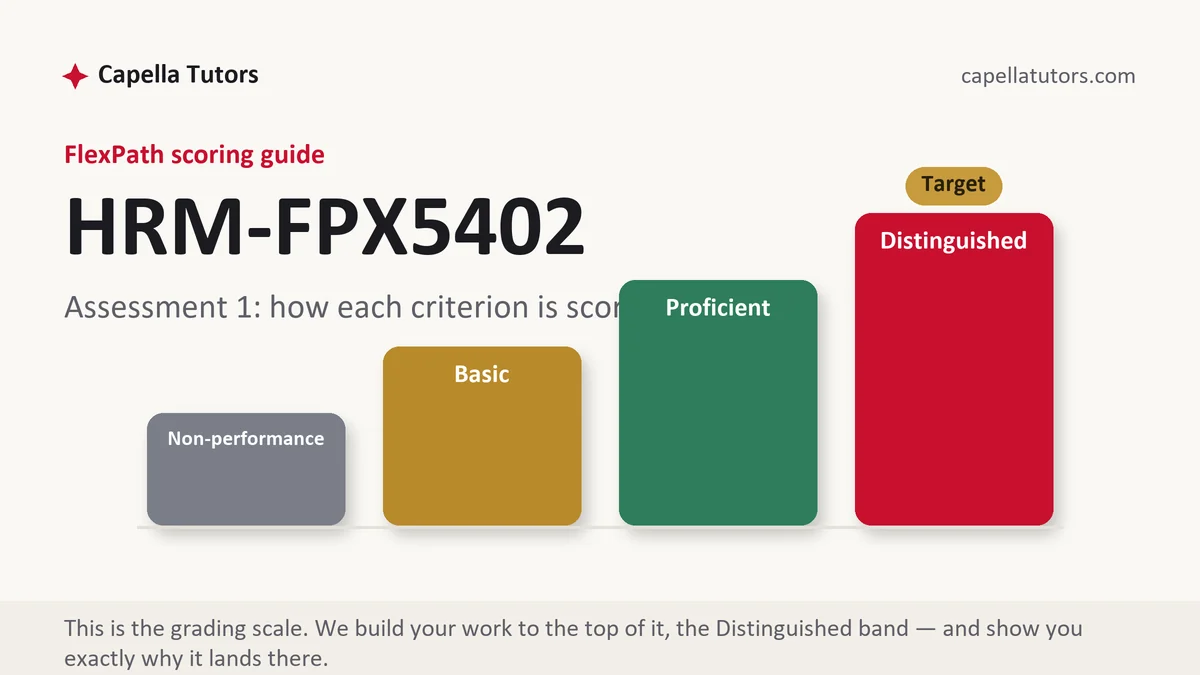
How HRM FPX 5402 Assessment 1 is scored
No letter grades here. Each criterion resolves to one of four levels, and the top level sentence is the specification for the section under it:
| Level | What it means on a demand and gap analysis |
|---|---|
| Distinguished | Demand is derived in coverage hours from the operating schedule, productive hours per position are stated and justified, every rate names its denominator, and the gap is expressed on the horizon the supply actually has. |
| Proficient | The requirement is calculated correctly and the gap is identified. Sound arithmetic with the assumptions left implicit. |
| Basic | Positions counted, vacancies listed, and a conclusion that the department needs more people. No hours, no horizon. |
| Non-performance | A required element is absent, most often the benefit and education time that has to be covered, or the supply side of the analysis entirely. |
Assess is not describe. Where the guide says assess a workforce situation, the reader expects a judgment supported by a figure.
The HRM FPX 5402 Assessment 1 method, step by step
-
Fix the unit of analysis and the horizon in paragraph one
Name the service, the roles in scope, the period and the reason the plan exists. A perioperative requirement for a three room center acquired on a fixed closing date is a different problem from a general recruitment plan, and stating that difference is the first analytical move the reader sees.
-
Derive demand from the schedule, not from the org chart
Three rooms running ten hours a day, five days a week across 51 operating weeks is 7,650 room hours a year. With one circulating nurse and one surgical technologist scheduled to each running room, that is 15,300 in room staffed hours, and pre-operative and recovery coverage of twelve hours a day across two positions adds 6,120, giving 21,420 staffed hours.
-
Convert with a productive hours figure you can defend
A full time position is 2,080 paid hours, but paid is not productive. Subtract 200 hours of paid time off and 40 hours of mandatory education and the working figure is 1,840. Dividing 21,420 by 1,840 gives 11.64 positions, and a 4.5 percent allowance for unplanned absence measured from the center's own timekeeping brings it to 12.2. Print the subtraction.
-
Establish supply from who is actually coming
The incumbent team is 10.1 positions, and 2.4 positions worth of staff have already declined to transfer on the terms offered, so 7.7 arrive on day one against a requirement of 12.2. The gap is 4.5 positions, or roughly 8,280 coverage hours a year.
-
Define every rate before you quote one
A vacancy rate calculated on budgeted positions and one calculated on filled positions answer different questions and can differ by several points from identical data, so name the denominator each time. The same discipline applies to turnover, which needs a defined population and a defined window before it means anything, and to any figure you lift from a system report whose definition you have not read.
-
Set the horizon by the slowest pipeline, then self-score
Experienced surgical technologists can be recruited in a market measured in months, while replacing that capability through new program graduates runs to two years, and any advanced practice element adds a credentialing period measured in months rather than weeks. State a separate horizon for each source of supply instead of giving the plan one end date. Then grade yourself criterion by criterion and redraft whatever sits short of the top.
A structure that maps to the criteria
Planning targets for a graduate workforce analysis, not Capella rules; grow the section your guide weights hardest.
| Section | What it must do | Guide word target |
|---|---|---|
| Scope and horizon | The service, the roles, the period, the reason the analysis exists and the decision it feeds. | ~200 words |
| Demand in coverage hours | Operating schedule, staffed hours by area, and the arithmetic that produces the annual total. | ~300 words |
| Conversion to positions | Paid hours, deductions for benefit and education time, unplanned absence allowance and the resulting figure. | ~250 words |
| Supply and transfer | Who is arriving, who has declined, expected departures and the local pipeline for each role. | ~300 words |
| The gap | Stated in hours and in positions, by role, with the timing of when each part of it bites. | ~200 words |
| Measures and assumptions | Every rate with its denominator, the source report for each input, and what would move the answer. | ~250 words |
| References | Current APA, public datasets cited with their collection year, internal reports named and dated. | as needed |
Annotated sample excerpt
A model paragraph of ours, written where a staffing conversion has to be pitched.
The requirement is 21,420 staffed hours a year, and converting that to positions is where most staffing plans quietly lose a person and a half.1 A full time position is paid for 2,080 hours but works fewer: subtracting 200 hours of paid time off and 40 of mandatory education leaves 1,840 productive hours, so the requirement is 11.64 positions before absence, and 12.2 once the center's own timekeeping figure of 4.5 percent unplanned absence is applied.2 The paid time off assumption is the soft input here, since it reflects the acquiring system's schedule rather than the center's current one, and a move to 240 hours would push the requirement to 12.5 and add roughly 34,000 dollars of annual cost at loaded perioperative rates.3
- 1The sentence names the specific place the error usually occurs.
- 2Each deduction is itemized and the absence factor is sourced to a named internal record.
- 3One assumption is isolated, flexed, and its effect is priced.
The full premium sample for your exact assessment, written fresh to your scoring guide and issue, is free to request. Study it, revise it into your own voice, and submit work you understand.
The five mistakes that cost Distinguished
- Demand taken from the position control report. That report says what was budgeted, not what the schedule requires, and the two diverge the moment a service changes hours.
- Paid hours used as productive hours. Dividing by 2,080 understates the requirement by around ten percent.
- A rate quoted without its denominator. Budgeted and filled positions produce different vacancy rates from the same data, and the reader cannot tell which one you used.
- Supply assumed to equal the incumbent headcount. In an acquisition the relevant number is who accepts the offer, and that is knowable before closing if anyone asks.
- One horizon for every source of supply. Experienced hires, program graduates and credentialed practitioners arrive on completely different timescales, and a single end date hides all three.
Pre-submission checklist
- Service, roles, period and purpose all stated in the opening section
- Demand built in coverage hours from the operating schedule, with the arithmetic shown
- Productive hours derived by explicit subtraction, absence allowance sourced internally
- Supply based on who is transferring, with expected departures and local pipeline included
- Gap stated in hours and positions by role, with the timing of each part
- Every rate carrying its denominator and every input its source, current APA verified both ways
Workforce analysis due?
Send the criteria, the service line, the operating schedule and the vacancy position. Eight people work the file and the premium original sample returns in 24 to 48 hours with the coverage arithmetic built and every rate carrying its denominator.