This manual is for HRM FPX 5402 Assessment 2, start to submission. Once a requirement has been sized, the next deliverable in Planning, Sourcing, and Developing Talent in Healthcare Organizations usually asks how the organization should buy the coverage, and that is an economics question rather than a recruitment one. The scenario our tutors handle most often is respiratory therapy across a two hospital system: fourteen positions short, a department that has to be covered tonight, and four purchasable options whose true cost per coverage hour nobody in the meeting has calculated. Method, criterion map and a worked excerpt are set out below. Prefer to outsource the draft? A premium original sample is delivered in 24 to 48 hours and revised at no charge until the criteria clear. Capella's catalog lists the course as HRM-FPX5402, and some courserooms print HRM5402; both point to this same Assessment 2.
One honesty note before the manual: Capella revises courses and scoring guides over time, so always write to the exact scoring guide attached to your assessment in the courseroom. The course identity above is verified on capella.edu; the method and structure below are our tutors' approach to it, not Capella's official rubric text.
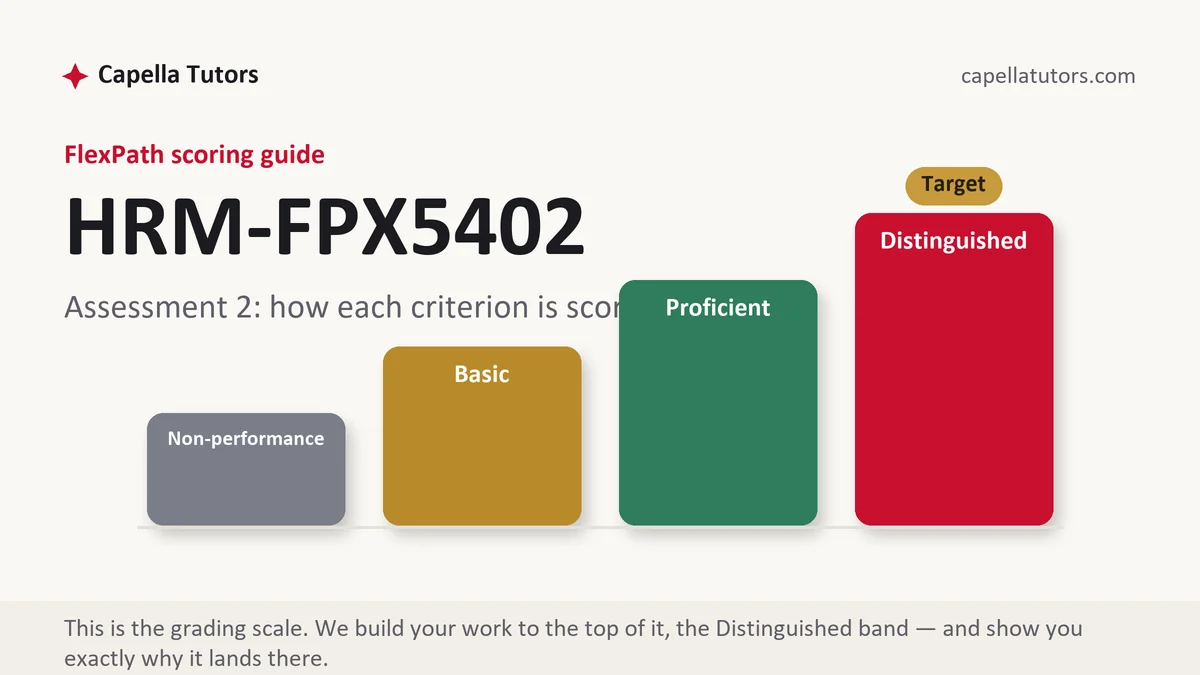
How HRM FPX 5402 Assessment 2 is scored
Four levels, applied criterion by criterion, and the top level wording tells you the extra move each section needs:
| Level | What it means on a sourcing economics deliverable |
|---|---|
| Distinguished | Every option is priced to a common unit, the blend is compared at its break even point, the writer attacks the assumptions in the model, and the second order effects on the existing team are identified and quantified. |
| Proficient | Options compared with credible costs and a recommendation made. Good work in which nothing tests the model. |
| Basic | Agency use described as waste, permanent hiring recommended, and no arithmetic that would let a reader check either claim. |
| Non-performance | A required element is missing, most often the loaded cost of an employed position or the equity consequence of the recommended blend. |
Evaluate carries a comparison and a verdict. Two options placed beside each other with their merits noted is a description.
The HRM FPX 5402 Assessment 2 method, step by step
-
Express the gap in hours before you price anything
Fourteen vacant respiratory therapy positions across two hospitals translate into 28 twelve hour shifts a week that have to be covered, which is 336 hours a week and 17,472 hours a year.
-
Load every rate to the same basis
A quoted rate and a cost are different objects. Travel labor bills at 104 dollars an hour, all in. An employed therapist at a 38.50 base with benefits and employer taxes at 39 percent costs 53.52. A per diem therapist at 52 dollars with taxes only at 9.2 percent costs 56.78. An incentive shift paid at time and a half on the same base is 57.75 before taxes and 63.06 after.
-
Build the blend and give it one comparable number
Covering the whole gap with travel labor costs 1,817,088 dollars a year. Eight permanent hires at 1,872 productive hours each cover 14,976 hours for 801,516; of the remaining 2,496 hours, 1,400 bought per diem costs 79,492 and 1,096 bought as incentive shifts costs 69,114. The blend totals 950,122 and saves 866,966. Then reduce it to the number the finance director will actually quote back at you: 54.38 dollars per coverage hour, against 104.00 for the unmixed alternative.
-
Attack your own model in writing
The blend assumes eight permanent therapists can be recruited from a market that has not filled fourteen positions in a year, and it assumes 1,096 incentive hours will be picked up by a department that is already fourteen people short. Both assumptions are the ones a director will challenge first, so challenge them yourself and show the answer if only five hires land, which moves the blended cost to roughly 62 dollars a coverage hour.
-
Find the break even the recommendation rests on
Recruiting a permanent therapist costs about 11,400 dollars. Each hour that person works instead of a traveller saves 50.48, so the recruitment cost is recovered after 226 hours, which is nineteen twelve hour shifts. That single sentence converts a hiring request into an investment with a payback period.
-
Price the second order effects, then self-score
A per diem therapist at 56.78 an hour standing beside a staff therapist at 53.52 loaded is a compression problem the coverage decision created, and the same is true of a traveller earning several times the differential of the person orienting them. Say what the blend does to the pay relationships inside the department, and whether the incentive shifts are quietly raising the effective hourly cost of the existing team. Then self-score every criterion before you submit.
A structure that maps to the criteria
Drafting targets for a graduate sourcing analysis, not Capella rules; expand what your guide weights heaviest.
| Section | What it must do | Guide word target |
|---|---|---|
| The gap in hours | Vacancies converted to shifts and annual coverage hours, with the schedule that produces them. | ~200 words |
| Options and their true cost | Each sourcing option loaded to a common basis, with the load factors named and sourced. | ~300 words |
| The blend | Hours allocated to each option, the total, and the cost per coverage hour against the unmixed case. | ~300 words |
| Assumption testing | The two or three inputs the recommendation depends on, flexed, with the revised answer shown. | ~250 words |
| Break even and payback | Recruitment cost, hourly saving, hours to recovery, and what changes the payback. | ~200 words |
| Equity and governance | Compression effects, the measure that would detect them, the owner and the review cadence. | ~250 words |
| References | Current APA, wage data cited with its collection year, vendor rates labeled as vendor data. | as needed |
Annotated sample excerpt
An original paragraph from our team, showing how a sensitivity test is written up.
The blended model costs 54.38 dollars per coverage hour against 104.00 for buying the whole gap from a travel agency, and the case for it collapses on one assumption rather than on the arithmetic.1 Eight permanent hires have to land, in a market where the department filled four positions in the last twelve months, and if only five arrive the remaining 5,616 hours revert to premium sources and the blended figure moves to roughly 62 dollars an hour.2 Even at that level the recommendation holds, which is worth saying plainly: the decision does not depend on optimistic recruiting, it depends on recruiting at all, and the sensitivity above is the evidence for that claim rather than a hedge against it.3
- 1One comparable unit, stated twice.
- 2The weak assumption is named against the department's own recruiting history and then flexed to a specific alternative answer.
- 3The sensitivity is used to strengthen the recommendation rather than to soften it.
The full premium sample for your exact assessment, written fresh to your scoring guide and issue, is free to request. Study it, revise it into your own voice, and submit work you understand.
The five mistakes that cost Distinguished
- Base pay compared with an agency bill rate. One carries benefits and taxes and the other does not, so the comparison exaggerates the saving.
- Premium labor written up as failure. It is coverage the organization chose to purchase at a price, and the analysis the criterion wants is the break even, not the indignation.
- A blend with no sensitivity. Every staffing model rests on hires that have not happened yet.
- Compression ignored. A per diem rate above the loaded cost of a staff position creates a retention problem inside the same department the plan is trying to fill.
- Incentive hours counted as free capacity. They come from people who are already covering a short department, and the plan should say what happens when they stop volunteering.
Pre-submission checklist
- The gap expressed in annual coverage hours before any option is priced
- All four options loaded to a common basis with the load factors named
- A blended cost per coverage hour quoted against the unmixed alternative
- At least two assumptions flexed, with the revised figure shown for each
- Recruitment cost converted to a payback in hours or shifts
- Compression and volunteer dependence addressed, current APA verified both ways
Sourcing deliverable due?
Send the criteria, the vacancy count, the shift pattern and any rate information you can share. Eight people work the file and the premium original sample returns in 24 to 48 hours with every option loaded to a common basis and the break even shown.