This manual is for HRM FPX 5080 Assessment 3, start to submission. The closing deliverable turns appraisal into a decision, so the assessment usually asks you to combine research findings, organizational data, practitioner judgment and stakeholder concerns into a single recommendation carrying a value, a condition and a review date. The case worked below is a vendor proposal to place an automated resume screening tool in front of hourly hiring at a national hospitality group. Prefer to delegate the whole thing? Send the guide and one premium original sample comes back inside 24 to 48 hours, revised at no charge until the criteria are cleared. Capella's catalog lists the course as HRM-FPX5080, and some courserooms print HRM5080; both point to this same Assessment 3.
One honesty note before the manual: Capella revises courses and scoring guides over time, so always write to the exact scoring guide attached to your assessment in the courseroom. The course identity above is verified on capella.edu; the method and structure below are our tutors' approach to it, not Capella's official rubric text.
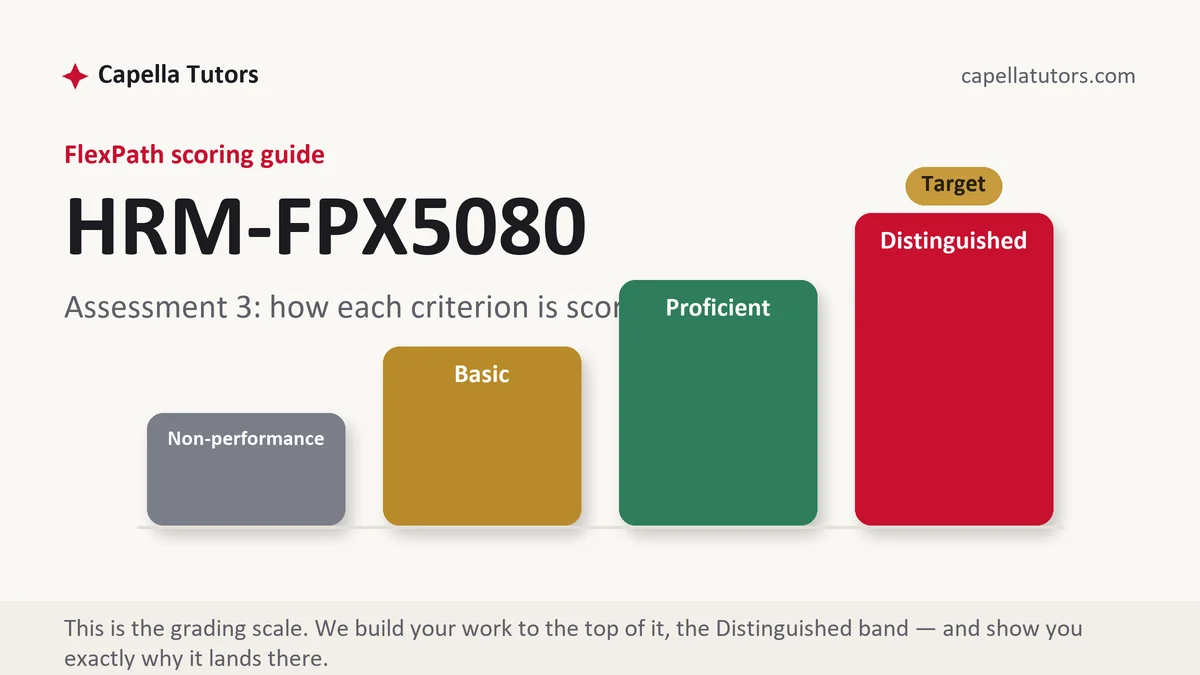
How HRM FPX 5080 Assessment 3 is scored
Each criterion returns at one of four levels, marked independently, and the descriptor wording is the specification for the section beneath it:
| Level | What it means on a recommendation |
|---|---|
| Distinguished | All four evidence sources present with the writer saying which one is carrying the weight, a value expressed as a range rather than a point, the legal exposure quantified, and a review measure fixed before implementation. |
| Proficient | A sound recommendation drawn correctly from the evidence assembled. It arrives as a single number and without a stated condition. |
| Basic | A conclusion that follows the vendor's framing, with the research used to decorate a decision already made elsewhere. |
| Non-performance | No plan to check the decision afterwards, which leaves the assessment criterion unanswered and the recommendation untested advice. |
A good decision and a good outcome are different things, and this deliverable is graded on the first. A process that gathered what was available, weighed it honestly and chose under acknowledged uncertainty is defensible even when the result disappoints.
The HRM FPX 5080 Assessment 3 method, step by step
-
Write the recommendation as one sentence, then earn it
Adopt, decline, or adopt subject to named conditions, with the decider and the date attached. Everything above that sentence is the argument for it, and any paragraph that does not move the reader toward it belongs in an appendix or nowhere.
-
Test the vendor claim against a base rate
A tool advertised as cutting screening time by 78 percent is describing a relative change, and relative changes are unreadable until the base appears. Ask what the current figure is, in what units, measured across how many requisitions, and whether the comparison group was the same organization.
-
Run the impact ratio before you run the business case
Across 1,480 pilot applicants, 214 of 890 in the higher-passing group advanced, or 24.0 percent, against 101 of 590 in the comparison group, or 17.1 percent, giving a ratio of 0.71. That sits below the four-fifths benchmark in the Uniform Guidelines on Employee Selection Procedures at 29 C.F.R. Part 1607 and puts the tool inside the disparate impact framework of Title VII of the Civil Rights Act of 1964 at 42 U.S.C. section 2000e-2(k).
-
Price the saving you can actually count
Recruiter review falls from about nine minutes to two per application across 14,800 applications a year, which is 1,727 hours at a 36 dollar loaded rate, or 62,172 dollars. Licensing is 84,000 dollars, so the labor saving alone leaves the organization 21,828 dollars short and the case has to be carried by hiring quality, which is the part nobody has measured.
-
Give the value a range and name your softest input
Quote a band rather than a point, and say which assumption moves it most. Where the benefit depends on a validity estimate supplied by the vendor and never replicated on your own workforce, that estimate is the softest input in the model and the reader should hear it from you rather than find it later.
-
Fix the review measure and date before implementation, then self-score
Evidence-based practice ends with assessment, so name the metric, the denominator, the interval and the person who reports it, and commit to a quarterly impact ratio recomputation with a stated action if it drops again. Then mark each criterion D, P, B or N yourself and rework anything below D.
A structure that maps to the criteria
The word targets here are our tutors' planning shape for a recommendation deliverable rather than Capella rules, so shift them wherever your guide places its own weight.
| Section | What it must do | Guide word target |
|---|---|---|
| The decision | The recommendation in one sentence, the decider, the date, and what happens if nothing is decided. | ~150 words |
| The four sources | Research, internal data, practitioner judgment and stakeholder concerns, with the one carrying the weight identified. | ~275 words |
| The vendor claim tested | The advertised effect converted to absolute terms, the comparison group examined, and the funding of any cited study disclosed. | ~225 words |
| Legal exposure quantified | Selection rates by group, the impact ratio, the authority it is measured against, and any local audit obligation. | ~250 words |
| Cost, benefit and range | Countable savings, licensing and implementation, the benefit as a band, and the softest input named. | ~275 words |
| Review plan and references | The measure, denominator, interval, owner and trigger action, plus current APA matched both ways. | ~200 words |
Annotated sample excerpt
Below is original work from our team showing how the legal exposure section should read when the arithmetic is unfavorable. Study the sequence, then run your own numbers.
Selection rates were computed from the pilot's own applicant file rather than from the vendor's summary, giving 214 advancements from 890 applicants in the highest-passing group, or 24.0 percent, and 101 from 590 in the lowest, or 17.1 percent, an impact ratio of 0.71.1 A ratio below 0.80 does not by itself establish unlawful discrimination, and it does shift the practical burden onto the employer to show the screen is job related and consistent with business necessity, which the vendor's validity documentation does not currently do for these roles in this workforce.2 Two of the group's markets also fall under local ordinances requiring an independent bias audit of automated employment decision tools before use, so the compliance work is a precondition of the pilot rather than a follow-up to it, and the 84,000 dollar license buys nothing until that audit exists.3
- 1Recomputes from the raw applicant file and shows both rates, so the ratio is verifiable rather than asserted.
- 2States the legal consequence accurately without overclaiming. Precision about what a threshold does and does not prove is a graduate expectation.
- 3Converts a compliance obligation into a sequencing point with a dollar figure attached, which is how a director makes finance care about it.
The full premium sample for your exact assessment, written fresh to your scoring guide and issue, is free to request. Study it, revise it into your own voice, and submit work you understand.
The five mistakes that cost Distinguished
- Relative improvement quoted with no base rate. A 78 percent reduction means nothing until the reader learns 78 percent of what, measured how.
- Vendor material used as proof of effect. A case study evidences that an implementation happened, and the client who failed never appears in the brochure.
- Selection rates never computed. A screening recommendation with no impact ratio in it has skipped the one calculation that carries legal consequence.
- A single point estimate of value. Every utility figure rests on a soft input, and a band with the assumption named survives questioning where a point does not.
- No review plan. A recommendation nobody will revisit is advice, and the criteria for this deliverable end on assessment for exactly that reason.
Pre-submission checklist
- Each criterion on the guide has its own labeled section
- The recommendation appears as one sentence with a decider and a date
- All four evidence sources present, with the load-bearing one identified
- Selection rates and the impact ratio computed from raw counts, with the authority named
- Benefit expressed as a range, with the softest input stated in the same paragraph
- A review measure, interval and owner fixed before implementation, current APA matched, every criterion self-scored D
Want this assessment done with backup?
Send the scoring guide, the decision on the table and any vendor material you have been given. A team of eight, including a research analyst and two QA reviewers, returns a premium original sample written to the Distinguished column in 24 to 48 hours, with revisions until it gets there. Every statistic carries its assumption, and the recommendation arrives with conditions attached.