This manual is for HRM FPX 5080 Assessment 1, start to submission. The opening deliverable in an evidence course is about the question and the reading, so the assessment usually asks you to frame a practice question a study could actually answer, run and document a search somebody else could rerun, and appraise what you find by what each design is capable of ruling out. The case worked below asks whether structured interviews outperform unstructured panels for project coordinator hiring at an engineering services firm. Happier handing it over? A premium original sample written against your own guide lands in 24 to 48 hours, with revision included until nothing sits below the top column. Capella's catalog lists the course as HRM-FPX5080, and some courserooms print HRM5080; both point to this same Assessment 1.
One honesty note before the manual: Capella revises courses and scoring guides over time, so always write to the exact scoring guide attached to your assessment in the courseroom. The course identity above is verified on capella.edu; the method and structure below are our tutors' approach to it, not Capella's official rubric text.
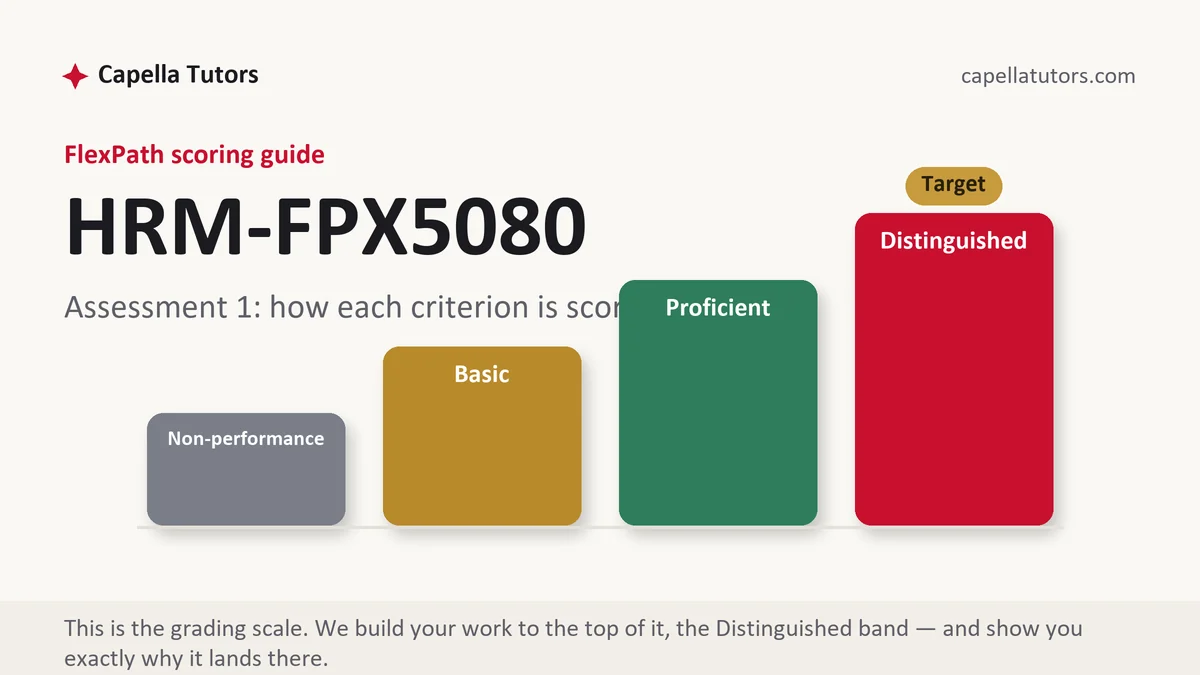
How HRM FPX 5080 Assessment 1 is scored
Criteria are marked one at a time at one of four levels, and the level wording is what you should have been drafting toward:
| Level | What it means on an evidence appraisal |
|---|---|
| Distinguished | A question containing a comparison, a search another person could reproduce from the page, studies weighed by design rather than by prestige, and an explicit statement of what the evidence still cannot decide. |
| Proficient | Relevant literature located and accurately reported, with the question well posed. The studies are described rather than ranked against each other. |
| Basic | Ten studies summarized in sequence with no comparison between them. A reading list wearing the clothes of a review. |
| Non-performance | No search method appears at all, which leaves the reader unable to tell whether the evidence was gathered or collected until it agreed. |
Appraisal is where most of the available marks sit, and the ranking has nothing to do with journal reputation. A design earns weight by how many rival explanations it can eliminate, which is why a modest randomized comparison can outrank a large survey.
The HRM FPX 5080 Assessment 1 method, step by step
-
Build the question in four parts
Population, the thing being changed, what it is being compared against, and the outcome you will measure. Do structured interviews work is unanswerable. Whether behaviorally anchored structured interviews produce higher twelve month supervisor ratings than unstructured panel interviews for project coordinator hires has a literature, a comparison and a measure inside it.
-
Record the search while you are running it, not afterwards
Name the databases, the exact Boolean strings, the date limits, the inclusion and exclusion rules, and the number of records surviving each stage. Business Source Complete, PsycINFO and ABI/INFORM Global cover this ground. A search you cannot reproduce is an opinion about the literature dressed as a review of it.
-
Read the methods before you read the findings
The abstract's conclusion is the author's marketing. Go to the design, the sample size, the setting and the outcome measure first, and only then decide whether the finding is worth carrying. Record all four for every study before any of them enters your argument.
-
Weigh each study by what its design rules out
A randomized comparison can eliminate selection differences between groups. A longitudinal design can establish sequence, which is necessary for a causal claim and not sufficient for one. A cross-sectional survey establishes only that two things co-occurred in one sample on one day, and where the same respondent supplied both variables the relationship is partly a property of the respondent.
-
Aggregate rather than list, and say where the evidence disagrees
Meta-analyses and systematic reviews sit above single studies because they combine rather than select, so lead with them and use individual studies to show boundary conditions. Where two well designed studies point different ways, the difference is usually the setting or the outcome measure, and identifying which is the analysis the criterion is paying for.
-
Name what the evidence cannot settle, then self-score
Every honest appraisal ends with a limit. Most interview research measures supervisor ratings rather than output, and ratings carry their own halo, so the finding supports a claim about assessed performance and not automatically about productivity. Write that sentence, then mark each criterion D, P, B or N and rework anything below D.
A structure that maps to the criteria
The targets below are how our tutors plan an appraisal deliverable, not Capella requirements, so shift the weight wherever your own guide scores a section separately.
| Section | What it must do | Guide word target |
|---|---|---|
| The decision and the question | The practice decision waiting on this evidence, then the question in four parts, in one sentence. | ~175 words |
| Search protocol | Databases, strings, limits, inclusion rules and counts at each stage, written so a stranger could rerun it. | ~225 words |
| Evidence table | Each study with its design, sample, setting, measure and effect, recorded before any of it is used. | ~250 words |
| Appraisal | Studies ranked by what their designs eliminate, with the weakest labeled weak rather than quietly promoted. | ~300 words |
| Synthesis | What the body of evidence jointly supports, where it disagrees, and the likely reason for the disagreement. | ~250 words |
| Limits and references | What the evidence cannot decide, what that means for the decision, and current APA matched both ways. | ~200 words |
Annotated sample excerpt
What follows is original work from our team, written to demonstrate the appraisal register rather than to be borrowed. Read for method, then apply it to your own set.
The two strongest studies in the set point in different directions, and the difference is in the outcome rather than in the intervention. The first randomized 312 applicants across nine offices to structured or unstructured formats and compared supervisor ratings at twelve months, a design that eliminates selection differences between the groups and therefore supports a causal reading.1 The second is a cross-sectional survey of 1,940 hiring managers reporting their own satisfaction with each format, where the same respondent supplied both the format used and the judgment of how well it worked, so the association it reports cannot be separated from the respondent's preference.2 Weighted by what each design rules out, the randomized comparison carries the conclusion and the survey is retained only as evidence about manager attitudes, which is a genuine finding about adoption risk and not a finding about hiring quality.3
- 1Design, sample, setting and outcome in a single sentence, followed by the one thing the design earns: a causal reading.
- 2Names common-source bias without the jargon. Explaining the mechanism is more persuasive than labeling the flaw.
- 3Demotes the weaker study rather than discarding it, and repurposes it for the claim it can support. This is the move the top column describes.
The full premium sample for your exact assessment, written fresh to your scoring guide and issue, is free to request. Study it, revise it into your own voice, and submit work you understand.
The five mistakes that cost Distinguished
- A question with no comparison in it. Without an alternative to measure against, no study can answer you, and the evidence section drifts into general reading.
- A search nobody could repeat. Terms, limits and counts belong on the page, because a review is a method before it is a summary.
- Studies ranked by journal name. Prestige is not a design, and a well conducted small trial outranks a large survey for a causal claim.
- Significance mistaken for size. A correlation near 0.10 across several thousand people clears the conventional threshold and accounts for about one percent of the variance.
- An appraisal with no limits section. Evidence that settles everything has usually been selected rather than searched.
Pre-submission checklist
- Every criterion on the guide is answered under its own heading
- The question names a population, a change, a comparison and a measurable outcome
- Databases, search strings, limits and record counts are all on the page
- Each study carries its design, sample, setting, measure and effect size
- Studies weighed against each other by design, with disagreements explained
- A stated limit on what the evidence can decide, current APA matched, every criterion self-scored D
Want this assessment done with backup?
Send the scoring guide and the decision your organization is trying to make. A team of eight, including a research analyst and two QA reviewers, returns a premium original sample written to the Distinguished column in 24 to 48 hours, with revisions until it gets there. The search is documented so you can rerun it yourself, and every effect size is checked twice.