This manual is for HRM FPX 5075 Assessment 1, start to submission. The opening deliverable in an influence course establishes the situation rather than the solution, so the assessment usually asks you to identify a specific decision you do not own, analyze who controls it and what each party stands to lose, and locate the base of power actually available to a staff function. The worked case below is a proposal to replace an annual rating cycle with quarterly documented check-ins at a specialty insurance firm. Would you rather delegate it? One original premium draft, aimed at the top descriptor, returns in 24 to 48 hours with unlimited free revision after that. Capella's catalog lists the course as HRM-FPX5075, and some courserooms print HRM5075; both point to this same Assessment 1.
One honesty note before the manual: Capella revises courses and scoring guides over time, so always write to the exact scoring guide attached to your assessment in the courseroom. The course identity above is verified on capella.edu; the method and structure below are our tutors' approach to it, not Capella's official rubric text.
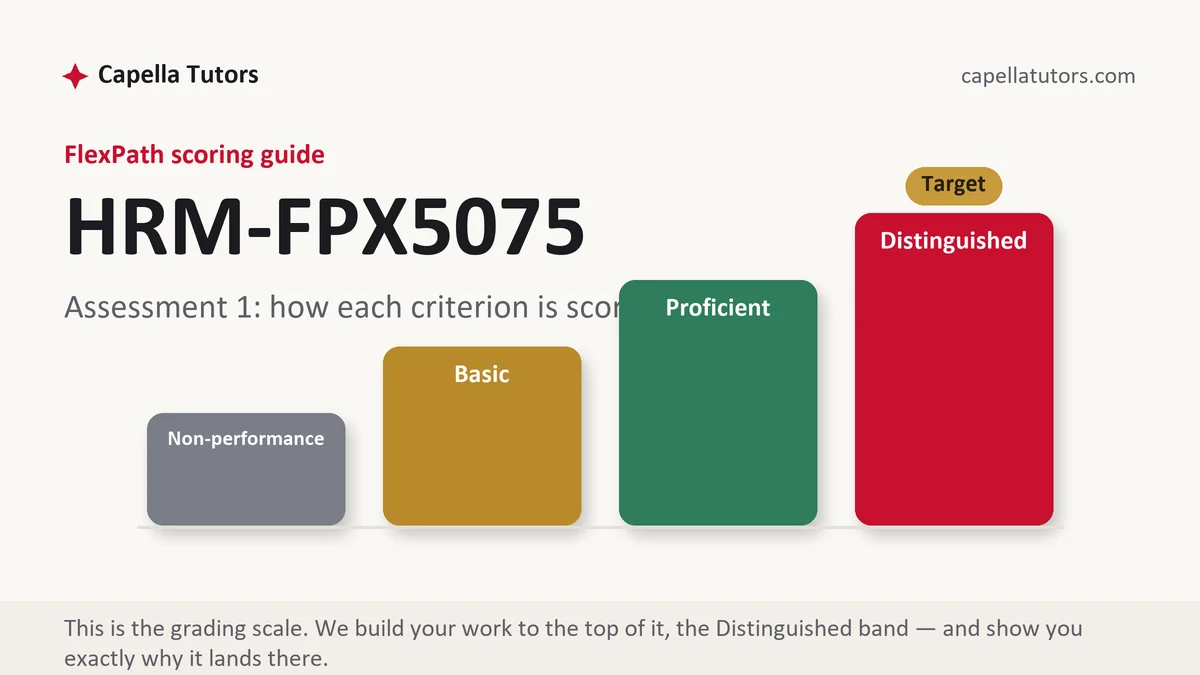
How HRM FPX 5075 Assessment 1 is scored
Nothing here is averaged. Each criterion returns at one of four levels, and the descriptors are the specification you should have drafted against:
| Level | What it means on an influence analysis |
|---|---|
| Distinguished | A named decision with a named approver, every party's control and exposure stated, the writer's own power base identified honestly, and the party who can kill the idea by doing nothing brought into the open. |
| Proficient | The situation is analyzed completely and the stakeholders are all present. What is missing is the reckoning with what you personally can and cannot compel. |
| Basic | A tour of leadership styles with an organizational problem attached. Nobody in it has to sign anything, and no criterion is fully satisfied. |
| Non-performance | No specific decision is ever identified, which leaves the analysis criteria with nothing to attach to and floors them. |
The reason the criteria insist on a decider is that influence is only observable through a decision. Culture change and stronger partnership cannot be graded because nobody could tell you afterwards whether they happened.
The HRM FPX 5075 Assessment 1 method, step by step
-
Write the decision on one line before anything else
Who has to say yes, to what, by when. The chief operating officer must approve retiring the annual rating cycle in favor of four documented quarterly conversations, in time for the compensation calendar to be rebuilt by November. If your line contains the words culture or alignment, it is not yet a decision.
-
Find out what the approver is measured on
Executives evaluate proposals against the number their own performance is judged by, so an operating officer graded on combined ratio and headcount productivity is not going to be moved by an argument about employee experience alone. Read their last two quarterly commentaries and write the objective you will attach your proposal to.
-
Map control instead of reporting lines
For each party record what they approve, what they can delay, what they are measured on and what this costs them. The finance function usually controls the merit pool that ratings feed, which makes it a second gate nobody drew on the chart, and division heads frequently hold a veto they never have to exercise out loud.
-
Locate your own base of power without flattering yourself
French and Raven's five bases are the vocabulary the criteria expect. Reward and coercive power belong to the line, and legitimate power in a staff role is borrowed, which is why an initiative introduced as a policy requirement dissolves the moment an operating leader treats the requirement as optional. Expert and referent power are the two you can build, and both are a record of having been right in public about small things.
-
Cost the change in manager hours, in both directions
The current cycle consumes about 95 minutes of writing, 45 of calibration and 40 in the meeting for each of 1,900 employees, which is three hours each, 5,700 hours a year, and 330,600 dollars at a 58 dollar loaded rate. Four quarterly conversations at 35 minutes come to 2.33 hours each, 4,433 hours, and 257,133 dollars, so the proposal returns roughly 73,467 dollars of supervisory time while spreading the burden across the year instead of concentrating it in one month.
-
Sequence the conversations, then self-score
Nobody should meet this proposal for the first time in the meeting where it is decided. Write the order, say what each conversation is for, and carry the objections you collect into the document rather than around it. Then mark every criterion D, P, B or N yourself and rework anything below D before you submit.
A structure that maps to the criteria
The word targets below are how our tutors plan this kind of analysis, not Capella requirements, so widen any section your own guide scores as a criterion in its own right.
| Section | What it must do | Guide word target |
|---|---|---|
| The decision at stake | State the action, the approver and the deadline plainly enough that a reader could paste the sentence into a meeting agenda. | ~150 words |
| Situation and evidence | Why the change is on the table now, supported by internal figures and comparable practice rather than by conviction. | ~250 words |
| Stakeholders and control | Each party's authority, measures, exposure and their ability to stop the idea through inaction. | ~275 words |
| Your power base | Which of the five bases you actually hold, how it was accumulated, and what it will not buy you here. | ~200 words |
| The cost to the line | Manager hours priced at a loaded rate under both the current and the proposed model, arithmetic shown. | ~250 words |
| Sequence, risks and references | The order of conversations, the strongest objection you expect, and current APA matched both ways. | ~225 words |
Annotated sample excerpt
Below is an original passage written by our team to show what naming a silent veto looks like on the page. Study the moves, then rebuild it around your own organization.
The chief operating officer approves the change, but the vice president of claims operations decides whether it happens, because she controls the 41 supervisors who would hold three quarters of the conversations and she is measured on cycle time rather than on documentation.1 She has not opposed the proposal and is unlikely to; the failure mode here is silence, in which the calendar invitations are never issued and the initiative is quietly recorded as a pilot that did not take.2 Finance holds the second gate, since the merit distribution is currently keyed to the five point rating, and a model producing no rating requires the compensation lead to rebuild the allocation logic before February, work nobody has scheduled and nobody has costed.3
- 1Separates the person who signs from the person who determines the outcome, and attaches each to what they control and what they are measured on.
- 2Names inaction as the real risk without accusing anyone. This is the analytical move the top of the guide is describing.
- 3Surfaces a downstream dependency the writer will be blamed for missing. Finding your own second gate reads as competence.
The full premium sample for your exact assessment, written fresh to your scoring guide and issue, is free to request. Study it, revise it into your own voice, and submit work you understand.
The five mistakes that cost Distinguished
- No decision, only a theme. An essay about influencing organizational culture gives the criteria nothing to grade, because no reader can say whether it succeeded.
- A stakeholder list with no authority attached. Until every name carries what that person signs, postpones or quietly declines to action, the table is decoration.
- Borrowed authority mistaken for power. Writing as though a policy statement compels operating leaders misses the structural premise the whole course rests on.
- A proposal that costs nothing. Every HR initiative spends manager minutes already committed elsewhere, and one presented as free invites a later refusal.
- Character described instead of behavior. Calling a director resistant to data is a judgment; noting that three of four proposals came back asking for cost detail is an observation.
Pre-submission checklist
- Each criterion on the guide has its own labeled section
- The decision, the approver and the deadline all appear in the opening paragraph
- Every stakeholder carries their authority, their measures and their exposure
- The party who can stop this by doing nothing is identified and addressed
- Your own power base named against French and Raven, with its limits stated
- Manager hours costed at a loaded rate, references in current APA, every criterion self-scored D
Want this assessment done with backup?
Send the scoring guide, the change you are trying to land and the names of the people who have to approve it. A team of eight, including a research analyst and two QA reviewers, returns a premium original sample written to the Distinguished column in 24 to 48 hours, with revisions until it gets there. The stakeholder map arrives with control attached to every name.