This manual is for HRM FPX 5075 Assessment 2, start to submission. Influence includes refusal, so the middle deliverable in this course usually asks you to handle a disagreement with somebody senior to you: state the request, separate it from the interest underneath it, and offer a route to that interest which does not create the exposure the original request would. The case worked below is a sales vice president who wants a regional manager role filled by a former colleague without the requisition ever being posted. Short on time? A premium original model of this deliverable comes back inside two business days, and revisions continue at no cost until your faculty are satisfied. Capella's catalog lists the course as HRM-FPX5075, and some courserooms print HRM5075; both point to this same Assessment 2.
One honesty note before the manual: Capella revises courses and scoring guides over time, so always write to the exact scoring guide attached to your assessment in the courseroom. The course identity above is verified on capella.edu; the method and structure below are our tutors' approach to it, not Capella's official rubric text.
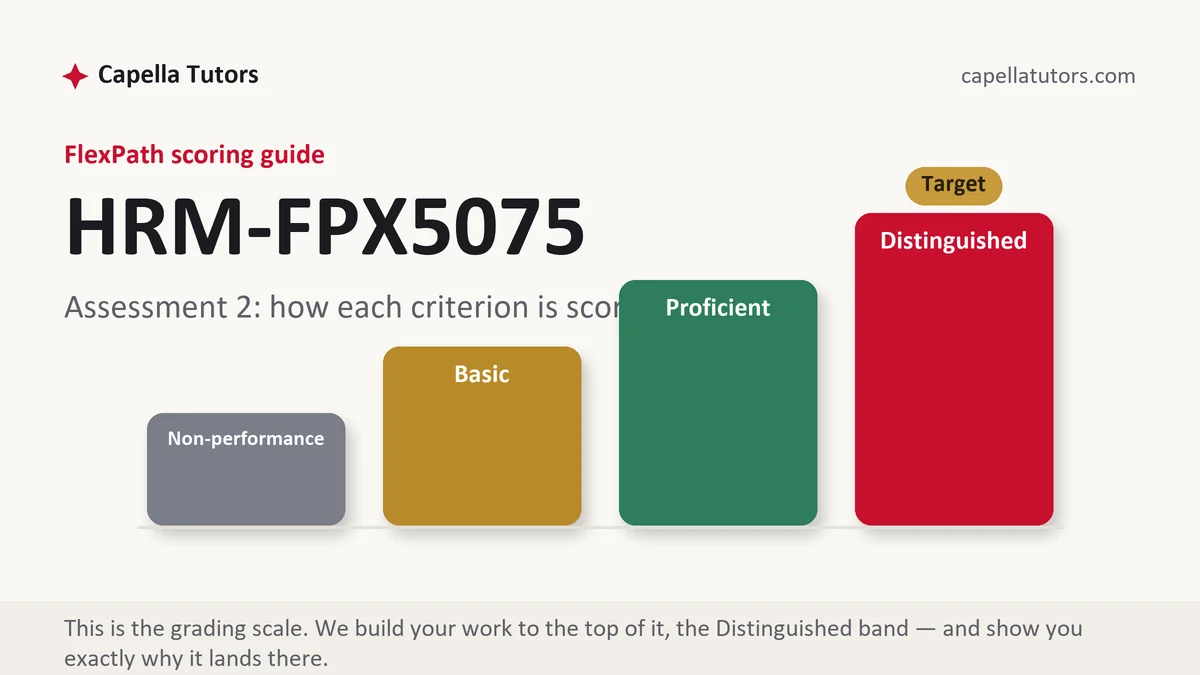
How HRM FPX 5075 Assessment 2 is scored
Four levels, criterion by criterion, and the wording of each level is a set of instructions rather than a description:
| Level | What it means on a negotiation deliverable |
|---|---|
| Distinguished | The interest is separated from the request, the constraint is cited to an actual authority rather than to policy in general, a workable alternative is specified with its own cost, and the escalation path is named before it is needed. |
| Proficient | The disagreement is handled professionally and the reasoning holds. What is absent is an alternative concrete enough for the executive to accept in the room. |
| Basic | A refusal justified by policy, written in the register of a compliance reminder. Correct, unpersuasive, and one level below where the criteria pay. |
| Non-performance | No exchange is ever written out, or the writer simply agrees, which leaves the negotiation criterion with nothing to grade. |
Graduate criteria treat a flat no as a failure of craft rather than a display of integrity. Anyone can decline; the deliverable is asking whether you can decline and still be invited to the next conversation.
The HRM FPX 5075 Assessment 2 method, step by step
-
Write the request and the interest as two different sentences
Fisher and Ury's distinction is the engine of this deliverable. The request is place a named individual in the role without posting it. The interest is cover the territory before the renewal season and avoid another twelve weeks of an empty desk. Those are not the same thing, and only one of them has more than one solution.
-
Establish the constraint and cite it properly
Company policy says so is the weakest sentence in professional writing. As a federal contractor the organization must list most openings with the appropriate state employment service delivery system under the Vietnam Era Veterans' Readjustment Assistance Act and its implementing regulations at 41 C.F.R. Part 60-300, and the requisition record has to show it. A constraint with a source behind it stops being your preference.
-
Price the delay the executive is actually worried about
Take the fear seriously in numbers. The territory books about 2.4 million dollars a year, so 15 business days of vacancy exposes 144,000 dollars of bookings on a 250 day calendar, and the historical shortfall during a manager vacancy in this region runs near 22 percent, which puts the real exposure around 31,680 dollars. Now you are negotiating about something measurable.
-
Build the alternative and cost that too
A seven calendar day internal and external posting run concurrently with the interim coverage plan cuts the gap to seven business days, or roughly 14,784 dollars of exposure, keeps the requisition record defensible, and leaves the preferred candidate free to apply and be selected on the strength of the file. The alternative has to be specific enough to be scheduled, not a promise to work something out.
-
Write the exchange, including the sentence you would actually say
The criteria want dialogue, not a summary of dialogue. Draft the opening you would use, the objection you expect back, and your reply to it. Keep every sentence about behavior and consequence, and keep the word cannot for the one place it belongs.
-
Name the escalation path and what you do if you lose, then self-score
Say who the decision goes to if the vice president proceeds anyway, whether that is the chief human resources officer or general counsel, and say what you will document either way. Then mark yourself D, P, B or N against each criterion and rework everything below D before submitting.
A structure that maps to the criteria
Our tutors plan a negotiation deliverable to roughly these proportions; they are not Capella rules, so follow your own guide wherever it weights a section differently.
| Section | What it must do | Guide word target |
|---|---|---|
| The situation | Who asked for what, when, and what makes the request one you cannot simply process. | ~175 words |
| Request against interest | Separate the stated demand from the outcome the executive genuinely needs, and evidence the second. | ~225 words |
| The constraint, sourced | The obligation named to statute, regulation or a policy you can quote, with the record it produces. | ~225 words |
| Exposure, both ways | The cost of the delay the executive fears and the cost of the shortcut, in the same units. | ~275 words |
| The alternative and the exchange | A schedulable alternative, then the conversation written as lines rather than summarized. | ~275 words |
| Escalation, record and references | Who it goes to next, what you document, and current APA matched both ways. | ~200 words |
Annotated sample excerpt
The passage below was written by our team as a model of how the exchange itself should read on the page. Take the register and the sequencing, then write your own conversation.
I opened on his interest rather than on his request: you need the Gulf territory covered before renewals open in October, and a twelve week gap is what you are trying to avoid.1 I then placed the constraint next to a number rather than next to a rule, saying that filling the role unposted puts the requisition outside what we are able to show in a compliance evaluation, and that a seven day posting costs about seven business days of coverage, or roughly 14,784 dollars against the 31,680 dollars a full open search would expose.2 His objection was that posting is theater when the decision is already made, and I answered it directly: the posting is not there to change his mind, it is there so that the record shows the selection survived a comparison, which is the only version of this hire that cannot be reopened later.3
- 1Leads with the executive's interest in his own words. Opening on the rule invites a contest about authority the staff function will lose.
- 2Converts a compliance argument into a comparison of two priced options, which is the register an operating leader already thinks in.
- 3Answers the strongest objection rather than the convenient one, and reframes the requirement as protection for his own decision.
The full premium sample for your exact assessment, written fresh to your scoring guide and issue, is free to request. Study it, revise it into your own voice, and submit work you understand.
The five mistakes that cost Distinguished
- Refusal grounded in policy alone. Naming the statute or regulation behind the obligation is a graduate expectation, and general references to compliance requirements do not meet it.
- No alternative offered. A no with nothing behind it moves the decision to somebody else's desk rather than resolving it, and the criteria can see the difference.
- The interest never separated from the request. Argue with the demand and you get a contest of wills; argue about the interest and there are usually three ways to satisfy it.
- The executive written as an antagonist. Description of character invites the reader to discount the analysis, and it reads as a complaint rather than as professional judgment.
- No escalation path. Deciding in the moment what to do if the request proceeds anyway is how people improvise into a position they cannot defend.
Pre-submission checklist
- Every criterion on the guide has its own labeled section
- The request and the underlying interest appear as separate, explicit sentences
- The constraint is cited to a statute, regulation or quotable policy, not to compliance in general
- Both the delay and the shortcut are priced in the same units, with the arithmetic visible
- An alternative specific enough to be put in a calendar, with dates attached
- Escalation path named, dialogue written as lines, current APA matched, every criterion self-scored D
Want this assessment done with backup?
Send the scoring guide, the request you have been handed and whatever the policy or contract actually says. A team of eight, including a research analyst and two QA reviewers, returns a premium original sample written to the Distinguished column in 24 to 48 hours, with revisions until it gets there. The exchange comes back written as dialogue, with both options priced.