This manual is for HRM FPX 5075 Assessment 3, start to submission. The closing deliverable treats influence as a result rather than an event, so the assessment usually asks what will be observably different once the approval is won, who reports it and from which existing report, and how honestly you can appraise your own effect on the outcome. The case worked below is a salary range disclosure rollout across twelve division leaders at a multistate software services firm. Need it off your desk? Give us the prompt and one premium original sample returns within 24 to 48 hours, reworked free of charge for as long as the criteria need it. Capella's catalog lists the course as HRM-FPX5075, and some courserooms print HRM5075; both point to this same Assessment 3.
One honesty note before the manual: Capella revises courses and scoring guides over time, so always write to the exact scoring guide attached to your assessment in the courseroom. The course identity above is verified on capella.edu; the method and structure below are our tutors' approach to it, not Capella's official rubric text.
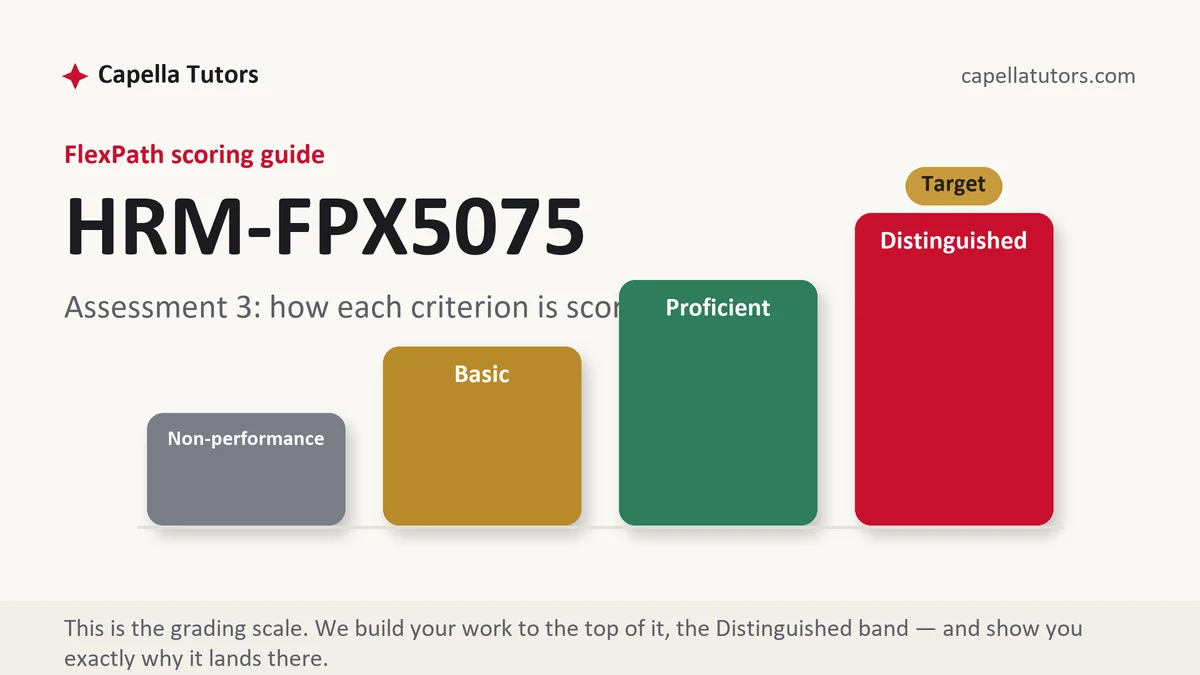
How HRM FPX 5075 Assessment 3 is scored
Every criterion lands at one of four levels and none of them are averaged, so read the descriptors as the brief they are:
| Level | What it means on a follow-through plan |
|---|---|
| Distinguished | Adoption stated as a fraction with a denominator and a window, drawn from a report that already exists, plus a written response for the case where approval holds and behavior does not follow. |
| Proficient | The plan is complete, the measures are sensible, and the self-appraisal is thoughtful. Nothing here has been set against an external check. |
| Basic | Success described as buy-in, positive feedback or engagement from the leadership team. Encouraging, unmeasurable, and one level short of the pay line. |
| Non-performance | No measure of any kind, or a self-assessment presented as fact with no acknowledgment of what a self-report can and cannot show. |
Attendance is the trap in this deliverable. A well received briefing tells you people were in the room, and the criteria are asking what those people did afterwards.
The HRM FPX 5075 Assessment 3 method, step by step
-
Turn the outcome into a fraction before you plan anything
The proportion of requisitions posted with a compliant salary range, measured quarterly, is a claim anyone can check. The baseline quarter carried 118 requisitions with 71 compliant, or 60.2 percent, and the target is 95 percent within two quarters. Write the numerator, the denominator and the window in one sentence and everything downstream gets easier.
-
Anchor the change in the obligation rather than in preference
With employees in nineteen states the firm is already inside several disclosure regimes, including the Colorado Equal Pay for Equal Work Act at C.R.S. 8-5-101, California Labor Code section 432.3 and New York Labor Law section 194-b, and a single national standard is cheaper to administer than twelve local ones. Naming the statutes moves the discussion off whether and onto how.
-
Surface the compression bill before somebody else finds it
Publishing ranges exposes people sitting below their own minimum, and the finance function will discover them within a week of the first posting. Say it first: 214 employees fall below the proposed minimums by an average of 2,860 dollars, which is 612,040 dollars, or about 658,900 dollars once employer payroll taxes are counted, and phasing it across two merit cycles puts roughly 329,400 dollars into each.
-
Sequence the twelve conversations by exposure, not by seniority
Rank the division leaders by what the change costs each of them, and see the ones carrying the largest compression liability first and alone. A leader who learns the number in a group meeting will defend a position in public that they might have negotiated in private, and you will spend the next quarter arguing with a statement rather than with a concern.
-
Report from something the organization already produces
The requisition audit already runs out of the applicant tracking system every month, so compliance can be a column on a report leaders receive rather than a new dashboard requiring their attention. A measure that needs a new artifact will be maintained for two quarters and then quietly abandoned.
-
Write the failure case and check your self-appraisal, then self-score
Say what happens if the policy is approved and the postings still go out without ranges: a named escalation, at a stated threshold, on a stated date. Then place your self-assessment beside something external, because self ratings of influence correlate only modestly with how other people rate the same person, and the gap generally runs in a flattering direction. Finish by marking each criterion D, P, B or N yourself.
A structure that maps to the criteria
These are our tutors' planning proportions for a follow-through deliverable rather than Capella instructions, so redistribute wherever your own guide places a criterion.
| Section | What it must do | Guide word target |
|---|---|---|
| The change, recapped | What was approved, by whom, and the obligation or business case that made it necessary, cited. | ~175 words |
| The adoption measure | Numerator, denominator, window, source report, baseline figure and target, all stated explicitly. | ~225 words |
| Cost surfaced early | The liability the change creates, calculated, with the phasing that makes it affordable. | ~250 words |
| Sequence and reinforcement | The order of conversations, what each is for, and the standing report that keeps the change visible. | ~250 words |
| The failure case | What you do if approval holds and behavior does not, with a threshold, a date and a named escalation. | ~200 words |
| Self-assessment and references | Your own effect appraised against an external check, the limits of self-report, and current APA. | ~250 words |
Annotated sample excerpt
The excerpt below is original work from our team, chosen to show how a measurable follow-through paragraph is built. Learn the construction and then write yours from your own reporting.
Adoption is the share of externally posted requisitions carrying a compliant range, taken from the monthly requisition audit that talent operations already distributes, measured by calendar quarter and reported by division.1 The baseline stands at 71 of 118, and the two divisions holding 34 of the 47 non-compliant postings are the same two whose compression liability is largest, which is a correlation the plan treats as a cause rather than a coincidence.2 If a division remains below 85 percent at the end of the second quarter, the requisition approval for that division moves to the compensation lead until the rate recovers, an escalation the chief human resources officer has agreed to in advance and which is stated here so that nobody encounters it as a surprise.3
- 1Denominator, window and source report in one sentence, all of them things the organization already produces without new work.
- 2Connects the behavior to the incentive behind it. Reading the pattern rather than reporting it is the analytical move the top column rewards.
- 3Writes the failure case with a threshold, a consequence and prior agreement. Most drafts stop before this sentence, and it is the one that separates an owner from an advocate.
The full premium sample for your exact assessment, written fresh to your scoring guide and issue, is free to request. Study it, revise it into your own voice, and submit work you understand.
The five mistakes that cost Distinguished
- Success defined as buy-in. Agreement in a meeting is a mood, and the criteria are asking for a proportion, a window and a source.
- A brand new dashboard as the measurement plan. Reporting that depends on somebody choosing to maintain it will not survive the second quarter.
- The financial consequence left for finance to find. A liability discovered by the chief financial officer after approval costs the HR function more credibility than the money ever costs the company.
- No failure case. Without a threshold and a named escalation the plan has no answer for the most likely outcome, which is partial compliance.
- A questionnaire treated as a measurement of your influence. Self-report is one perspective, and a paper that presents it as evidence has conceded a criterion before the reader finishes the section.
Pre-submission checklist
- Each criterion on the guide is answered under its own heading
- Adoption written as a numerator, a denominator, a window and a named source report
- A baseline figure captured and a target stated, both with dates
- The cost the change creates calculated and phased, with the softest input identified
- A failure case with a threshold, a consequence and an agreed escalation
- Self-assessment paired with an external check, current APA matched both ways, every criterion self-scored D
Want this assessment done with backup?
Send the scoring guide, the change you are landing and the reports your organization already circulates. A team of eight, including a research analyst and two QA reviewers, returns a premium original sample written to the Distinguished column in 24 to 48 hours, with revisions until it gets there. Adoption comes back as a fraction, and the failure case is already written.