This manual is for HRM FPX 5065 Assessment 1, start to submission. Assessment 1 of HRM FPX 5065, Employment Law in the Successful Workplace, teaches you to analyse rather than to conclude. The assessment usually hands you a fact pattern and asks which statutes reach the employer, which framework governs the claim, and how the facts move through it. Below is the method our tutors use, a structure that maps to the criteria, and an annotated sample excerpt. Prefer to hand it off? A premium original sample for this exact assessment comes back in 24 to 48 hours, revised free until it meets the guide. Capella's catalog lists the course as HRM-FPX5065, and some courserooms print HRM5065; both point to this same Assessment 1.
One honesty note before the manual: Capella revises courses and scoring guides over time, so always write to the exact scoring guide attached to your assessment in the courseroom. The course identity above is verified on capella.edu; the method and structure below are our tutors' approach to it, not Capella's official rubric text.
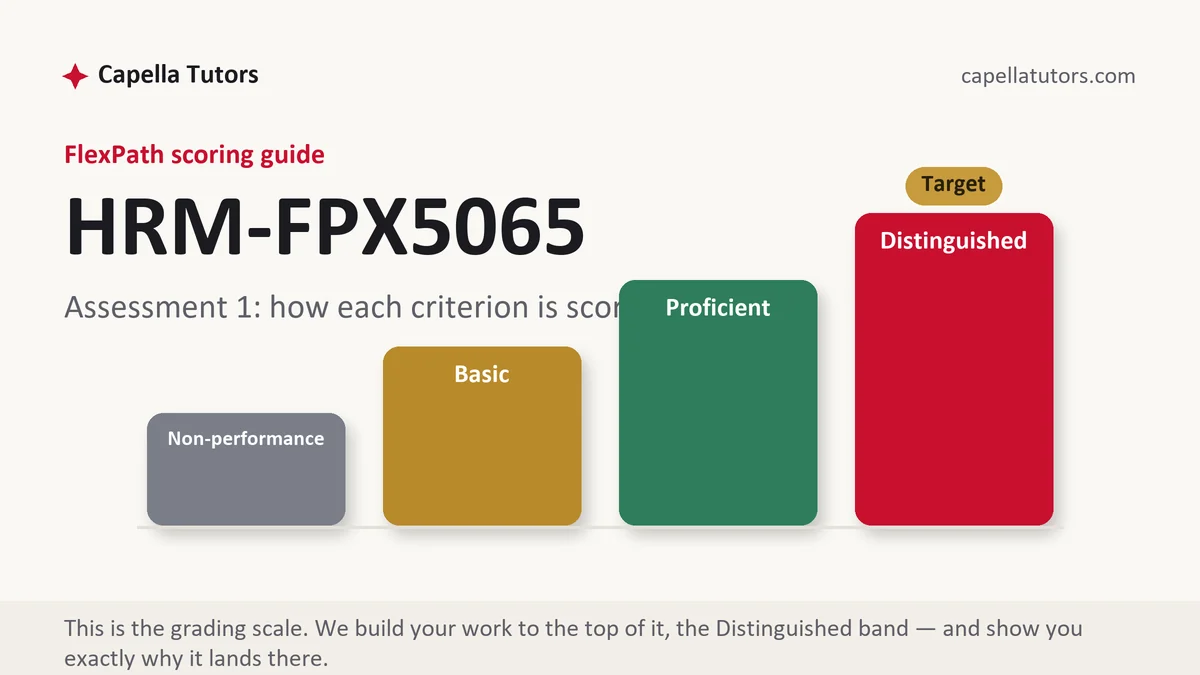
How HRM FPX 5065 Assessment 1 is scored
FlexPath issues no letter grades. Each criterion sits at one of four levels, and the level descriptions are the instructions for the memo:
| Level | What it means on a fact pattern analysis |
|---|---|
| Distinguished | Coverage is tested against the employer described, the correct framework is named and cited to its source, every element is applied to specific facts including the unhelpful ones, and the facts that are missing are identified as missing. |
| Proficient | The right statute, the right framework, and a complete application. Correct work that never names the weakness in its own conclusion. |
| Basic | The statute summarized and a conclusion announced, with the elements never separately tested. This is the most common shape for a first submission in this course. |
| Non-performance | The wrong statute governs the analysis, or coverage is never checked, which makes everything after it an answer to a question nobody asked. |
Precision here has a particular shape. Every statute gets its year, its employee threshold, its enforcing agency, and then the analysis it demands, in that order. Fact patterns at this level are frequently constructed so that a confident answer under the wrong statute reads perfectly well and is worthless.
The HRM FPX 5065 Assessment 1 method, step by step
-
Build the chronology before the argument
Read the facts once for what happened and once for the dates. What the employer knew and when, whether a complaint preceded a discipline, how many days sat between a request and a refusal. Employment questions are frequently decided by sequence, and a timeline built first makes the decisive gap visible before any law is applied to it.
-
Test coverage against the employer in front of you
Title VII of the Civil Rights Act of 1964 attaches at 15 employees, with the EEOC as the enforcing agency. The Age Discrimination in Employment Act of 1967 attaches at 20, and the class it protects is workers of 40 and above. The disability statute, the Americans with Disabilities Act of 1990 as broadened by its 2008 amendments, shares the 15-employee floor. Count the employees in the fact pattern and rule out whichever statutes do not reach them, with a reason.
-
Name the framework before you apply anything
A disparate treatment claim moves through the burden-shifting sequence from McDonnell Douglas Corp. v. Green: the employee carries a prima facie case first, the employer then produces a legitimate nondiscriminatory reason, and the burden returns to the employee to expose that reason as pretext. A disparate impact claim, following Griggs v. Duke Power Co., starts from a neutral practice with an unequal effect and turns on job-relatedness and business necessity. Say which one you are inside.
-
Apply the elements one at a time to specific facts
Give the rule, restate the governing standard with its citation attached, test it against the fact in front of you, and only then conclude. What is being graded is whether this employee was qualified, whether this employer knew, and whether this reason for this decision is supported by anything in the record. Address the facts that cut against you instead of walking past them.
-
Get the causation standard right for the statute
The standards differ, and using the wrong one quietly invalidates a whole section. Age claims under the ADEA require the plaintiff to show age was the but-for cause of the decision, a standard the Supreme Court settled in 2009, which is stricter than the motivating-factor route available under Title VII. Say which standard you are applying and why it belongs to this claim.
-
Finish with what the employer should do on Monday
This is a memo inside a human resource programme, not a moot court exercise. Say whether to settle or defend, what the exposure looks like in rough figures, which documents need preserving and who gets retrained by when. Then self-score every criterion and leave two business days for evaluation.
A structure that maps to the criteria
A fact pattern memo at this level runs to about these lengths in our tutors' planning, not by any Capella rule. Give more room to whichever section your scoring guide weights hardest.
| Section | What it must do | Guide |
|---|---|---|
| Facts and chronology | Who did what, in what order, with dates and what the employer knew at each point. | ~250 words |
| Coverage | Each candidate statute with its year, threshold and enforcing agency, and the ones ruled out with reasons. | ~200 words |
| The framework | The burden-shifting sequence or elements the claim requires, cited to the source case or regulation. | ~250 words |
| Application | Each element tested against named facts, with the unhelpful facts addressed and the gaps identified. | ~350 words |
| Exposure and recommendation | Rough figures, documents to preserve, the policy change, the owner and the deadline. | ~250 words |
| Authority and references | Statutes, regulations, agency guidance and cases in current APA for legal materials. | ~150 words |
Annotated sample excerpt
An original model excerpt from our team, showing the register that scores at the top of the guide. It is study material: learn the moves, then write your own version.
The printing company employs 240 people, which places it above the 20-employee threshold in the Age Discrimination in Employment Act of 1967 and above the 15 required by Title VII, so both reach this employer and the analysis proceeds under the ADEA.1 Of the 34 positions eliminated, 23 were held by employees aged 40 or over, or 67.6 percent, against 51 percent of the workforce in that group before the reduction, a disparity that supports an inference and settles nothing.2 Two facts cut against the inference and belong in the same paragraph: the eliminated positions cluster in the sheetfed division the company is closing outright, and the selection memoranda predate the workforce analysis by six weeks, which is the sequence the employer will rely on and the record does not currently contradict.3
- 1Counts the employees and tests both thresholds explicitly before naming the governing statute. Coverage checked in the first sentence is what stops a well-written analysis of the wrong law.
- 2Presents the disparity and immediately states its limit. An inference described as an inference is credible; the same figure presented as proof invites the reader to start disbelieving the writer.
- 3Volunteers the two facts most damaging to the writer's own position and dates them. Addressing the unhelpful record rather than omitting it is the specific behaviour the top column pays for.
The full premium sample for your exact assessment, written fresh to your scoring guide and issue, is free to request. Study it, revise it into your own voice, and submit work you understand.
The five mistakes that cost Distinguished
- The wrong statute for the facts. An age claim analysed under the disability statute has failed before the reasoning begins.
- Coverage never counted. A 30-employee employer sits outside some statutes and inside others, and the entire answer can turn on the headcount.
- Conclusion first, elements never tested. Announcing that the employer is liable skips the analysis the criterion was buying.
- Cases cited from a textbook summary. Faculty recognise it, and the actual holding is usually narrower than the paraphrase suggested.
- Nothing recommended. A memo that identifies exposure and proposes no action leaves the reader exactly where it found them.
Pre-submission checklist
- A dated chronology appears before any legal analysis
- Employee count stated and tested against each statute's threshold
- Statutes that do not apply are ruled out with a stated reason
- The governing framework is named and cited to its source case or regulation
- Every element applied to named facts, including the ones that weaken the conclusion
- A recommendation with an owner and a deadline, and current APA for legal materials verified
Fact pattern to analyse?
Send the scoring guide and the fact pattern. The memo moves through eight people, an analyst at the front and two reviewers at the end, and the premium original sample is back inside 24 to 48 hours with coverage tested, elements applied one at a time, and primary authority cited directly.