This manual is for HRM FPX 5065 Assessment 3, start to submission. Assessment 3 of HRM FPX 5065, Employment Law in the Successful Workplace, puts money on the line. The assessment usually asks you to audit a pay practice, calculate what is actually owed, scale the error across the affected population and recommend what the employer does about it. Below is the method our tutors use, a structure that maps to the criteria, and an annotated sample excerpt. Prefer to hand it off? A premium original sample for this exact assessment comes back in 24 to 48 hours, revised free until it meets the guide. Capella's catalog lists the course as HRM-FPX5065, and some courserooms print HRM5065; both point to this same Assessment 3.
One honesty note before the manual: Capella revises courses and scoring guides over time, so always write to the exact scoring guide attached to your assessment in the courseroom. The course identity above is verified on capella.edu; the method and structure below are our tutors' approach to it, not Capella's official rubric text.
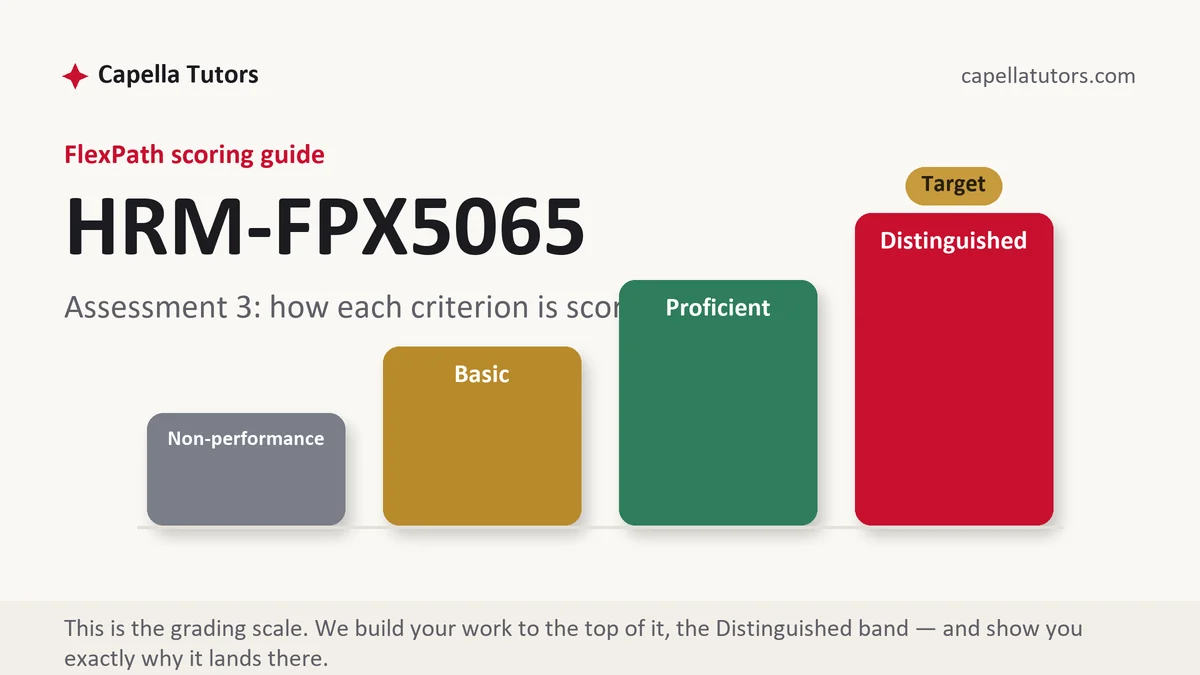
How HRM FPX 5065 Assessment 3 is scored
Criteria are placed at one of four levels and no letter grade is issued. The level language tells you exactly what the deliverable owes:
| Level | What it means on a wage and hour audit |
|---|---|
| Distinguished | Exemption status is analysed on duties as well as salary, the regular rate is rebuilt from all includable remuneration, the per-employee error is scaled across the population and the limitations period, and the remedy names who signs it off. |
| Proficient | The violation identified and correctly calculated for the example employee. Accurate, and never showing the employer the size of the whole exposure. |
| Basic | Overtime described as time and a half of the hourly rate, with bonuses left outside the calculation, which produces a number that looks right and is not. |
| Non-performance | No calculation appears, or exemption status is asserted from a job title with no duties analysis behind it. |
Small per-employee errors are the characteristic shape of wage and hour exposure. Seven dollars a week attracts no attention from anybody until it is multiplied by a headcount and a limitations period, and the whole point of the audit is to perform that multiplication before somebody else does.
The HRM FPX 5065 Assessment 3 method, step by step
-
Settle coverage and exemption before touching any arithmetic
The Fair Labor Standards Act of 1938, at 29 U.S.C. 201 and following, governs minimum wage and overtime. Exemption turns on how the employee is paid and what the employee actually does, never on the job title, and the salary threshold for the white-collar exemptions has been revised and litigated, so quote whichever figure is in force on your writing date and say that you did.
-
Rebuild the regular rate from everything includable
The regular rate is total straight-time remuneration divided by hours worked, and nondiscretionary bonuses, shift differentials and production incentives all belong in the numerator. This is the single most commonly missed point in the whole subject, because the arithmetic looks finished before the bonus is added and the resulting figure is confidently wrong.
-
Calculate the half-time premium on the corrected rate
Once straight time for all hours is in the total, the overtime hours attract an additional half of the regular rate rather than the full time and a half, since the straight-time portion has already been paid. Write the steps out in order. A reader who can follow the calculation will accept the conclusion, and a reader who cannot will disbelieve it.
-
Scale the error across people and time
Multiply the weekly shortfall by the affected headcount, then by the weeks in the limitations period, which runs two years and extends to three where the violation is willful. Liquidated damages generally double the unpaid amount unless the employer establishes good faith, so present the exposure as a range with its assumptions on the page rather than as a single confident figure.
-
Check the recordkeeping and the state overlay
Hours worked must be recorded accurately, and unrecorded work the employer knew about or should have known about is still compensable. State law sits on top of federal law and is often stricter on overtime thresholds, meal periods and pay timing, so say plainly which jurisdiction you checked and which you did not.
-
Recommend a correction with a signature on it
Back pay for the identified period, the payroll configuration change, who approves the disbursement, the notice to affected employees, and the audit interval that will catch the next one. Then self-score each criterion, re-add every figure independently, and allow two business days for evaluation.
A structure that maps to the criteria
These are the section sizes our tutors work to on a wage and hour memo, and Capella sets none of them. Reweight to match the emphasis in your own guide.
| Section | What it must do | Guide |
|---|---|---|
| The practice audited | Who is paid how, on what schedule, with what additional remuneration, and where the concern arose. | ~200 words |
| Coverage and exemption | The statute, the exemption tested on salary and duties, and any industry exemption analysed. | ~250 words |
| The regular rate rebuilt | Every includable component, the division, and the corrected rate shown step by step. | ~250 words |
| The shortfall calculated | What was paid against what was owed, for one pay period, with both totals visible. | ~250 words |
| Exposure scaled | Headcount, weeks, limitations period, liquidated damages, presented as a range with assumptions. | ~250 words |
| Remedy and references | Back pay, the system change, the approver, employee notice, audit interval, and current APA. | ~200 words |
Annotated sample excerpt
An original model excerpt from our team, showing the register that scores at the top of the guide. It is study material: learn the moves, then write your own version.
A wholesale delivery driver paid $21.50 an hour worked 47 hours and earned a $95 nondiscretionary route bonus, and the employer paid $1,180.75, being 40 hours at base, seven at time and a half, plus the bonus.1 The bonus is includable remuneration, so the regular rate is straight time of $1,010.50 plus $95, divided by 47 hours, which is $23.52; the seven overtime hours therefore attract an additional half-time premium of $11.76 each, or $82.32, and the correct total is $1,187.82.2 The $7.07 gap is unremarkable until it is scaled: across 21 drivers and 104 weeks it is $15,441, and liquidated damages would put the exposure near $30,900 before any state claim or any finding of willfulness extends the period to three years.3
- 1States what the employer actually paid and how it arrived at the figure, so the error is located rather than merely asserted. Reconstructing the wrong calculation is what makes the right one persuasive.
- 2Rebuilds the regular rate in visible steps and applies the half-time premium rather than time and a half, because the straight-time portion was already paid. Getting this order right is the technical centre of the whole deliverable.
- 3Multiplies a trivial weekly figure by headcount and weeks, then flags the two factors that could enlarge it. Scaling the error is the sentence that turns a payroll observation into a management decision.
The full premium sample for your exact assessment, written fresh to your scoring guide and issue, is free to request. Study it, revise it into your own voice, and submit work you understand.
The five mistakes that cost Distinguished
- Bonuses left out of the regular rate. Nondiscretionary incentive pay belongs in the numerator, and omitting it produces a confident wrong answer every time.
- Time and a half applied on top of straight time already paid. The overtime hours owe an additional half, and doubling the premium is an error whichever direction it runs.
- Exemption decided from the job title. Salary and actual duties decide it, and a title-based conclusion is the finding an investigator overturns first.
- A per-employee error never scaled. Seven dollars is not a memo; fifteen thousand across a limitations period is.
- State law never mentioned. It frequently sits above the federal floor, and silence about it reads as an audit that was never completed.
Pre-submission checklist
- Exemption analysed on pay method and actual duties, with the current salary level cited
- Every item of includable remuneration named before the regular rate is computed
- The regular rate division and the half-time premium both shown as separate steps
- What was paid and what was owed both stated, so the gap is visible
- Exposure scaled by headcount and weeks, with liquidated damages and willfulness flagged as assumptions
- Remedy names an approver and an audit interval, and current APA for legal materials verified
Wage and hour audit due?
Send the scoring guide, the pay practice and any rates, hours or bonus figures the fact pattern gives you. Eight of us take it from there, and the premium original sample comes back inside 24 to 48 hours with the regular rate rebuilt, the exposure scaled, and free revision until the criteria are satisfied.