This manual is for HRM FPX 5065 Assessment 2, start to submission. Assessment 2 of HRM FPX 5065, Employment Law in the Successful Workplace, is the deliverable where eligibility arithmetic decides the answer. The assessment usually gives you an employee requesting time away or an adjustment to the job and asks which statutes apply, whether this employee qualifies under each, and what the employer is obliged to do next. Below is the method our tutors use, a structure that maps to the criteria, and an annotated sample excerpt. Prefer to hand it off? A premium original sample for this exact assessment comes back in 24 to 48 hours, revised free until it meets the guide. Capella's catalog lists the course as HRM-FPX5065, and some courserooms print HRM5065; both point to this same Assessment 2.
One honesty note before the manual: Capella revises courses and scoring guides over time, so always write to the exact scoring guide attached to your assessment in the courseroom. The course identity above is verified on capella.edu; the method and structure below are our tutors' approach to it, not Capella's official rubric text.
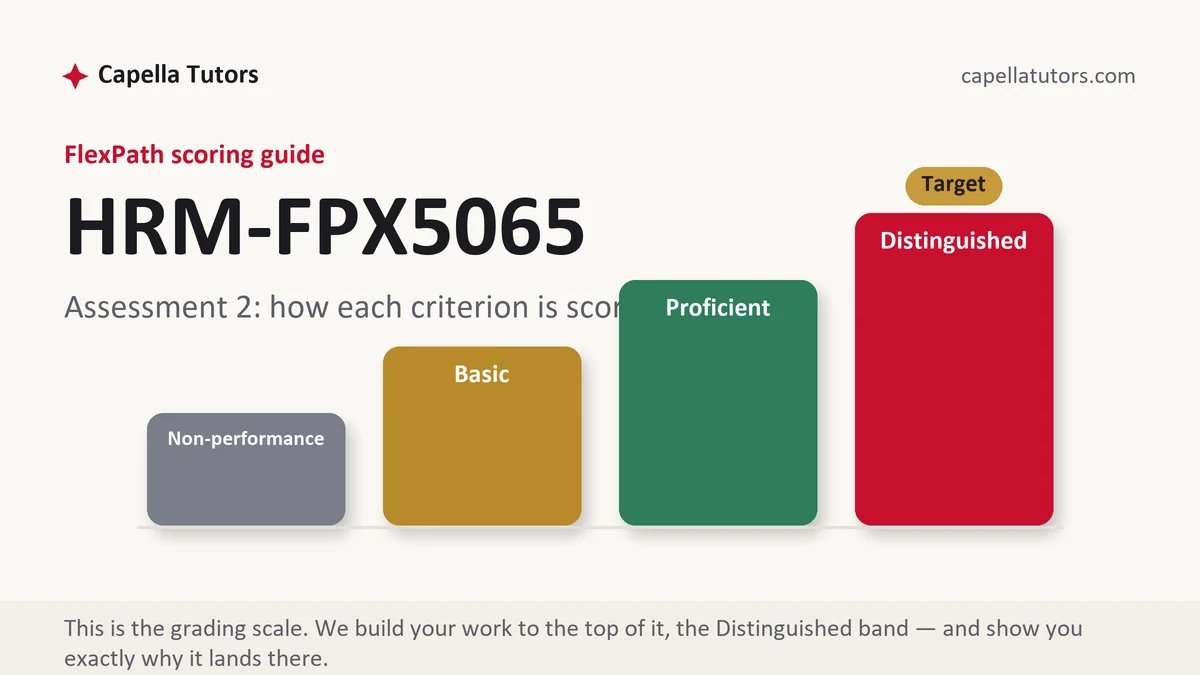
How HRM FPX 5065 Assessment 2 is scored
Nothing in FlexPath is graded as a letter. Four levels exist for each criterion, and whichever one your evaluator selects was described in advance, which makes those descriptions the brief:
| Level | What it means on a leave and accommodation analysis |
|---|---|
| Distinguished | Eligibility is computed rather than assumed, the hours definition is applied correctly, the statutes are analysed separately before they are read together, and the obligation is stated as a process rather than as an outcome. |
| Proficient | Both statutes identified and applied accurately to the employee. Complete, and treating the eligibility figures as given rather than auditing them. |
| Basic | Both laws described in general terms with the employee's own numbers never tested against either threshold, so the analysis could have been written before the facts arrived. |
| Non-performance | A governing statute is omitted, most often because the first one examined did not apply and the analysis stopped there. |
The habit worth building here is that a failed threshold is a beginning, not an ending. An employee who misses one statute's eligibility test may still be owed something under another, and an analysis that closes the file at the first negative answer has stopped one question early.
The HRM FPX 5065 Assessment 2 method, step by step
-
Test employer coverage and employee eligibility separately
They are different questions and students merge them constantly. The Family and Medical Leave Act of 1993 covers employers with 50 or more employees within 75 miles, while an individual employee additionally needs a year of service and 1,250 hours actually worked across the 12 months before the leave begins. A covered employer with an ineligible employee is a completely ordinary situation and a common trap.
-
Audit the hours figure instead of accepting it
The 1,250 hours are hours worked under the Fair Labor Standards Act definition, which means paid holiday, vacation and sick time do not count, while overtime and unrecorded work do. Payroll systems routinely report a number built on the wrong definition. Recomputing it is frequently the entire analysis, and the criteria reward the writer who checked.
-
Analyse each statute on its own before combining them
Leave entitlement and accommodation obligation are separate legal questions with separate tests, and the same facts can produce a negative answer under one and a positive answer under the other. Write them as separate sections, then a short section on how they interact, rather than blending them into one discussion where neither test is visible.
-
Treat the interactive process as the obligation it is
Under the Americans with Disabilities Act of 1990, whose 2008 amendments widened the definition of disability considerably, the employer owes a good-faith exchange about possible adjustments. The statute requires a conversation rather than a particular outcome, and an employer that documents the exchange, weighs the alternatives on the record and gives its reasons is usually defensible even where it ends up saying no.
-
Handle undue hardship with figures rather than adjectives
Cost, disruption and effect on operations are the terms, and an employer asserting hardship without quantifying it has asserted nothing. If the fact pattern gives you numbers, use them; if it does not, say what the employer would need to produce and roughly what it would cost to produce it.
-
Write the process the employer should follow now
Who contacts the employee, what medical information may lawfully be requested and from whom, what gets documented, what the interim arrangement is while the exchange continues, and when the decision gets revisited. Then self-score each criterion D, P, B or N, and leave two business days for faculty to evaluate the attempt.
A structure that maps to the criteria
Our tutors size a leave and accommodation memo like this, as planning figures rather than Capella requirements. Follow the weighting in your own scoring guide.
| Section | What it must do | Guide |
|---|---|---|
| The request and the employer | What was asked for, when, of whom, and the employer's size and site structure. | ~200 words |
| Coverage and eligibility computed | Each threshold tested against actual figures, with the hours calculation shown. | ~300 words |
| Statute one applied | The elements of the leave analysis, applied to this employee, with the conclusion qualified. | ~250 words |
| Statute two applied | The accommodation analysis run separately, including the interactive process obligation. | ~300 words |
| Interaction and hardship | How the two obligations overlap, and any hardship argument expressed in figures. | ~200 words |
| Process and references | The steps the employer takes next, with owners and dates, and current APA for legal materials. | ~200 words |
Annotated sample excerpt
An original model excerpt from our team, showing the register that scores at the top of the guide. It is study material: learn the moves, then write your own version.
The millwork shop employs 62 people at a single site, so it is a covered employer under the Family and Medical Leave Act of 1993 and sits above the 15-employee threshold for the Americans with Disabilities Act of 1990 as amended.1 Payroll reports 1,232 hours for the drafter over the preceding 12 months, 18 short of the 1,250 the statute requires, and the employer has already denied the request on that basis. The figure does not survive an audit: 40 of those hours are paid holiday, which the Fair Labor Standards Act definition of hours worked excludes, while 61 hours of Saturday production support were logged on paper and never keyed, which it includes.2 Corrected, the total is 1,253 hours, and the employee clears the threshold by three, which converts a closed file into an eligible leave request and an employer notice problem.3
- 1Settles employer coverage under both statutes in one sentence with the actual headcount, so neither analysis later rests on an assumption.
- 2Names the legal definition governing the count, then adjusts in both directions. Removing hours that help the employee and adding hours that help them is what makes the recomputation credible rather than advocacy.
- 3Lands the finding on a margin of three hours and says what the correction changes. A conclusion that turns on a small verified number is the most persuasive shape an employment law memo can take.
The full premium sample for your exact assessment, written fresh to your scoring guide and issue, is free to request. Study it, revise it into your own voice, and submit work you understand.
The five mistakes that cost Distinguished
- Employer coverage confused with employee eligibility. They are separate tests, and passing one says nothing about the other.
- The payroll hours figure accepted as given. It is routinely built on the wrong definition, and auditing it is often the whole assignment.
- The analysis stopped at the first negative answer. Failing one statute's threshold does not end the employer's obligations under another.
- The interactive process described as optional. The exchange is itself the obligation, and skipping it is frequently what an employer is found to have done wrong.
- Undue hardship asserted without figures. Cost and disruption are quantities, and a hardship claim with no numbers behind it persuades nobody.
Pre-submission checklist
- Employer coverage and employee eligibility tested as separate questions
- The hours calculation shown, with excluded and included categories named
- Each statute analysed in its own section before any discussion of how they interact
- The interactive process obligation stated as a process the employer owes
- Any hardship argument expressed in cost, disruption or operational effect
- Next steps carry owners and dates, and current APA for legal materials verified
Leave or accommodation question due?
Send the scoring guide and the fact pattern, including any hours or headcount figures it gives you. Eight people carry the file from the statutory research to the final read, and one premium original sample returns within 24 to 48 hours with eligibility recomputed, both statutes analysed separately, and revision at no charge until the criteria are met.