This manual is for HRM FPX 5002 Assessment 3, start to submission. Assessment 3 of HRM FPX 5002, Survey of Human Resource Management in Practice, is the synthesis deliverable. The assessment usually asks you to take everything the earlier work established about an organization and turn it into a recommendation somebody with a budget would actually approve, which means a change with a price, an owner and a measure attached. Below is the method our tutors use, a structure that maps to the criteria, and an annotated sample excerpt. Prefer to hand it off? A premium original sample for this exact assessment comes back in 24 to 48 hours, revised free until it meets the guide. Capella's catalog lists the course as HRM-FPX5002, and some courserooms print HRM5002; both point to this same Assessment 3.
One honesty note before the manual: Capella revises courses and scoring guides over time, so always write to the exact scoring guide attached to your assessment in the courseroom. The course identity above is verified on capella.edu; the method and structure below are our tutors' approach to it, not Capella's official rubric text.
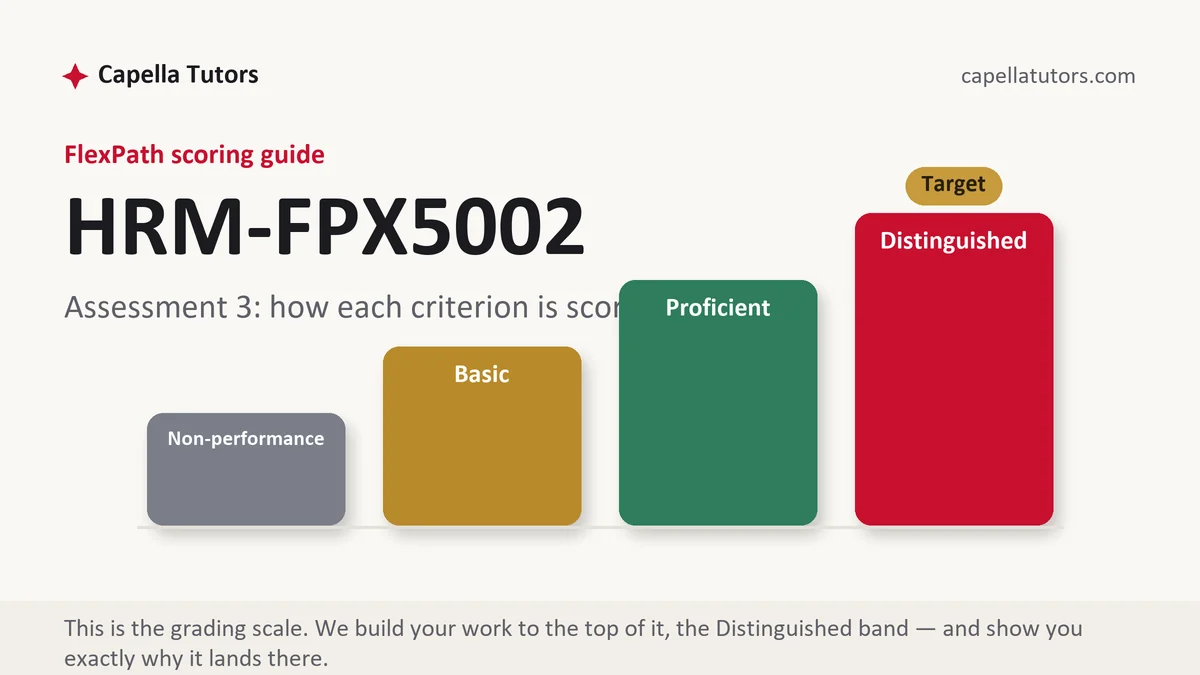
How HRM FPX 5002 Assessment 3 is scored
FlexPath scores criteria, not papers, and each one lands on one of four levels. Read the level descriptions as instructions rather than as feedback:
| Level | What it means on a recommendation |
|---|---|
| Distinguished | The problem is measured, the proposal is costed against the saving it claims, the sensitivity of that comparison is stated, and the writer names the condition under which the recommendation should be dropped. |
| Proficient | A sound proposal with a cost and an owner, supported by evidence. Complete, and silent about how much has to change before the arithmetic stops working. |
| Basic | A sensible idea with no price on it. Recommending that the organization improve something is a position; recommending it for $18,400 against a $37,700 return is a decision. |
| Non-performance | No recommendation is made, or the recommendation addresses a problem the paper never established. |
Finance is the imagined reader here. A director who takes your memo into a budget meeting will be asked two questions, what it costs and how we will know it worked, and a paper that cannot answer both has done the analysis without doing the job.
The HRM FPX 5002 Assessment 3 method, step by step
-
Restate the problem as a measured quantity
Not the depot has an absence problem but unscheduled absence ran at 7.4 percent of scheduled hours across the last four quarters. Give the measure a formula, a population, a period and a source. Every later figure in the memo inherits its credibility from this sentence, so it is worth rewriting three times.
-
Convert the quantity into the currency the organization uses
Hours lost become hours covered, hours covered become premium pay, premium pay becomes a line item. Do the conversion in visible steps and state each assumption as an assumption. A reader who can follow the arithmetic will argue with your coverage rate rather than dismissing your conclusion.
-
Find the cause before proposing the cure
Absence rising in one classification and not another, concentrated on particular shifts, or dated from a scheduling change, points somewhere specific. Bring at least one peer-reviewed source that tested an intervention of the kind you intend to propose, and read it for its design and sample rather than for its headline finding.
-
Price the intervention honestly, including the time it consumes
Supervisor hours, training, licence fees, backfill during rollout. Loaded labour cost, not base pay. Understating the cost of your own proposal is the fastest way to lose a reader who has bought training before, and the criterion rewards the caution rather than the optimism.
-
Set the two numbers against each other and test the margin
State the expected saving, the cost, and the net, then say how far the effect can fall before the net reaches zero. A proposal that returns nineteen thousand dollars on a thirty-eight thousand dollar saving is a real proposal with a thin margin, and saying so is stronger than pretending the margin is comfortable.
-
Name the owner, the start date and the report that will settle it
The recommendation ends with a person, a date, and an existing report that will show whether the change worked, plus a review point. Then self-score every criterion D, P, B or N, check the arithmetic separately, and submit early enough to absorb two business days of evaluation.
A structure that maps to the criteria
Our tutors plan a costed recommendation memo to roughly these lengths, which are not Capella rules. Reweight wherever your scoring guide puts more emphasis.
| Section | What it must do | Guide |
|---|---|---|
| Purpose and the decision requested | What the reader is being asked to approve, in the first three sentences, with the amount named. | ~150 words |
| The problem, measured | The metric, its formula, denominator, period and source, with a comparison that shows why it is a problem. | ~250 words |
| Cause and evidence | What the data points to, and the research supporting the type of intervention proposed. | ~300 words |
| The proposal and its cost | What changes, who does it, what it consumes in money and hours, and over what timetable. | ~250 words |
| Return, sensitivity and risk | Expected saving against cost, the net, how far the effect can fall, and what could go wrong. | ~250 words |
| Governance and references | Owner, start date, review measure, abandonment condition, and current APA both ways. | ~150 words |
Annotated sample excerpt
An original model excerpt from our team, showing the register that scores at the top of the guide. It is study material: learn the moves, then write your own version.
The depot schedules 96 mechanics for 199,680 hours a year, and unscheduled absence at 7.4 percent removes 14,776 of them.1 Roughly 70 percent of that coverage is bought back on overtime, and at a $38.50 base the half-time premium alone is $19.25 an hour, so absence currently costs about $199,103 a year in premium before any effect on vehicle availability is counted.2 Bringing the rate to 6.0 percent releases 2,795 hours, of which 1,957 would have been covered at premium, worth $37,672 against a programme cost of $18,400, a first-year net of about $19,300; if the rate falls only to 6.7 percent the net is roughly zero, which is the number the approving director should be given rather than the optimistic one.3
- 1Starts from scheduled hours rather than from a percentage, so the reader can see the population the rate is calculated on before seeing the rate.
- 2Converts hours to dollars in named steps and prices the premium only, not the base wage, because the base was payable whoever worked the shift. Getting that distinction right is what a finance reader checks first.
- 3Publishes the break-even point. Volunteering the figure that weakens your own case is the clearest evidence of judgement a scoring guide can find in a memo.
The full premium sample for your exact assessment, written fresh to your scoring guide and issue, is free to request. Study it, revise it into your own voice, and submit work you understand.
The five mistakes that cost Distinguished
- A saving with no cost beside it. Half an arithmetic is not an argument, and finance readers reach for the missing half immediately.
- Base pay counted as the cost of overtime coverage. The wage was owed regardless; only the premium is caused by the absence, and inflating it invalidates the whole comparison.
- A cause skipped on the way to a cure. Proposing an intervention before diagnosing the pattern is how organizations buy training that treats nothing.
- Research quoted for its headline. A study with 40 participants in one site and a multi-site trial support different sentences, and the criterion expects you to know which you are holding.
- No owner, no date, no review report. A recommendation nobody is accountable for is a suggestion with formatting.
Pre-submission checklist
- The decision being requested appears in the opening paragraph with a dollar amount
- The problem metric carries a formula, a denominator, a period and a source
- Every conversion from hours to money is shown in steps a reader can reproduce
- The intervention is costed including supervisor and backfill time at loaded rates
- The break-even point is stated, along with what would make you withdraw the proposal
- Owner, start date and review report named, and current APA verified in both directions
Recommendation memo due?
Send the scoring guide, the problem you intend to solve and any operating figures you hold, including rates, hours and budget lines. A studio of eight, with two reviewers who see nothing but the scoring guide, turns that into a premium original sample within 24 to 48 hours, every calculation visible, the break-even stated, revisions free until the criteria are met.