This manual is for HRM FPX 5002 Assessment 2, start to submission. Assessment 2 of HRM FPX 5002, Survey of Human Resource Management in Practice, moves from describing the function to judging it. The assessment usually asks you to hold a piece of real human resource practice against a recognized competency or professional standard and say, with evidence, where it meets the standard and where it does not. Below is the method our tutors use for that evaluation, a structure that maps to the criteria, and an annotated sample excerpt. Prefer to hand it off? A premium original sample for this exact assessment comes back in 24 to 48 hours, revised free until it meets the guide. Capella's catalog lists the course as HRM-FPX5002, and some courserooms print HRM5002; both point to this same Assessment 2.
One honesty note before the manual: Capella revises courses and scoring guides over time, so always write to the exact scoring guide attached to your assessment in the courseroom. The course identity above is verified on capella.edu; the method and structure below are our tutors' approach to it, not Capella's official rubric text.
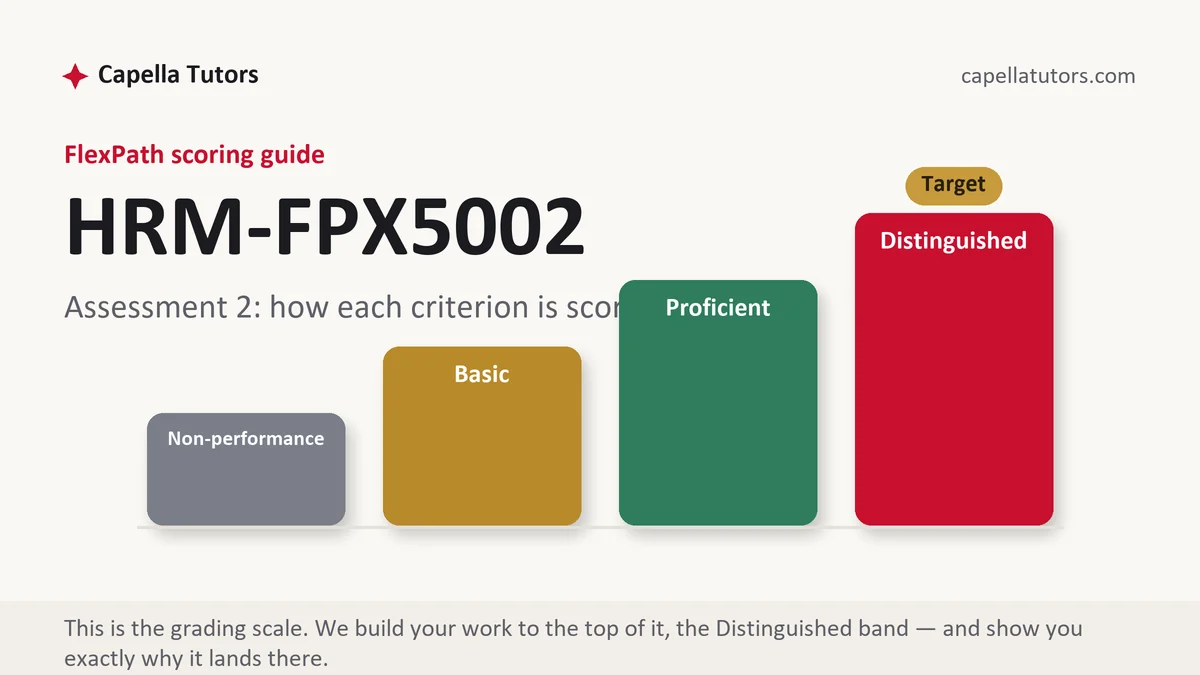
How HRM FPX 5002 Assessment 2 is scored
There are no letter grades in FlexPath. Your scoring guide places each criterion on one of four levels, and the level language tells you exactly what to write:
| Level | What it means on a practice evaluation |
|---|---|
| Distinguished | A named framework is applied domain by domain to observed practice, each judgement is carried by evidence rather than impression, and the evaluation admits which domains your access could not reach. |
| Proficient | The framework is applied correctly across the practice and the conclusions follow from it. Sound work that never states the limits of its own evidence. |
| Basic | The framework is summarized, the practice is summarized, and the two sit on the page without meeting. Quoting a model is description; measuring something against it is evaluation. |
| Non-performance | The evaluation reaches conclusions with no standard behind them, or the framework named in the criterion never appears at all. |
A useful test before you submit: cover the framework section and read the findings. If the findings still make sense on their own, they were opinions with a model bolted on afterwards, and the criterion that pays for application will not pay for them.
The HRM FPX 5002 Assessment 2 method, step by step
-
Choose the framework the criterion actually names
If your guide names a competency model, use that one and cite it to the body that publishes it. If it leaves the choice to you, pick one and defend the choice in two sentences. A professional competency model, a service-delivery model and an ethics code answer different questions, and picking the wrong instrument is a mistake no amount of good writing repairs.
-
Decompose the framework into testable statements
A domain expressed as a noun cannot be evaluated. Rewrite each one as something observable: not business acumen but the function can state the operating result its largest programme is meant to move. Five or six testable statements are plenty, and they become the spine of the whole paper.
-
Gather evidence before forming a judgement
Documents, cycle times, ticket volumes, service standards, published policy, and short conversations with two or three people who use the service. Write down what you can see and what you cannot. An evaluation built from one person's impression of their own department has a design problem the criterion will find.
-
Score each statement and show the evidence beside it
A three-level judgement of meets, partially meets or does not meet is usually enough, provided each one carries the observation that produced it. Put the evidence in the same row as the rating so the reader never has to hunt for the basis of a conclusion.
-
Convert one gap into money or time
The gap that matters is the one somebody can price. Service standards missed, hours consumed, cases reopened, cost per employee against a benchmark. A director will act on a defended number and will not act on the observation that a domain partially meets a standard.
-
Write the recommendation as something a person can be held to
Name the change, the owner, the cost in money or hours, the start date, and the report that will show whether it worked. Then name the condition under which you would abandon it, since a stated limit reads as judgement and unqualified enthusiasm reads as a sales pitch.
A structure that maps to the criteria
These lengths are our tutors' planning targets for a practice evaluation at master's level, not Capella requirements. Follow the weighting in your own guide where it differs.
| Section | What it must do | Guide |
|---|---|---|
| Purpose and setting | The organization, the practice under evaluation, and why this practice is worth examining now. | ~200 words |
| The standard applied | The framework, its source, and the domains rewritten as observable statements. | ~250 words |
| Evidence gathered | What you looked at, who you spoke to, over what period, and what you could not reach. | ~200 words |
| Findings by domain | Each statement, its rating, and the observation supporting it, arranged so the pairing is visible. | ~350 words |
| The costed gap | One shortfall expressed in money, hours or missed service standards, with its arithmetic. | ~200 words |
| Recommendation and references | The change, owner, cost, start date, review measure, failure condition, and current APA. | ~200 words |
Annotated sample excerpt
An original model excerpt from our team, showing the register that scores at the top of the guide. It is study material: learn the moves, then write your own version.
Since the shared service centre absorbed the plant generalists, the function runs 14.0 FTE against 1,340 employees, a ratio of 1.04 per 100 or one practitioner for every 96 people, and an operating budget of $2,340,000 works out to about $1,746 per employee a year.1 Those figures sit inside the published range, which is why the centre reports itself as adequately staffed. Case data disagrees: of 9,600 tickets last year the centre closed 7,872 inside its two-day standard, an 82 percent attainment against the 94 percent the two plants that retained an embedded generalist recorded.2 The 1,728 late tickets are the cost of the consolidation, and no ratio in the benchmark set would ever have shown them.3
- 1Puts the conventional staffing metrics on the page first, at full precision, so the argument that follows cannot be read as ignorance of them.
- 2Sets the same function against an internal comparison group rather than an external benchmark. Two plants under one policy is the cleanest natural comparison a student is ever handed.
- 3Names what the accepted measure structurally cannot detect. Criticizing your own instrument, then supplying a better one, is the specific behaviour the Distinguished column rewards.
The full premium sample for your exact assessment, written fresh to your scoring guide and issue, is free to request. Study it, revise it into your own voice, and submit work you understand.
The five mistakes that cost Distinguished
- The framework quoted, never applied. Listing a model's domains is background, and the criterion is asking you to measure something against them.
- Ratings with no evidence in the same row. A judgement whose basis lives three paragraphs away reads as an assertion the reader has to take on trust.
- Benchmark ratios treated as verdicts. Being inside a published range says the organization resembles others, not that the practice works.
- An evaluation with no access statement. Every student writes from a partial view, and only some of them say so, which is the difference the top column notices.
- A recommendation with no owner and no price. Proposals nobody has to fund and nobody has to deliver are opinions in a formal font.
Pre-submission checklist
- The framework is named, cited to its publisher, and matched to what the criterion asked for
- Each domain appears as an observable statement rather than a noun
- Every rating sits in the same row as the evidence that produced it
- One gap is priced in money, hours or missed service standards, with the arithmetic shown
- The recommendation carries an owner, a cost, a start date and a review measure
- Limits of access stated plainly, and current APA checked in text and in the list
Evaluating a practice against a standard?
Send the scoring guide, the framework your criterion names, and whatever service data you can reach. The file passes through eight sets of hands before it reaches you, and a premium original sample written to the Distinguished descriptors lands within 24 to 48 hours, every rating tied to evidence, revised at no charge until the criteria are satisfied.