This manual is for HIM FPX 3640 Assessment 3, start to submission. Assessment 3 is the synthesis deliverable of the course, and the assessment usually asks you to judge something rather than propose it: whether a change to the record system worked, what the evidence supports, and what should happen next. Judgment is graded on the comparison you build, so the measure you choose and the period you compare it across decide the paper before the writing does. Below is the method our tutors use for it, a structure that maps to the criteria, and an annotated sample excerpt. Prefer to hand it off? A premium original sample for this exact assessment comes back in 24 to 48 hours, revised free until it meets the guide. Capella's catalog lists the course as HIM-FPX3640, and some courserooms print HIM3640; both point to this same Assessment 3.
One honesty note before the manual: Capella revises courses and scoring guides over time, so always write to the exact scoring guide attached to your assessment in the courseroom. The course identity above is verified on capella.edu; the method and structure below are our tutors' approach to it, not Capella's official rubric text.
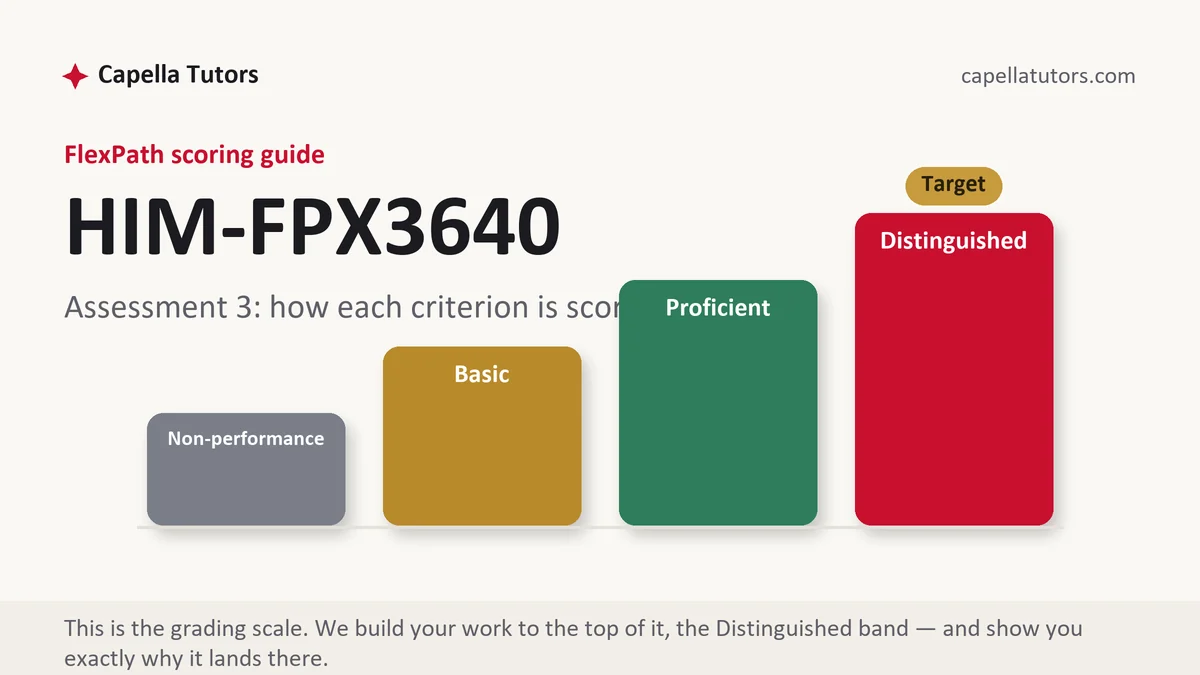
How HIM FPX 3640 Assessment 3 is scored
Levels replace grades in FlexPath, one level per criterion, and the level text is the most useful writing instruction in the courseroom:
| Level | What it means on an evaluation of a system change |
|---|---|
| Distinguished | The measures were defined before they were reported, before and after are genuinely comparable, and a competing explanation for the movement is raised and answered. A conclusion arrives anyway, with its conditions attached. |
| Proficient | Results reported accurately against a baseline, with a defensible conclusion. Complete, and silent about what else could have moved the numbers. |
| Basic | An account of what was implemented, with satisfaction or improvement asserted rather than measured. Common when the writer had no baseline to work from. |
| Non-performance | A criterion goes unanswered, usually the recommendation for what happens next or the limitations of the evidence. |
One warning about evidence in this deliverable. Vendor material and product literature will tell you a system improves outcomes, and none of it is evidence about your organization. A measure taken before the change and taken again after it, on the same base, is the only thing in the paper that carries weight.
The HIM FPX 3640 Assessment 3 method, step by step
-
Build the outline from the guide, in the guide's order
Keep the criteria in the sequence the guide lists them and let that be your table of contents. Evaluators read with the guide open beside the paper, and a document that follows it row by row is faster to score and harder to mark down for a missing element that is actually present three pages away.
-
Define each measure in writing before you report a value
Name the numerator, the denominator, the period and the system the data comes from, in a short block near the top. This is the highest-value paragraph in an evaluation and most submissions do not contain one. It lets a reader confirm your later figures agree with each other, and it forces you to notice when the data you have cannot support the measure you named.
-
Make before and after comparable, then say how you did it
Hold the population, the period length and the counting rule steady across both windows. If the organization changed how it counts partway through, the comparison is broken and the honest move is to say so and use the window you can defend. A comparison between two unlike periods produces a number that looks like a finding and is not one.
-
Measure adoption with something countable
User satisfaction is a sentence, not a measure. The share of orders entered by the ordering clinician, the proportion of notes closed inside a day, help desk tickets per hundred users per month, enrollment per thousand eligible patients: each of those has a base and a direction, and each says something a survey does not.
-
Argue against your own result once, in writing
Ask what else changed during the same months, then answer the question with data rather than assurance. Seasonality, a staffing change, a new service line, a revised counting rule and a concurrent project are all ordinary explanations for movement in a health information measure. Raising one and dismissing it with evidence is usually the exact move the top column pays for.
-
Recommend, monitor, and leave time for one revision
Close with what should happen next, who owns it, and which measure will show whether it worked. Then submit with slack in your session. An evaluation is a long deliverable, an evaluator may take two business days, and the students who finish courses on schedule are the ones who planned for a second submission they usually do not need.
A structure that maps to the criteria
Treat these as our tutors' planning targets for an evaluation of this size rather than as limits, and follow your scoring guide wherever it asks for something longer.
| Section | What it must do | Guide |
|---|---|---|
| Purpose and the change evaluated | What was implemented, when, in what organization, and the question this paper answers. | ~175 words |
| Measures and definitions | Each measure with its numerator, denominator, period and source system named. | ~200 words |
| Results | Before and after values with bases, and the direction of travel stated plainly. | ~300 words |
| Interpretation and alternatives | What the movement supports, what else could explain it, and how that was tested. | ~300 words |
| Limitations and next steps | What the data cannot settle, the recommendation, its owner and its measure. | ~250 words |
| References | Current APA in both directions, with standards and research separated by role. | as needed |
Annotated sample excerpt
An original model paragraph from our team, written to show how a result reads when the writer has already anticipated the reader's objection. Take the structure, not the sentences.
Twelve months after the patient portal opened at Fairmount Family Medicine, 4,470 of the practice's 12,400 active patients had completed enrollment, or 36.0 percent, against 11.4 percent at the three-month mark.1 Laboratory results reached the portal a median of 1.2 days after verification, down from 4.6 days when release was handled by a weekly clerical batch, with both figures drawn from the same result-release report and the same 90-day window in each year.2 Enrollment growth cannot be credited to the portal alone, since the practice added registration staff in the same quarter and began offering enrollment at check-in, so the release interval is the stronger evidence here: it depends on a workflow that changed and on no other project running at the time.3
- 1A rate with its numerator, its base and a prior value for comparison. Three facts in one sentence, and a reader could recompute all of them.
- 2Names the source report and holds the window length constant across both years. Saying so in the sentence is what makes the comparison defensible rather than merely plausible.
- 3Concedes a competing explanation, then ranks the evidence instead of retreating from it. Refusing to conclude scores no better than overclaiming.
The full premium sample for your exact assessment, written fresh to your scoring guide and issue, is free to request. Study it, revise it into your own voice, and submit work you understand.
The five mistakes that cost Distinguished
- Product literature used as proof. A vendor claim describes the software, never your organization, and it belongs nowhere in a results section.
- Measures invented after the data. A definition written to fit the number you already have is not a definition, and a careful reader can see the seam.
- Mismatched windows. A quarter compared with a month, or a full year against a partial one, produces movement that came from the calendar.
- Adoption asserted. Staff are happy with the change is a sentence any paper can contain, and no criterion can award anything for it.
- Limitations instead of a conclusion. Listing everything the data cannot prove and then declining to decide reads as evasion, and lands in the same column as an overstated claim.
Pre-submission checklist
- Sections follow the scoring guide in the guide's own order
- Every measure defined with numerator, denominator, period and source
- Before and after windows equal in length and drawn from the same report
- At least one adoption measure with a countable base
- One competing explanation raised and answered with evidence
- A next step with an owner, a measure and a review date, in current APA throughout
Evaluation due at the end of a long course?
Send the prompt, the criteria and any before and after figures you hold, even partial ones. We pin the measure definitions first, then build the comparison on top of them so nothing in the results section can be pulled apart by a reader. Premium original sample in 24 to 48 hours, free revisions until the criteria are met.