This manual is for HIM FPX 3640 Assessment 2, start to submission. Assessment 2 moves from describing a record system to proposing how it should be operated, and the assessment usually asks for a recommendation somebody could act on: a change to how the system is configured or governed, with the roles, the approval path and the monitoring written down. Recommendations are graded on whether they could be implemented, not on whether they sound sensible, so the specifics carry the criteria. Below is the method our tutors use for it, a structure that maps to the criteria, and an annotated sample excerpt. Prefer to hand it off? A premium original sample for this exact assessment comes back in 24 to 48 hours, revised free until it meets the guide. Capella's catalog lists the course as HIM-FPX3640, and some courserooms print HIM3640; both point to this same Assessment 2.
One honesty note before the manual: Capella revises courses and scoring guides over time, so always write to the exact scoring guide attached to your assessment in the courseroom. The course identity above is verified on capella.edu; the method and structure below are our tutors' approach to it, not Capella's official rubric text.
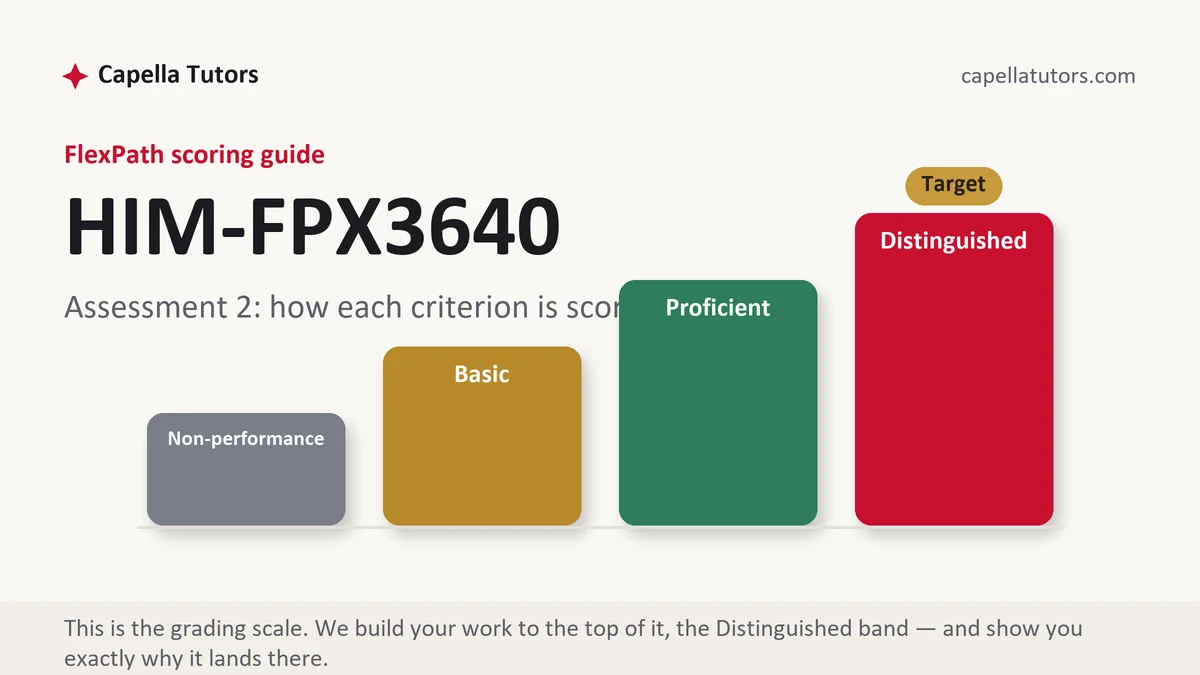
How HIM FPX 3640 Assessment 2 is scored
There is no curve and no letter grade in FlexPath. Your guide lists criteria, each criterion resolves to one of four levels, and the level descriptions tell you what to write:
| Level | What it means on a system recommendation |
|---|---|
| Distinguished | The recommendation names roles, an approval body, a review cadence and what happens when the review finds something. It also concedes the cost the change imposes on somebody's day. |
| Proficient | A sound recommendation, supported and complete, but written as a design rather than as an operating routine. Nothing wrong with it, and nothing that pins responsibility down. |
| Basic | The right idea stated in general terms. Access should be limited, training should be provided, logs should be reviewed, with nobody named and no cycle attached. |
| Non-performance | A required element never appears, most often the monitoring or the authority that approves the change. An empty row scores lower than a weak one. |
The word that decides this deliverable is who. A control nobody owns is a paragraph, and every criterion in the second half of this guide is built to notice the difference between a control that exists on paper and one that somebody performs on a schedule.
The HIM FPX 3640 Assessment 2 method, step by step
-
Read the criteria as a list of deliverables, then outline from them
Each criterion is asking for an object: a design, a comparison, a plan, a justification. Write the object names down the page as headings before you draft a sentence, and note next to each one what evidence would satisfy it. You are not writing an essay with sections; you are assembling the pieces the guide is buying.
-
State the problem in one sentence with a number in it
Your recommendation inherits its credibility from the sentence that sets it up. A situation described as confusing has no size and cannot be improved measurably. A situation described with a count, a base and a period gives you a baseline to promise movement against, and the last criterion in the guide almost always wants that promise.
-
Design against the standard, not around it
Access, privacy and integrity requirements are not decoration. Minimum necessary is a design instruction that decides which job may open which part of a chart, and quoting the phrase without applying it to named roles is the classic middle-column move. Take your organization's actual job titles, list what each one needs to do the work, and let the differences between them be the design.
-
Write the exception path, because the exception is where the risk lives
Every access model meets a situation it did not anticipate, and the answer is an emergency path that records itself. Say who may invoke it, what the system captures when they do, who reads those records, on what cycle, and what a lookup with no clinical explanation triggers. A control with no review is a setting rather than a safeguard.
-
Cost the change honestly in one paragraph
Somebody pays for every recommendation in staff hours, delay or inconvenience. Naming that cost is not a weakness in the paper, it is the evidence that you understand implementation, and an evaluator who has worked in a department can tell the difference immediately between a plan written by someone counting the hours and one written by someone who never did.
-
Check every criterion has a paragraph, then submit deliberately
Walk the guide top to bottom and point at the text that satisfies each row. If you cannot point, the row is not answered, however good the surrounding paper is. Then submit with days left in your session rather than hours, since two business days of evaluation plus one revision cycle is the realistic arithmetic of a FlexPath point.
A structure that maps to the criteria
Lengths below are the planning targets our tutors work to on a recommendation of this kind, not Capella requirements; expand any section your guide weights more heavily.
| Section | What it must do | Guide |
|---|---|---|
| Purpose and situation | The organization, the change under consideration, and the sized problem that prompted it. | ~175 words |
| Requirements that apply | The privacy, security and integrity requirements governing the decision, cited to their source. | ~225 words |
| The design | Job roles mapped to what they may open, with the reasoning for each difference between them. | ~350 words |
| Exceptions and oversight | The emergency path, what it records, who reviews it, how often, and the escalation rule. | ~250 words |
| Implementation and cost | Sequence, training by role, the approval body, and the burden the change creates. | ~200 words |
| Monitoring and references | The measure, its base, target, owner and cycle, plus current APA in text and list. | ~150 words |
Annotated sample excerpt
An original model paragraph from our team, showing how an operating control reads when it is written to be performed. Study the moves and then build your own version.
When Lakeshore Behavioral Health joined Meridian Community Hospital's record system in January, its 41 staff were mapped to six job profiles, and counseling notes were placed outside the profile carried by schedulers, registration staff and the medical surgical units.1 Any user outside those profiles who needs a counseling note may open it through the emergency path, which requires a reason from a fixed list and writes the user, the patient, the time and the reason to a report the privacy officer reviews every Monday.2 A lookup whose reason does not match a scheduled appointment or an open order is queried with the user's manager within two business days, and a second unexplained lookup by the same user moves to the compliance committee rather than staying inside the department.3
- 1Applies minimum necessary to real job profiles and a real number of users. The design is visible in what was excluded, which is where the reasoning belongs.
- 2The exception path is named, what it captures is listed, and a specific person reviews it on a stated day. Every element here is something an auditor could confirm.
- 3An escalation rule with a threshold and a destination outside the department. Naming what happens on the second occurrence is the detail most submissions leave out.
The full premium sample for your exact assessment, written fresh to your scoring guide and issue, is free to request. Study it, revise it into your own voice, and submit work you understand.
The five mistakes that cost Distinguished
- Regulation quoted, never applied. A paragraph restating a privacy requirement, with no job title anywhere near it, answers a knowledge question the guide did not ask.
- A control with no reviewer. Logging is not oversight until somebody reads the log on a named cycle and something happens when a review finds an outlier.
- One training class for everyone. Roles that hold different permissions need different training, and a single session for all staff signals the design was never taken seriously.
- Free improvement. A recommendation that costs nobody anything has not been thought through, and evaluators in this field read that as inexperience.
- No baseline to move. Without a starting figure, the monitoring section can only promise attention rather than a measurable result.
Pre-submission checklist
- Every criterion answered in a section you can point at
- Real job titles mapped to what each may open, with the exclusions justified
- Emergency access path defined, with what it records and who reads it
- A review cadence, a threshold and an escalation destination in writing
- The cost of the change stated in hours, delay or inconvenience
- One measure with a base, a target, an owner and a review date
Recommendation due and no time to build it?
Send the criteria and whatever you know about the setting, the job titles and the system. Eight people sit between your brief and the file you download, one of whom reads the finished draft against your guide and does nothing else. One premium original deliverable inside 24 to 48 hours, with revision at no charge until every row is satisfied.