This manual is for HIM FPX 3640 Assessment 1, start to submission. Assessment 1 opens Managing Electronic Health Records Systems, and it usually asks for something that sounds easy and is not: an account of how a record system behaves inside one real organization today, with the problem you picked described in counts rather than in complaints. The assessment usually asks you to set a scope, establish the current state, and analyze what produces it, so the grade turns on evidence and boundaries rather than on how much you know about the software. Below is the method our tutors use for it, a structure that maps to the criteria, and an annotated sample excerpt. Prefer to hand it off? A premium original sample for this exact assessment comes back in 24 to 48 hours, revised free until it meets the guide. Capella's catalog lists the course as HIM-FPX3640, and some courserooms print HIM3640; both point to this same Assessment 1.
One honesty note before the manual: Capella revises courses and scoring guides over time, so always write to the exact scoring guide attached to your assessment in the courseroom. The course identity above is verified on capella.edu; the method and structure below are our tutors' approach to it, not Capella's official rubric text.
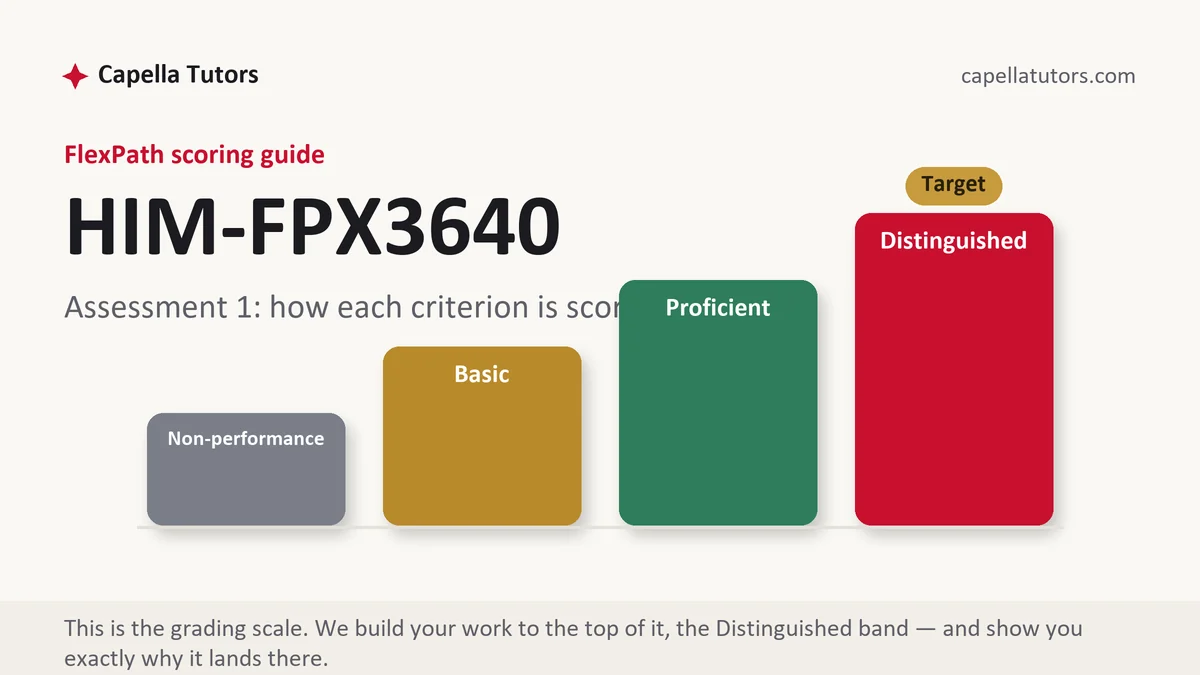
How HIM FPX 3640 Assessment 1 is scored
FlexPath awards no letter grades. Every criterion on your scoring guide settles on one of four levels, and the wording of the level you are aiming at is the brief you should be writing to:
| Level | What it means on a current-state system analysis |
|---|---|
| Distinguished | The scope is one decision wide, the present situation carries figures with their bases attached, and the analysis explains the workflow that manufactures those figures. The extra move sits inside the criterion sentence; find it and make it. |
| Proficient | The problem is described accurately, completely, and with numbers in it. Correct work, one step short of saying why the numbers look the way they do. |
| Basic | A general account of electronic records, with the organization appearing only as adjectives. This is where most first attempts in this course land. |
| Non-performance | Something a criterion asked for is not on the page, usually the scope statement or the measured baseline. Missing costs more than thin. |
Two habits carry more weight here than anything else. Name the boundary of the paper in the first paragraph, and put a denominator beside every count. Undergraduate submissions in this course rarely fail on knowledge; they fail because a reader cannot tell what the paper is about, or cannot check a single figure in it.
The HIM FPX 3640 Assessment 1 method, step by step
-
Turn the criteria into your headings before anything else
Open the scoring guide, copy each criterion into your document as a heading, and paste the top-level description underneath it in a different color. That skeleton is the assignment. Any paragraph you later write that does not sit under one of those headings is unpaid work, and there is a lot of it in submissions that score in the middle.
-
Pick one decision and defend the boundary out loud
A record system reaches registration, coding, ordering, billing and release of information, so a paper without a boundary drifts across all of them and satisfies no criterion fully. Choose a single decision, then write one sentence on what the paper covers and one on what it leaves out. An evaluator reading a stated boundary stops looking for the missing topics.
-
Describe the organization so the paper could only be about it
Give the setting, the number of sites, the staff who touch the workflow, the record system in use and the department that owns it. If you work in health information, use your own employer and say so. If not, construct the facility, label it as constructed, then keep every later figure consistent with the parameters you set. Consistency is what an evaluator can verify.
-
Count something, and put the base in the same sentence
Adjectives cannot be graded and cannot be improved. Volumes, rates and elapsed times can. Report a count with the population and the period it came from, because one numerator carries two meanings against two bases, and the criterion asking about current performance is asking whether you know that.
-
Trace the workflow that produces the number
Follow the data from the moment somebody types it to the moment somebody relies on it, and mark the point where the defect enters. A number without a workflow behind it is a symptom, and symptom papers stall at Proficient. Say which step lacks a control, whether the control is technical or procedural, and who currently owns it.
-
Grade your own draft, then submit with room in the session
Read the draft one criterion at a time and mark yourself at each level honestly. Anything you cannot defend at the top level gets one more pass. Submit early in the week, because an evaluator has up to two business days for each attempt and a Friday submission can idle over the weekend before the clock even starts.
A structure that maps to the criteria
These lengths are planning targets our tutors use for a first analysis in this course, not Capella rules, and your scoring guide outranks them wherever it asks for more.
| Section | What it must do | Guide |
|---|---|---|
| Introduction and scope | Name the organization, the decision under examination, and what the paper covers and excludes. | ~150 words |
| The organization and its system | Setting, size, record system, the department that owns it, and the roles inside the workflow. | ~200 words |
| Current state, measured | What happens today, with counts, rates or elapsed times, each carrying its base and period. | ~350 words |
| Analysis of causes | The workflow step where the defect enters, the missing control, and who owns it now. | ~300 words |
| What the analysis implies | The one change this evidence points to, and the risk of leaving the situation alone. | ~150 words |
| References | Current APA in both directions, with standards and practice guidance cited to their source. | as needed |
Annotated sample excerpt
An original model paragraph from our team, written to show the register that scores at the top of the guide. Treat it as study material: take the moves, then write your own.
Riverbend Orthopedic Group runs one record system across three clinic sites, and its master patient index held 96,400 identities at the end of April.1 The health information department's monthly integrity report flagged 1,140 of those identities as suspected duplicates, or 1.2 percent of the file, and 61 of the 3,880 accounts created during April were flagged, a creation rate of 15.7 suspected duplicates per 1,000 new registrations.2 Front-desk staff at all three sites can create an account from the scheduling screen without completing a search of the existing index, and the walk-in workflow at the west site skips that search by design when a patient arrives without an insurance card.3
- 1Opens on the organization and the size of the file, so every rate that follows has something to sit on. No definition of a master patient index, because the criterion does not pay for one.
- 2Two rates, each with its own base and period, and they answer different questions: how much of the file is affected, and how fast the problem is being added to. Reporting both is the move that separates the top two columns.
- 3Points at the exact workflow step where the defect enters instead of blaming staff. A missing search is a control that can be added; carelessness is not.
The full premium sample for your exact assessment, written fresh to your scoring guide and issue, is free to request. Study it, revise it into your own voice, and submit work you understand.
The five mistakes that cost Distinguished
- The textbook opening. Two paragraphs explaining what an electronic record is, in a paper whose criteria never asked, spends the reader's attention before the analysis begins.
- No boundary. A paper touching interfaces, privacy, training and cost in four shallow pages answers no criterion completely.
- Counts with no base. Forty-one flagged accounts means nothing until the reader knows how many accounts were created and over what period.
- Invented precision. A figure carried to two decimals in a scenario you constructed reads as false, and honest estimates labeled as estimates never do.
- Description where the verb said analyze. The criterion's verb sets the ceiling, and describing a system that the guide asked you to analyze caps the row before the writing is judged.
Pre-submission checklist
- Each scoring-guide criterion has its own labeled section
- Scope stated in the introduction, including what the paper excludes
- Every count reported with its denominator and its period
- Constructed figures labeled as constructed, and consistent from section to section
- The cause tied to a named workflow step with a current owner
- Current APA in text and list, with standards cited to the body that publishes them
Want this assessment done with backup?
Send the prompt, the scoring guide, and any counts you can share about registrations, tickets or duplicate volumes. A team of eight, including a research analyst and two QA reviewers, returns a premium original sample written to the Distinguished column in 24 to 48 hours, with revisions until it gets there.