This manual is for HIM FPX 2670 Assessment 3, start to submission. Assessment 3 of HIM FPX 2670, Strategic Management of Health Information Systems, is the one that has to survive contact with a working department. The assessment usually asks you to plan an implementation and say how anybody would know afterwards whether it worked, and your scoring guide decides whether that arrives as a project plan, a rollout schedule, a risk register or a presentation with speaker notes. A plan in which nothing can go wrong is the clearest sign that the risks were never examined. Below is the method our tutors use for this deliverable, a structure built from the criteria, and an annotated sample excerpt. Prefer to hand it off? A premium original sample for this exact assessment comes back in 24 to 48 hours, revised free until it meets the guide. Capella's catalog lists the course as HIM-FPX2670, and some courserooms print HIM2670; both point to this same Assessment 3.
One honesty note before the manual: Capella revises courses and scoring guides over time, so always write to the exact scoring guide attached to your assessment in the courseroom. The course identity above is verified on capella.edu; the method and structure below are our tutors' approach to it, not Capella's official rubric text.
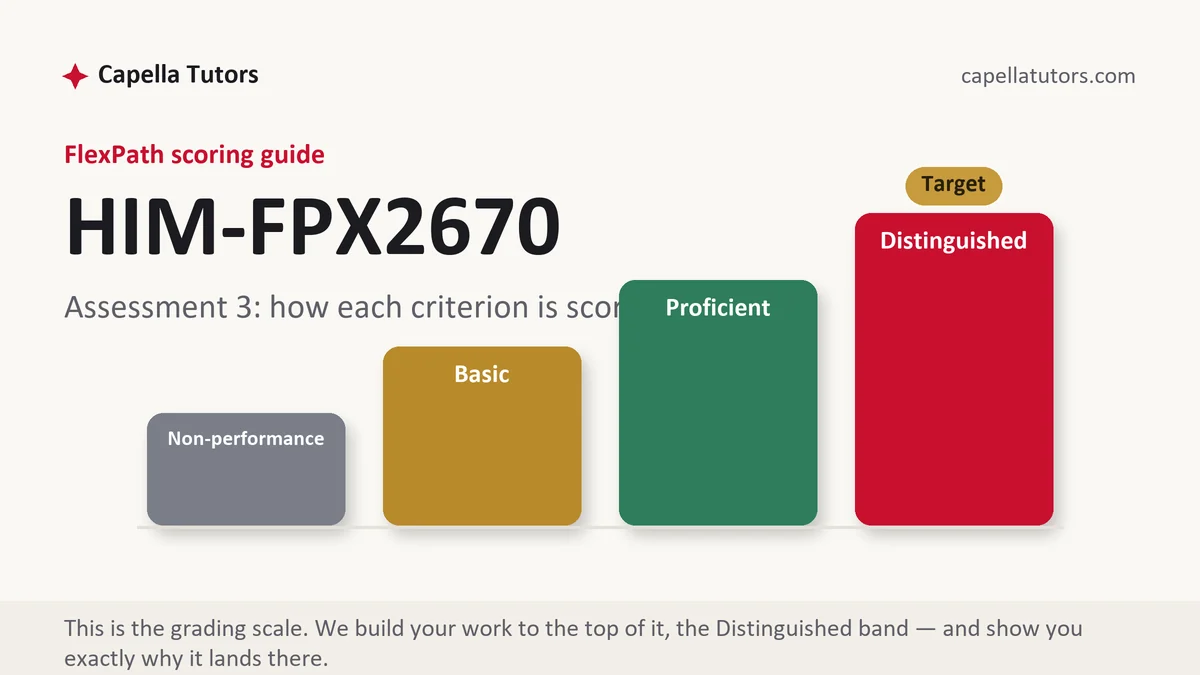
How HIM FPX 2670 Assessment 3 is scored
Four written levels, marked criterion by criterion, and on an implementation and measurement deliverable the levels separate by whether the plan admits it could fail:
| Level | What it means on an implementation and measurement plan |
|---|---|
| Distinguished | The rollout approach is chosen with its consequence stated, the sequence shows what must finish before the next thing starts, every stage has an owner, risks carry likelihood, consequence and a response, and the measures have baselines captured before go-live plus a threshold that would count as failure. |
| Proficient | A complete and sensible plan with owners and dates, and measures named without baselines or a failure threshold. |
| Basic | A schedule. Phases listed in a credible order, no dependencies, no owners, and benefits asserted rather than measured. |
| Non-performance | A required element is absent, most often the risk analysis or the measurement plan, or the approach is named with no reasoning behind the choice. |
The sample runs on a 240-bed hospital rolling out computer-assisted coding inside its health information department, where the software proposes codes from the documentation and the coder accepts, edits or rejects each one. The department has fourteen coders and a change that will make the first four weeks slower before it makes anything faster, which is the fact most student plans leave out.
The HIM FPX 2670 Assessment 3 method, step by step
-
Build the criteria into the plan's own headings
Approach, sequence, risk and measurement are usually separate criteria, and a plan written as one narrative leaves at least one of them implied. Give each its own heading.
-
Choose the rollout approach and state what it costs you
A single cutover concentrates the disruption and ends it quickly. A phased rollout stretches the period during which two ways of working have to be reconciled. A pilot buys evidence and spends momentum. Name the one you chose, name the consequence you accepted, and the criterion is answered in two sentences.
-
Sequence the work by dependency
Say what has to be finished before the next thing can start: the documentation samples that train the tool, the code set and edit rules loaded and checked, the interface to the abstracting system tested with real records, then the first group of coders.
-
Write the risks with three parts each
Likelihood, consequence and a response, plus the trigger that would make you stop. For this scenario the honest register includes coders accepting proposals without reading them, the tool performing well on routine records and poorly on the complex ones that carry the most weight, productivity falling during training while the unbilled backlog grows, and a code set update arriving mid-rollout. Each of those gets a named owner and a response, and one of them gets a rollback condition.
-
Capture the baseline while the old process still runs
Measures have to be taken before go-live or they are not baselines. Records coded per hour, the accuracy rate from your own quality review, days between discharge and final bill, and query volume back to physicians are all countable without special tooling, and every one of them needs a value, a date and a method recorded now.
-
Set the review date and the failure threshold, then self-score
Name the date somebody has to report, the number that would count as success, and the number that would count as the project having failed. Then mark yourself against each criterion, rewrite anything below the top level, and submit early in the week, since an evaluation can take up to two business days.
A structure that maps to the criteria
The figures below are our tutors' planning targets for a plan of this scope, not Capella requirements, and your scoring guide decides the sections and the format.
| Section | What it must do | Guide |
|---|---|---|
| Scope and approach | What is being implemented, for whom, and which rollout approach was chosen with the consequence accepted. | ~225 words |
| Sequence and dependencies | The stages in order, what each one waits for, who owns it, and what the department does if it slips. | ~325 words |
| People and training | Who is trained, when, how the hours are covered, and what completion is a gate for. | ~225 words |
| Risk register | Each risk with likelihood, consequence, response, owner, and the trigger that would stop the rollout. | ~300 words |
| Measurement | Indicators with baseline values, the method and date of capture, the review date, and the failure threshold. | ~275 words |
| References | Peer-reviewed implementation studies read with their design in view, standards and federal material, current APA both ways. | as needed |
Annotated sample excerpt
An original model excerpt from our team, written to show a measurement section with something at stake in it. Learn the sequence, then build yours from your own scenario.
Baselines were captured across the four weeks ending 12 March, while the current process was still the only process: 3.1 inpatient records coded per coder hour, an accuracy rate of 94.2 percent from the department's own monthly review of 30 records per coder, 6.8 days between discharge and final bill, and 1.9 physician queries per hundred records.1 The plan expects productivity to fall for the first four weeks after each group goes live, so the first review on 30 June asks only that accuracy has not dropped below the baseline and that unbilled days have not exceeded 8.5; the productivity target of 3.8 records per hour is not tested until the review on 30 September.2 Failure is defined in advance: accuracy below 92 percent at either review, or unbilled days above 9.5 for two consecutive weeks, returns the affected group to the previous workflow while the proposals are re-examined, and the decision belongs to the coding manager rather than to the vendor.3
- 1Four measures, each with a value, a window and the method that produced it. Baselines dated before go-live are what make every later claim checkable.
- 2The plan states that things will get worse before they get better and sequences its own reviews accordingly.
- 3Failure is defined numerically and the rollback decision is given to a named role inside the organization. A plan that cannot fail is a plan nobody has to keep honest.
The full premium sample for your exact assessment, written fresh to your scoring guide and issue, is free to request. Study it, revise it into your own voice, and submit work you understand.
The five mistakes that cost Distinguished
- Benefits with no before figure. Claiming improved turnaround without a baseline gives the reader nothing to verify and the department nothing to manage.
- A schedule without dependencies. Stages in a row cannot answer the only question a plan gets asked, which is what happens when one of them slips.
- Risks written as worries. Staff resistance is a mood. A likelihood, a consequence, a response and an owner is a risk.
- Training counted in hours nobody covers. Fourteen coders in a classroom is fourteen coders not coding, and a plan that omits the backfill has understated its own cost.
- No definition of failure. A plan with no threshold and no rollback owner is a plan that will be defended long after it should have been stopped.
Pre-submission checklist
- The rollout approach named with the consequence you accepted stated
- Stages sequenced by dependency, each with an owner and a slip response
- Training hours covered, with completion tied to something enforceable
- Every risk carrying likelihood, consequence, response and owner
- Baselines captured before go-live with values, dates and methods
- A review date, a success number and a failure threshold, APA reconciled both ways
Rollout plan due and every phase looks the same length?
Send the prompt, the guide and what your scenario says about the department. Inside 24 to 48 hours you get the approach with its trade-off stated, a sequence built on dependencies, a risk register with owners and triggers, and a measurement section with baselines and a failure threshold. Marked against your criteria before it arrives, and revised free.