This manual is for HIM FPX 2670 Assessment 1, start to submission. Assessment 1 of HIM FPX 2670, Strategic Management of Health Information Systems, is the one that has to be written before anybody looks at a product. The assessment usually asks you to describe an organization's current state and turn its problems into requirements, and your scoring guide decides whether that arrives as a report, a needs analysis, a memo or a set of specifications. Describing the software an organization already owns is not the same as stating what it needs, and the criteria are built to tell the two apart. Below is the method our tutors use for this deliverable, a structure built from the criteria, and an annotated sample excerpt. Prefer to hand it off? A premium original sample for this exact assessment comes back in 24 to 48 hours, revised free until it meets the guide. Capella's catalog lists the course as HIM-FPX2670, and some courserooms print HIM2670; both point to this same Assessment 1.
One honesty note before the manual: Capella revises courses and scoring guides over time, so always write to the exact scoring guide attached to your assessment in the courseroom. The course identity above is verified on capella.edu; the method and structure below are our tutors' approach to it, not Capella's official rubric text.
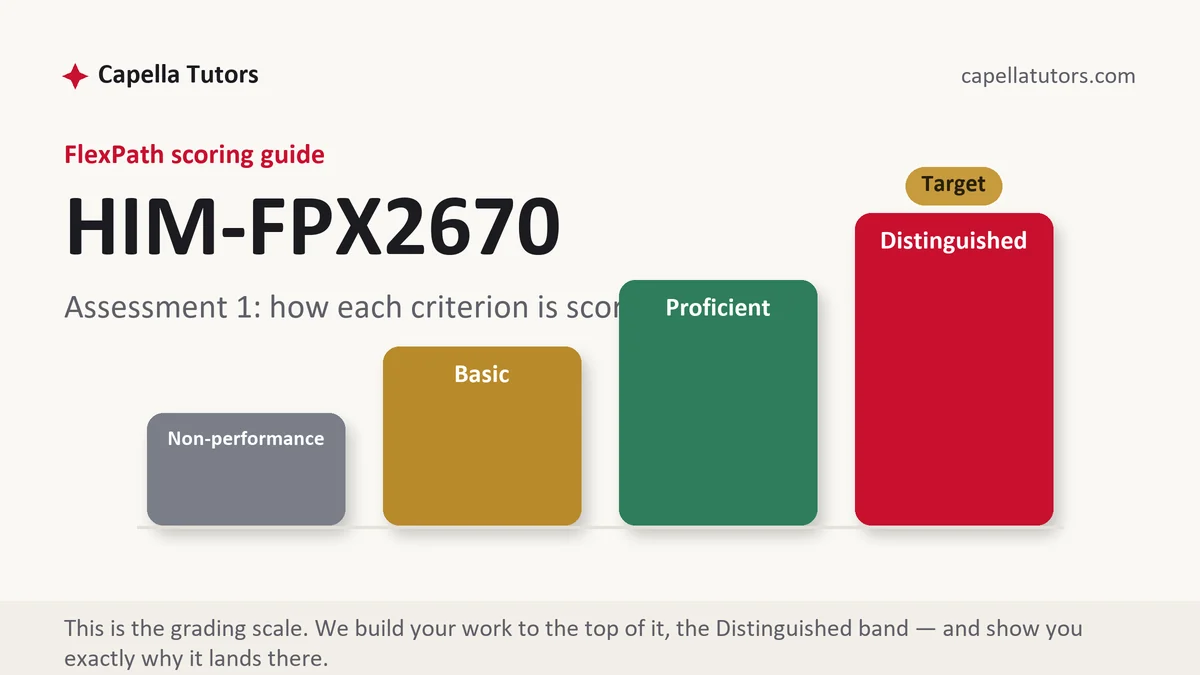
How HIM FPX 2670 Assessment 1 is scored
FlexPath marks each criterion separately against four written levels, and on a current state and requirements deliverable the levels sort by whether the writing could be tested:
| Level | What it means on a current state and requirements analysis |
|---|---|
| Distinguished | The problem carries a measure, the workflow is described as it happens rather than as the manual says, each requirement is written so a demonstration could pass or fail it, must-have is separated from desirable before any option appears, and every requirement traces back to a named problem. |
| Proficient | An accurate account of the current state and a complete requirement list, with the requirements phrased as capabilities rather than as tests. |
| Basic | A description of the existing system and a wish list. Everything correct, nothing measurable, and no way to tell which items are negotiable. |
| Non-performance | A required element is missing, most often the current state measurement, or the requirements are transcribed from a vendor's feature list. |
The sample runs on a four-provider primary care clinic in a rural county whose practice management system was installed twelve years ago and is no longer supported by its publisher. The interesting part is not the age of the software. It is that nobody at the clinic can say how long a records request takes, which means the first job is measurement rather than shopping.
The HIM FPX 2670 Assessment 1 method, step by step
-
Convert the criteria into headings before you write a line
Systems papers slide into description faster than any other assessment type in this program, and description earns the middle column. Headings taken straight from the criteria are what keep each paragraph accountable to something.
-
Describe the workflow as it actually runs
Walk one process end to end and count the steps: who touches the paper, where the same information is typed a second time, what gets carried across the hall, and how long each hand-off waits.
-
Give the problem a number
Slow, inefficient and outdated are not findings. Eleven days average turnaround on a records request, 34 percent of new patients arriving without their referral attached, four hours a week spent rekeying insurance details: each of those can be argued with, and each becomes the baseline you will measure the eventual decision against.
-
Write requirements as tests, not as adjectives
The system shall be user friendly cannot pass or fail. A clerk with two hours of training shall complete a new patient registration, including insurance verification, in under four minutes can. Write every requirement so a demonstration decides it, and split the list into must-have and desirable while no salesperson is in the room, because everything looks essential once one is.
-
Script the demonstration from your own organization
Draft three or four scenarios drawn from the clinic's real week, a walk-in with no record, a records request from an attorney's office, a referral arriving from a hospital fifty miles away, and require each vendor to perform them rather than to present the tour they prepared.
-
Trace every requirement back, then self-score
Put a column on your requirement table naming the problem each line answers, and delete anything that cannot fill it in. Then mark yourself against each criterion, rewrite what sits below the top level, and submit early in the week, since an evaluation can occupy two business days.
A structure that maps to the criteria
Treat the lengths below as our tutors' planning figures for an analysis of this size rather than as Capella requirements, since the sections and the format belong to your scoring guide.
| Section | What it must do | Guide |
|---|---|---|
| The organization | Type, size, staffing, patient volume, and the systems currently in place with their ages and support status. | ~200 words |
| Current workflow | One or two processes described step by step as observed, with the hand-offs and the duplicate entry marked. | ~300 words |
| The problem, measured | Each problem stated with a figure, a source for the figure, and the consequence it produces for staff or patients. | ~275 words |
| Requirements | Functional, technical, security and reporting needs, written as pass or fail tests and split into must-have and desirable. | ~350 words |
| Demonstration scenarios | Three or four scripted scenarios from this organization that every option will be asked to perform. | ~175 words |
| References | Peer-reviewed informatics work, federal certification material, standards bodies, current APA both ways. | as needed |
Annotated sample excerpt
An original model excerpt from our team, written to show a requirement that can be failed. Read it for the pattern, then build yours around the organization in your prompt.
Over the eight weeks reviewed, the clinic completed 96 records requests in an average of 11.4 days, with the slowest quarter of them taking more than 18, and the delay is not created by the request itself: 7 of those days are spent waiting for a provider to sign a printed authorization that sits in a physical tray.1 Registration shows the same shape. Insurance details are typed once into the practice management system and again into the clearinghouse portal, which the front desk staff estimate at four hours a week and which produced 23 rejected claims last quarter for mismatched member identifiers.2 The requirement that follows is therefore not a better interface but a testable one: the system shall transmit eligibility verification to the clearinghouse without re-entry, and shall return a result within 60 seconds during a live demonstration using three of the clinic's own payers.3
- 1The problem arrives with a count, a window, a distribution and the location of the delay. A measured baseline is what any later claim of improvement will be judged against.
- 2Duplicate entry is quantified in staff hours and in rejected claims, so the cost sits in two currencies a reader can recognize.
- 3The requirement is written as a test with a threshold and the organization's own payers in it, which is the difference between a specification and a preference.
The full premium sample for your exact assessment, written fresh to your scoring guide and issue, is free to request. Study it, revise it into your own voice, and submit work you understand.
The five mistakes that cost Distinguished
- Requirements lifted from a brochure. Build the list from one vendor's feature set and that vendor has won the evaluation before it opens.
- A current state with no numbers. Inefficient is an opinion, and an opinion cannot serve as the baseline the measurement criterion will ask for later.
- User friendly as a specification. Anything a demonstration cannot pass or fail belongs in the desirable column or nowhere.
- The workflow as written rather than as worked. Copying a policy's version of the process hides the rekeying and the waiting that the paper exists to find.
- No must-have line drawn. A requirement list with no priorities gives every option a way to appear compliant.
Pre-submission checklist
- The organization described with size, volume and the age and support status of current systems
- At least one workflow walked step by step as observed, hand-offs marked
- Every problem carrying a figure and the source of that figure
- Each requirement written as something a demonstration could fail
- Must-have and desirable separated before any option is named
- Every requirement traced to a stated problem, APA reconciled both ways
Needs analysis due and the current state is a blur?
Send the prompt, the guide and whatever the scenario tells you about the organization. Inside 24 to 48 hours you get the workflow walked step by step, the problems carrying figures, and a requirement table written as tests with priorities and traceability. A reviewer scores it against your criteria first, and revisions are free.