This manual is for HIM FPX 2670 Assessment 2, start to submission. Assessment 2 of HIM FPX 2670, Strategic Management of Health Information Systems, is where a decision has to be defended with arithmetic. The assessment usually asks you to compare options against weighted criteria and cost the winner across the life of the commitment, and your scoring guide decides whether that arrives as a recommendation memo, a comparison matrix, a business case or a presentation. A quoted price per user is not a cost of ownership, and this is the criterion where most undergraduate drafts stop too early. Below is the method our tutors use for this deliverable, a structure built from the criteria, and an annotated sample excerpt. Prefer to hand it off? A premium original sample for this exact assessment comes back in 24 to 48 hours, revised free until it meets the guide. Capella's catalog lists the course as HIM-FPX2670, and some courserooms print HIM2670; both point to this same Assessment 2.
One honesty note before the manual: Capella revises courses and scoring guides over time, so always write to the exact scoring guide attached to your assessment in the courseroom. The course identity above is verified on capella.edu; the method and structure below are our tutors' approach to it, not Capella's official rubric text.
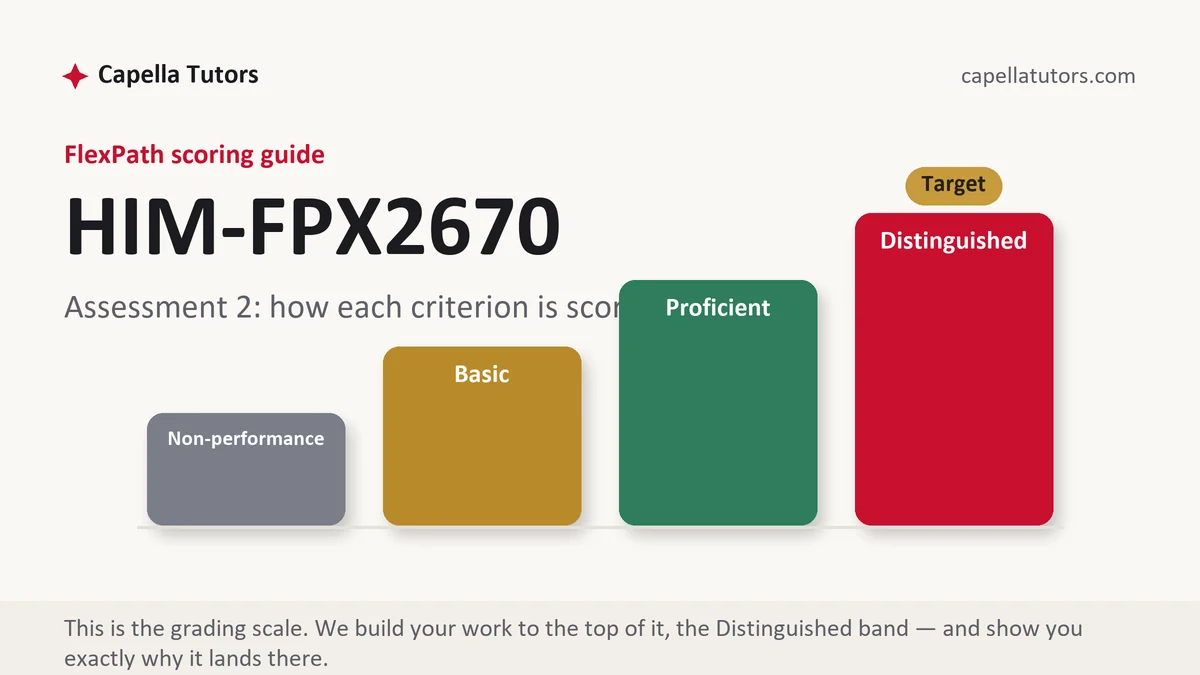
How HIM FPX 2670 Assessment 2 is scored
Each criterion is judged on its own against four written levels, and on an options and cost deliverable the levels separate by whether a reader could audit the work:
| Level | What it means on an evaluation and cost of ownership analysis |
|---|---|
| Distinguished | Weights are published and justified before any score appears, doing nothing is treated as a real option, the cost model adds up across at least five years with every assumption visible, the largest cost driver is named, and the runner-up is taken seriously enough to say what would change the answer. |
| Proficient | A sound comparison and a complete cost table, with weights asserted rather than defended and the alternatives dismissed briefly. |
| Basic | A feature comparison and a price. Accurate as far as it goes, and it goes about half as far as the commitment does. |
| Non-performance | A required element never appears, most often the multi-year model, or the scores arrive with no criteria behind them. |
The sample runs on a three-hospital system that has measured about 2.2 percent of its 1.9 million patient identities as suspected duplicate pairs and is deciding whether to buy an enterprise identity matching service, hire two data quality analysts to work the queue by hand, or leave the problem for another year. Each of those is a real option with a price.
The HIM FPX 2670 Assessment 2 method, step by step
-
Put the criteria in the outline, then keep the sections apart
Evaluation and cost are separate criteria and they collapse into each other unless you build them as separate sections. Decide in the outline which one owns the recommendation, and let the other one feed it.
-
Include doing nothing as an option with a price
Rework hours, denied claims, the duplicate identities created every month while the decision waits: put a figure on all of it, because a comparison against nothing is how a reader knows the recommendation was necessary rather than merely attractive.
-
Publish the weights before the scores
List the criteria, assign the weights, and write one sentence defending each weight. Only then score the options. A weight defended in advance can be argued with, and a weight that appears after the scores cannot.
-
Build the cost model in lines, not in a total
Subscription or license, one-time data work, every interface priced separately, hosting, training hours and the backfill to cover the people in training, annual support, and the staff time the new process will consume permanently. Arrange it over five years, show each year, and label every figure with the assumption behind it so a reader can change one number and watch the total move.
-
Name the largest driver and say what it means
The instructive part of a cost model is its shape. When one-time cleanup or interface work outweighs the subscription, the sentence saying so is the analysis, and it usually changes the negotiation the organization should be having.
-
Test the recommendation, then self-score
Ask which single assumption would have to be wrong to change your answer, then write that sentence into the paper. Mark yourself against each criterion afterwards, revise anything below the top level, and submit early in the week given a two business day evaluation window.
A structure that maps to the criteria
These targets are our tutors' planning figures for an analysis of this scope rather than Capella rules, and your scoring guide decides the format and the length.
| Section | What it must do | Guide |
|---|---|---|
| Decision and options | What is being decided, the alternatives on the table including doing nothing, and what each one is meant to fix. | ~200 words |
| Criteria and weights | The comparison criteria, the weight on each, and a sentence defending every weight before any scoring. | ~250 words |
| Scored comparison | The options against the weighted criteria, with the evidence behind each score named and vendor claims labeled as claims. | ~300 words |
| Cost of ownership | Every line of cost across five years, year by year, with assumptions attached and the arithmetic shown. | ~350 words |
| Recommendation | The choice, the largest cost driver, what the runner-up would need to win, and the assumption that would overturn the answer. | ~225 words |
| References | Peer-reviewed evaluations, federal and standards material, industry sources labeled as such, current APA both ways. | as needed |
Annotated sample excerpt
A model excerpt from our team, showing a cost model whose arithmetic a reader can follow. Take the pattern, then build yours from the figures your prompt allows.
Year one carries four lines: the platform subscription at $86,000, one-time remediation of roughly 41,000 suspected duplicate pairs quoted at $1.90 each for $77,900, three interfaces to the registration, laboratory and billing systems at $9,200 each for $27,600, and half of a data quality analyst's year at a loaded $58,000, which is $29,000, giving $220,500.1 Years two through five carry the subscription and the analyst only, $115,000 a year, so $460,000 across the four, and the five-year commitment is $680,500.2 The shape of that number is the finding. Remediation and interfaces, both of them one-time lines that never appeared in the vendor's per-record pricing, account for more than 47 percent of year one, and the analyst who has to keep working the queue afterwards is the line the organization will be tempted to cut first and can least afford to.3
- 1Each line shows its unit, its quantity and its arithmetic, so a reader can change the per-pair price and recompute without asking the writer anything.
- 2The recurring years are separated from year one, which is what makes a five-year figure meaningful rather than decorative.
- 3Names the largest driver, notes that it was absent from the sales conversation, and identifies the line most at risk later.
The full premium sample for your exact assessment, written fresh to your scoring guide and issue, is free to request. Study it, revise it into your own voice, and submit work you understand.
The five mistakes that cost Distinguished
- The subscription mistaken for the cost. One-time work, interfaces and permanent staff time usually outweigh it, and omitting them understates the decision by half.
- Weights that arrive after the scores. A matrix built backwards is a decision wearing an analysis, and the numbers give it away.
- Doing nothing left off the table. Without the cost of the status quo, the recommendation has no floor to stand on.
- Vendor claims quoted as findings. Marketing material can be cited, and it has to be attributed as a claim in the sentence that uses it.
- A total with no arithmetic. A five-year figure that cannot be reproduced from the lines above it is a number the reader has to take on trust.
Pre-submission checklist
- Every option listed, including doing nothing, each with a cost
- Weights published and defended before any score appears
- Each score supported by named evidence, vendor material labeled as a claim
- Five years of cost shown line by line with visible assumptions
- The largest cost driver named and interpreted
- The assumption that would change the recommendation stated, APA reconciled both ways
Cost model due and the numbers will not behave?
Send the prompt, the guide and any figures your scenario provides. Back inside 24 to 48 hours comes the weighted matrix with its weights defended, a five-year model whose arithmetic a reader can follow, and a recommendation that names its own weakest assumption. A reviewer marks it against your criteria before delivery, and rewrites are free.