This manual is for HIM FPX 1610 Assessment 1, start to submission. Assessment 1 of HIM FPX 1610, Introduction to Medical Terminology, is where the course stops asking whether you recognize a word and starts asking whether you can take one apart. The assessment usually asks you to analyze a set of assigned terms, say what each word part contributes, and render the meaning for somebody who does not work inside the chart, and your scoring guide decides whether that arrives as a table, a memo or continuous prose. Pasting a dictionary entry is the Basic answer. Below is the method our tutors use for this deliverable, a structure built from the criteria, and an annotated sample excerpt. Prefer to hand it off? A premium original sample for this exact assessment comes back in 24 to 48 hours, revised free until it meets the guide. Capella's catalog lists the course as HIM-FPX1610, and some courserooms print HIM1610; both point to this same Assessment 1.
One honesty note before the manual: Capella revises courses and scoring guides over time, so always write to the exact scoring guide attached to your assessment in the courseroom. The course identity above is verified on capella.edu; the method and structure below are our tutors' approach to it, not Capella's official rubric text.
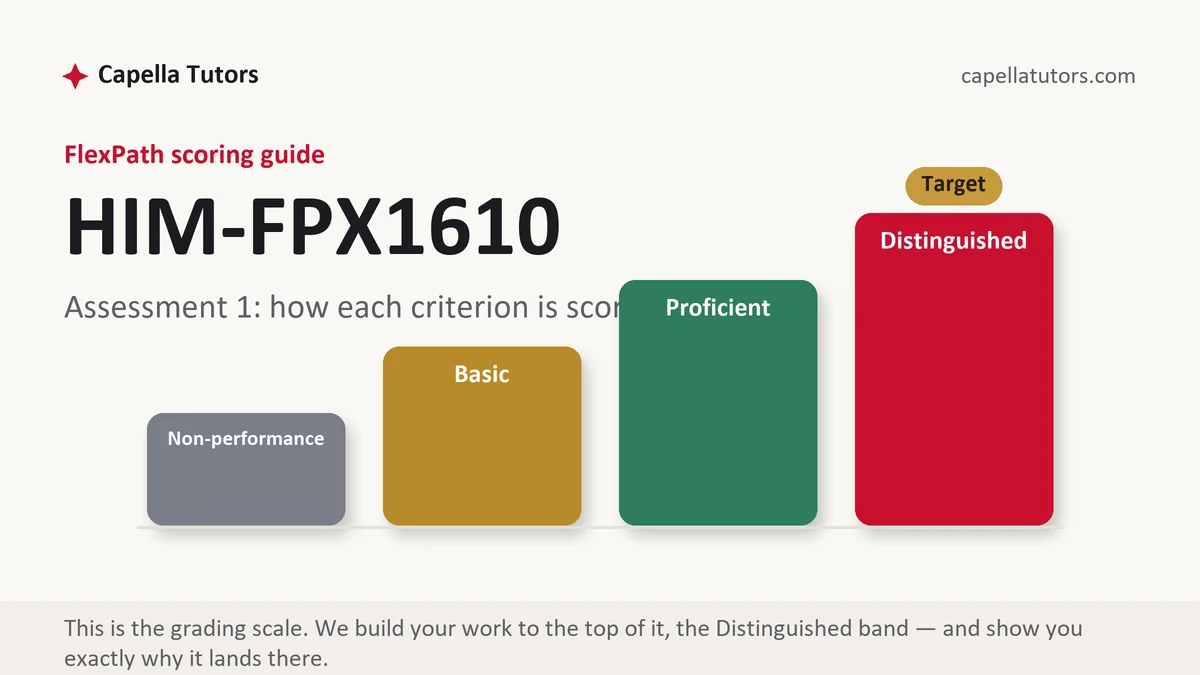
How HIM FPX 1610 Assessment 1 is scored
FlexPath issues no letter grades. Each criterion is marked on its own against four written levels, and on a term analysis those levels sort themselves by how far the writing travels past recognition:
| Level | What it means on a term analysis |
|---|---|
| Distinguished | Every term is separated into its parts, the combining vowel rule is applied correctly where it is awkward as well as where it is easy, each meaning is placed in the situation the source describes, and the plain-language line keeps the clinical word instead of deleting it. |
| Proficient | Parts identified, meanings accurate, and a plain-language version written for a general reader rather than for the reader the assessment named. |
| Basic | A glossary. Correct, sourced, and still written in the vocabulary the reader could not use in the first place. |
| Non-performance | A required element never appears, most often the breakdown itself, with terms defined but never taken apart. |
The sample below runs on a multi-specialty group that hires four patient access clerks in one month, where somebody in health information has to build them a reference that survives a real morning at the front desk. Write for that reader and most of the criteria answer themselves, because a reference nobody can use fails in exactly the way the guide calls Basic.
The HIM FPX 1610 Assessment 1 method, step by step
-
Turn the criteria into columns before you look anything up
Number the criteria and decide which part of your working document answers each one. A terminology deliverable is marked element by element, so a term that arrives with a definition and no breakdown has answered half of one row and none of another.
-
Separate every term before you define any of them
Write the term, then the parts with slashes between them, then the literal assembly, and only then the meaning. Pericarditis is peri, cardi and itis before it is inflammation of the sac around the heart.
-
Apply the combining vowel rule where it is inconvenient
The o stays when the next part opens with a consonant and disappears when it opens with a vowel, which is why gastroenteritis keeps it and gastritis has none. Evaluators check the awkward terms rather than the tidy ones, so include at least one term where the rule changes the spelling and say in your analysis why it changed.
-
Give every term a body system and a reason for being in the set
Name the system the root belongs to and say why the term appears in the source you were handed, and the analysis criterion stops reading as a list and starts reading as an account of a document.
-
Write the plain-language line for a named reader, out loud
Decide who the sentence is for, then read it aloud to somebody outside health care and watch where they stop. Keep the clinical term and attach the everyday words to it, because a reader who loses the word has gained nothing usable on the phone tomorrow.
-
Trace the sources, then self-score
Every part and every definition should trace to a named edition of a medical dictionary or to a government plain-language source, cited in current APA both ways. Then mark yourself against each criterion, rewrite anything below the top level, and submit early in the week; an evaluation can take two business days.
A structure that maps to the criteria
The lengths below are our tutors' planning targets for a deliverable of this size, not Capella requirements. The sections and the length are your scoring guide's call.
| Section | What it must do | Guide |
|---|---|---|
| Purpose and source | What you were given, which section each term came from, and who the piece is for. | ~150 words |
| Word part analysis | Each term split into prefix, root, combining vowel and suffix, with the contribution of every part named separately. | ~350 words |
| Meaning in context | What each term means in the situation described rather than in the abstract, with the body system stated where it removes doubt. | ~275 words |
| Plain-language version | The sentence you would actually say to the named reader, clinical term retained and defined once. | ~250 words |
| Abbreviations handled | Short forms expanded at first use, and any prohibited entry flagged with the reason it was withdrawn from use. | ~150 words |
| References | Dictionary edition and year, government and professional sources, current APA in the text and in the list. | as needed |
Annotated sample excerpt
An original model excerpt from our team, written to show a breakdown carrying its own explanation. Read it for the sequence, then build your set from the terms you were actually assigned.
The four terms analyzed here were taken from the referral letters that reach the front desk most often, which is why they belong in a reference built for patient access staff rather than for clinicians.1 Esophagogastroduodenoscopy separates as esophag, o, gastr, o, duoden, o, scopy: three organs in the order the instrument meets them, followed by the act of looking, and the o survives at each join because gastr, duoden and scopy all open with consonants.2 For a clerk taking the call, that becomes a camera examination of the food pipe, the stomach and the first part of the small intestine, booked in the schedule as an EGD, which is the short form the reader will actually see on screen.3
- 1Source and reader are named in one sentence, which answers the purpose criterion before the analysis begins.
- 2The breakdown is carried through a term long enough to be uncomfortable and the vowel rule is stated rather than assumed. This is usually the sentence that separates the top two columns.
- 3The plain-language line keeps the clinical word, adds the everyday one, and ends on the abbreviation the reader will meet at work.
The full premium sample for your exact assessment, written fresh to your scoring guide and issue, is free to request. Study it, revise it into your own voice, and submit work you understand.
The five mistakes that cost Distinguished
- A glossary wearing a table's clothing. Four columns filled with dictionary text is still a list of definitions, and no amount of formatting satisfies an analysis criterion.
- Combining vowels placed by ear. An o kept in front of a suffix that opens with a vowel tells the evaluator the building rule was never learned.
- Definitions assembled from more clinical words. Explaining one term with three the reader also does not know moves the problem instead of solving it.
- Sound-alikes left unchecked. Ilium and ileum both clear a spelling checker and sit in different halves of the body.
- English plurals on Latin and Greek words. Diagnosises and vertebras are two-letter errors that invite a reader to check everything else twice.
Pre-submission checklist
- Every term separated into its parts before any definition appears
- The vowel rule applied and explained on at least one term where it changes the spelling
- Each term tied to a body system and to the document it came from
- A plain-language line written for one named reader and tested out loud
- Abbreviations expanded at first use, prohibited entries flagged with the reason
- Dictionary edition and year cited, APA reconciled both ways, self-scored before submitting
Term set due and it will not come apart?
Send the assigned terms, the source document and the guide, and say who the finished piece is written for. The sample arrives inside 24 to 48 hours with every term split to its parts in the same file as the wording a non-clinical reader could act on, and rewriting continues at no charge until the criteria are met.