This manual is for HIM FPX 1610 Assessment 2, start to submission. Assessment 2 of HIM FPX 1610, Introduction to Medical Terminology, moves from taking terms apart to writing for somebody who will never see the original document. The assessment usually asks you to work from a clinical report and produce something a reader outside the record can act on, and your scoring guide decides whether that arrives as a letter, a summary, a script or an essay. Simplifying by deleting the clinical content is the trap the criteria are built to catch. Below is the method our tutors use for this deliverable, a structure built from the criteria, and an annotated sample excerpt. Prefer to hand it off? A premium original sample for this exact assessment comes back in 24 to 48 hours, revised free until it meets the guide. Capella's catalog lists the course as HIM-FPX1610, and some courserooms print HIM1610; both point to this same Assessment 2.
One honesty note before the manual: Capella revises courses and scoring guides over time, so always write to the exact scoring guide attached to your assessment in the courseroom. The course identity above is verified on capella.edu; the method and structure below are our tutors' approach to it, not Capella's official rubric text.
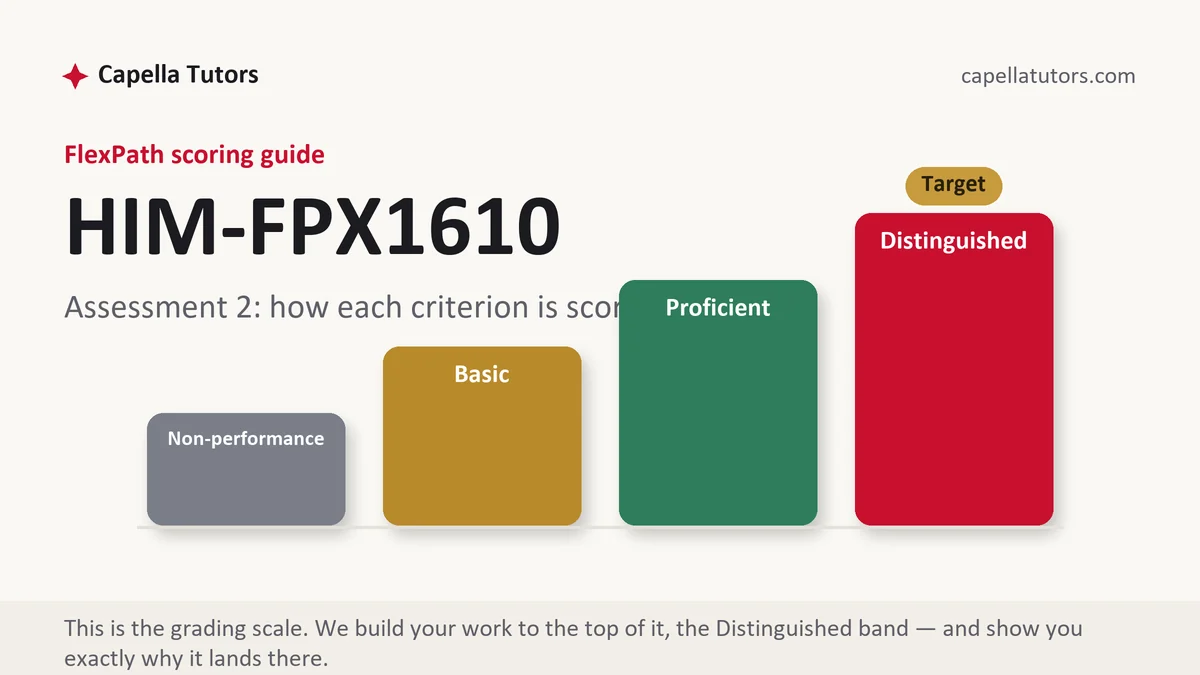
How HIM FPX 1610 Assessment 2 is scored
Every criterion lands on one of four written levels, judged on its own, and on a translation deliverable the levels separate along a single line: whether the clinical meaning survived the rewrite.
| Level | What it means on a plain-language translation |
|---|---|
| Distinguished | The reader can follow what was done, to which structure, and what it means for them, with the clinical terms kept and explained, nothing added that the source does not support, and the sentence lengths chosen for the reader rather than for the writer. |
| Proficient | Accurate and readable, with two or three terms carried across unexplained or one detail from the report quietly left behind. |
| Basic | Readable because it is vague. Organs and procedures generalized until the sentence is true of almost any patient. |
| Non-performance | Clinical content contradicted, or the required audience never addressed, so the document is written for the writer. |
The sample runs on an operative report for a gallbladder removal that has to become a letter for the patient who had it, on the day she calls to ask what happened. Two readers are being served in that letter at once: the woman who needs to understand her own surgery, and the evaluator who is checking whether you understood it well enough to explain it.
The HIM FPX 1610 Assessment 2 method, step by step
-
Read the criterion verbs first
Define, apply, translate and communicate are four different jobs, and only the first is satisfied by a definition. Copy each criterion into your outline as a heading and write the verb beside it, because the verb decides the shape of the paragraph underneath.
-
Inventory the source before you rewrite a word of it
List every clinical term in the report with the section it came from, then mark which ones the reader has to understand, which ones only need to be recognizable if they see them again, and which are internal detail.
-
Build the meaning from the parts, not from a memory
Break each term you keep before you explain it, so cholecystectomy is chole, cyst and ectomy, bile plus bladder plus removal, and the explanation you write is anchored to something checkable.
-
Write the pair, term and everyday words, then use either
Introduce the clinical word once with its plain equivalent attached, then use whichever the sentence needs. The reader who meets cholecystectomy, the removal of the gallbladder, has gained a word they can recognize on a bill, and deleting it would have left them stranded the next time it appears.
-
Cut the sentence length, not the content
Federal plain-language guidance for health material points toward short sentences and everyday words, and the way to reach that is to split rather than to summarize. One clause per idea, active verbs, and the patient as the subject wherever the report allows it.
-
Test it on a real outsider, then self-score
Read the draft to somebody who has never worked in health care and ask them to tell you back what happened. Then mark yourself criterion by criterion, revise anything under the top level, and submit early enough that a two business day evaluation window does not cost you a weekend.
A structure that maps to the criteria
These targets are our tutors' planning figures for a translation of this size rather than Capella rules, and your scoring guide decides both the sections and the format.
| Section | What it must do | Guide |
|---|---|---|
| Reader and purpose | Who the document is for, what they already know, and what they need to be able to do after reading it. | ~125 words |
| The source, mapped | The report type and the terms taken from it, each marked as essential, recognizable or internal detail. | ~300 words |
| Terms built from parts | The retained terms separated into word parts, with the literal meaning assembled before the explanation. | ~275 words |
| The translation itself | The finished passage in the format the guide asks for, paired terms, short sentences, nothing invented. | ~350 words |
| Choices defended | What you kept, what you left out, and why each decision serves this reader rather than a general one. | ~200 words |
| References | Dictionary edition, plain-language and government sources, current APA reconciled in both directions. | as needed |
Annotated sample excerpt
A model paragraph from our team, showing paired terms doing the work in a letter a patient could actually keep. Learn the moves, then write yours from your own report.
Your surgeon removed your gallbladder, the small sac under your liver that stores bile, in an operation the report calls a laparoscopic cholecystectomy: chole for bile, cyst for the sac that holds it, ectomy for removal, and laparoscopic because the work was done through four small openings rather than one long one.1 The report also notes that the tissue was inflamed and thickened, which is what cholecystitis means, and that is the reason the operation took longer than a routine one.2 Nothing else was removed, the ducts that carry bile from your liver to your intestine were left in place, and your body will keep making bile without the storage sac, which is why fatty meals may be uncomfortable for a few weeks.3
- 1The clinical term is kept and taken apart in the same breath, so the patient can recognize it on a bill and the evaluator can see the word part analysis inside the translation.
- 2A finding from the report is explained rather than dropped, and it is connected to something the patient noticed.
- 3States what was not done, which prevents the commonest patient misreading, and stops at what the report supports instead of drifting into advice the document never gave.
The full premium sample for your exact assessment, written fresh to your scoring guide and issue, is free to request. Study it, revise it into your own voice, and submit work you understand.
The five mistakes that cost Distinguished
- Simplifying by subtracting. A sentence that removes the organ, the procedure and the finding is easy to read and tells the reader nothing they can use.
- Terms carried across untouched. Anastomosis in a patient letter, unexplained, is the report's vocabulary wearing a friendly font.
- Advice the source never gave. Adding what the patient should do next, when the report does not say it, is the one error that can push a criterion to the floor.
- One register for every reader. A passage aimed at a patient and a passage aimed at a new records clerk are two documents, and writing one for both satisfies neither criterion.
- Reading level claimed rather than shown. Saying the text is written in plain language while running twelve clauses per sentence invites the evaluator to count.
Pre-submission checklist
- Every retained term appears once with its everyday equivalent attached
- Each explanation traceable to word parts and to a cited reference, not to memory
- Nothing added that the source document does not support
- Sentences split rather than summarized, one idea per clause
- The draft read aloud to a non-clinical listener and rebuilt where they hesitated
- Choices about what to keep and drop defended in writing, APA reconciled both ways
Translation due and the report will not soften?
Send the report or scenario, the guide, and the reader you were told to write for. What comes back inside 24 to 48 hours is the term inventory, the word part working, and the finished passage in one file, with a reviewer having marked it against your criteria first. Corrections stay free until the guide is satisfied.