This manual is for HIM FPX 1610 Assessment 3, start to submission. Assessment 3 of HIM FPX 1610, Introduction to Medical Terminology, is the one that asks you to judge language rather than only read it. The assessment usually asks you to examine documentation for terminology and abbreviation problems and to recommend something a department could act on, and your scoring guide decides whether the answer arrives as a memo, a report, a training piece or a set of guidelines. Listing errors without saying which ones can change a patient's care is the middle of the guide. Below is the method our tutors use for this deliverable, a structure built from the criteria, and an annotated sample excerpt. Prefer to hand it off? A premium original sample for this exact assessment comes back in 24 to 48 hours, revised free until it meets the guide. Capella's catalog lists the course as HIM-FPX1610, and some courserooms print HIM1610; both point to this same Assessment 3.
One honesty note before the manual: Capella revises courses and scoring guides over time, so always write to the exact scoring guide attached to your assessment in the courseroom. The course identity above is verified on capella.edu; the method and structure below are our tutors' approach to it, not Capella's official rubric text.
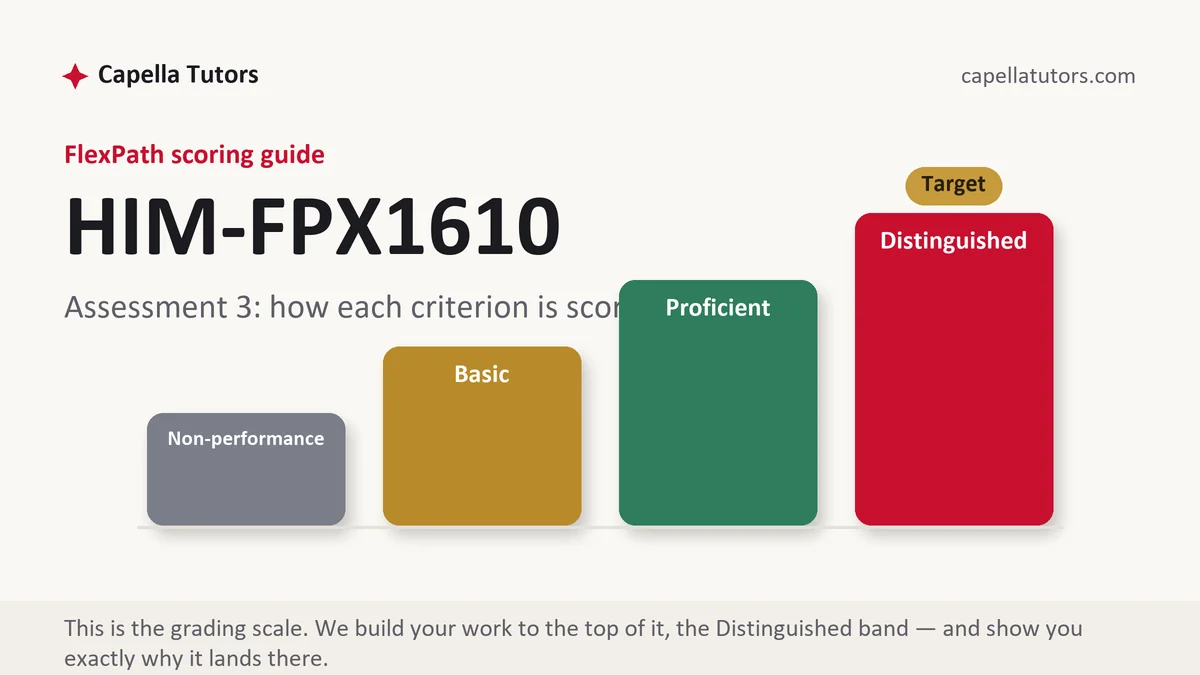
How HIM FPX 1610 Assessment 3 is scored
There is no curve and no letter grade. Each criterion is measured against four written levels, and on a language review the top level is reached by consequence rather than by volume:
| Level | What it means on a terminology and abbreviation review |
|---|---|
| Distinguished | Each finding is named with its word parts, ranked by what it would change in the record, tied to the standard or the published list that makes it a problem, and followed by a fix somebody could adopt without rewriting the department. |
| Proficient | Findings identified correctly and explained, with all of them treated as equally serious and the recommendation left general. |
| Basic | A list of what is wrong. Accurate, complete, and silent on which entries matter and on what happens next. |
| Non-performance | No authority behind the judgments, or a required element such as the abbreviation analysis never appears at all. |
The sample runs on dictated radiology reports returned by an outside transcription service, where two problems keep appearing: terms that sound identical and mean different organs, and short forms withdrawn from acceptable use years ago. The finished document there is a corrections memo to the vendor, which is a useful frame because a memo has to be specific enough to argue with.
The HIM FPX 1610 Assessment 3 method, step by step
-
Build the criteria into a review form
Convert each criterion into a column heading before you read a single report, so every finding you record already has a row waiting for it.
-
Count what you looked at, not only what you found
Say how many documents you reviewed and over what period, then report findings against that number. Nine problems in twelve reports and nine in two hundred describe different services, and a finding without a denominator cannot be argued with or improved.
-
Separate the sound-alike from the misspelling
A typing slip produces a word that does not exist. A sound-alike produces a different real word in a different body system, which is why ilium and ileum, dysphagia and dysphasia, and mucus and mucous all clear a spelling checker on their way into a record.
-
Check the short forms against a published list, not against habit
The Joint Commission publishes entries that are not to be used, and each one is there for a stated reason: a handwritten U reading as a zero, IU reading as IV or as ten, Q.D. and Q.O.D. mistaken for one another, a trailing zero after a decimal point multiplying a dose by ten, a missing leading zero doing the same, and MS sitting unreadably between two different drugs. Quote the reason, because the criterion is testing whether you know why rather than whether you can copy the list.
-
Rank the findings by what they would change
Sort your list into three groups: entries that could alter which organ or which side a reader believes was involved, entries that damage a document's credibility without changing its meaning, and entries that are style. Then write the ranking down. An undergraduate paper that says which of its own findings matters most is doing the work the top column describes.
-
Recommend something with edges, then self-score
Name what changes, who owns it, how often it is checked and what sample size counts, since a recommendation to be more careful is not a recommendation. Then mark yourself against each criterion and submit early in the week, because a two business day evaluation can otherwise become four.
A structure that maps to the criteria
The figures below are planning targets our tutors use for a review of this scope, not Capella requirements, and your scoring guide decides the format and the length.
| Section | What it must do | Guide |
|---|---|---|
| Scope of the review | What was examined, how much of it, over what window, and against which standards and lists. | ~175 words |
| Findings, with word parts | Each problem quoted, separated into its parts, and stated as what a reader would take from it. | ~325 words |
| Sound-alike pairs | The pairs found, both members analyzed, and the body system each one moves the reader to. | ~250 words |
| Abbreviation analysis | Short forms used, expanded at first use, with prohibited entries flagged and the published reason quoted. | ~250 words |
| Ranking and recommendation | Findings ordered by consequence, then a fix with an owner, a frequency and a way to tell whether it worked. | ~250 words |
| References | Dictionary edition, the accrediting body's published list, professional guidance, current APA both ways. | as needed |
Annotated sample excerpt
An original model excerpt from our team, written to show a finding earning its place in a memo. Take the sequence and rebuild it around the documents you were given.
Across 40 dictated reports returned between 1 and 14 June, eleven terminology defects were recorded, and they are not of equal weight.1 Two are the same substitution: a computed tomography report reads distal ilium where the dictation described the ileum, and ili is the pelvic bone while ile is the final stretch of small intestine, so the transcribed sentence relocates the finding from the skeleton to the bowel and a reader has no way of noticing.2 Six are abbreviation entries that should not appear in a finished document at all, including two instances of a trailing zero after a decimal point, which the accrediting body withdrew from acceptable use because a decimal point that fails to reproduce turns the figure into ten times itself.3
- 1Opens with the denominator and the window, then states plainly that the findings will be ranked. Two criteria are answered before the first defect is described.
- 2The pair is broken into parts and the consequence is stated as what a later reader would believe.
- 3The prohibited entry is counted, named, and attached to the published reason it was withdrawn. Quoting the reason is what the top column is asking for.
The full premium sample for your exact assessment, written fresh to your scoring guide and issue, is free to request. Study it, revise it into your own voice, and submit work you understand.
The five mistakes that cost Distinguished
- Findings with no denominator. Eleven defects means nothing until the reader knows how many documents and how many days produced them.
- Every error weighted the same. A misplaced hyphen and a relocated organ in one undifferentiated list is the clearest signal that no judgment was applied.
- Prohibited entries listed without their reasons. Copying a published list proves access to it, and the criterion is asking for the reasoning behind it.
- Corrections that quietly rewrite the record. Language findings are reported and corrected through a documented process, never by editing an entry so the problem disappears.
- A recommendation with no owner. More attention to detail is a wish; a named reviewer, a monthly sample and a threshold is a control.
Pre-submission checklist
- Scope stated as a count of documents over a named window
- Every finding quoted, separated into word parts, and explained as a consequence
- Both members of each sound-alike pair analyzed, not just the wrong one
- Prohibited short forms named with the published reason behind each entry
- Findings ranked, with the ranking justified in a sentence
- A fix with an owner, a frequency and a measure, APA reconciled both ways
Language review due and the findings will not sort themselves?
Send the documents or the scenario, the guide, and any list your prompt tells you to review against. Inside 24 to 48 hours you get the review table, the word part working behind each finding, and a recommendation written with an owner and a frequency attached. Revisions run free until the criteria are satisfied.