This manual is for EDD FPX 9980 Assessment 1, start to submission. Assessment 1 in a continuation term usually asks you to say plainly where the project stands, so the graded object is diagnosis rather than progress. The deliverable is a stall diagnosis with a protocol audit behind it: which cause actually applies, every element of the approved design marked delivered, partly delivered or not started, and the one item everything else is waiting on. Your scoring guide sets the deliverable and how much of it is expected. Below is our method, a criterion-mapped structure, and an annotated sample excerpt. Prefer to hand it off? A premium original sample comes back in 24 to 48 hours, revised free until it meets the guide. Capella's catalog lists the course as EDD-FPX9980, and some courserooms print EDD9980; both point to this same Assessment 1.
One honesty note before the manual: Capella revises courses and scoring guides over time, so always write to the exact scoring guide attached to your assessment in the courseroom. The course identity above is verified on capella.edu; the method and structure below are our tutors' approach to it, not Capella's official rubric text.
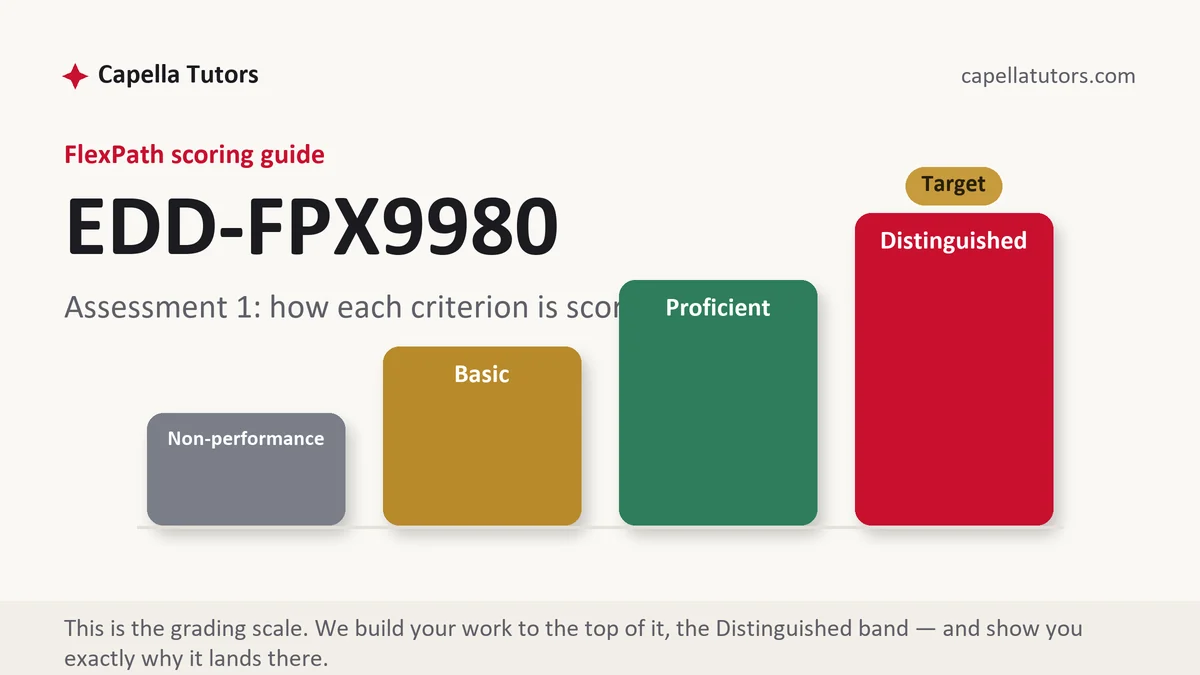
How EDD FPX 9980 Assessment 1 is scored
Each criterion resolves to one of four levels, and on a diagnosis the top level pays for naming the real cause rather than the comfortable one:
| Level | What it means on a stall diagnosis and protocol audit |
|---|---|
| Distinguished | The cause is named in one sentence with evidence behind it, every protocol element carries a status, the blocking item is identified, and the response is matched to the diagnosis rather than to habit. |
| Proficient | An accurate account of where the project stands and what remains. Solid, and short of the row above wherever the audit runs against the draft instead of against the approved design. |
| Basic | A narrative of the delay written as circumstances, with a general intention to catch up and no element-by-element status anywhere in it. |
| Non-performance | A required element is absent, most often the audit against the approved protocol, or the plan the criterion asked you to attach to the diagnosis. |
A delay has approval consequences that are easy to miss and expensive to discover late. Determinations run for a period and can lapse, so find out whether yours is still current and whether resuming requires continuing review or a fresh submission. Site permission signed by a superintendent who has left may need re-signing by whoever holds the role now. Consent collected from staff who have since transferred does not travel to their replacements. Ask those three questions in week one, in writing, because none of them can be answered by working harder.
The handoff is into the block plan that follows, and a diagnosis is only useful if it changes what you do next. A site that moved wants a scope decision, an approval returned wants the design rewritten to the reviewer's actual objection, and a writing debt wants words on days. Treating a writing debt as though it were a design problem is how a single continuation term turns into three, and it is the most expensive error available here.
The EDD FPX 9980 Assessment 1 method, step by step
-
Open the protocol, not the manuscript
The draft is the document your doubts are attached to; the protocol is the document that says what you promised and what still counts as done. Read the approved design first and the draft second, because half of what feels unfinished has already been delivered and is sitting in a file you stopped opening.
-
Mark every element with a status
Go element by element through the approved design and write delivered, partly delivered or not started against each, with the date and the location of whatever exists. The map that produces is almost always smaller than the anxiety around it, and it points at the single item the rest has been queued behind.
-
Name the cause in one sentence
A site that changed underneath you, an approval returned for redesign, or work that is simply unwritten. Write the sentence, then write the evidence for it. Vague causes produce vague plans, and a term spent responding to the wrong diagnosis is the most expensive mistake available at this stage.
-
Check the approvals and the site before anything else
Confirm the status of your determination, whether a modification or continuing review is needed, whether site permission still holds under current leadership, and whether the cohort your design specified still exists. These are queue items you do not control, so they start on day one and everything else is scheduled around them.
-
Do the arithmetic on the weeks you have
FlexPath bills in flat 12-week sessions with two courses open at most, so the term is a fixed quantity of weeks that will pass whether or not you write. Fourteen thousand words remaining across six two-week blocks is 2,340 words a block, roughly 170 words a day. Written down that is a plan; left as a feeling it is the same work carrying unlimited dread.
-
Attach one plan, then self-score
Close the diagnosis with a plan sized to the cause: a scope decision and a date, a modification filed by a named week, or a block schedule with a daily count. Then mark each criterion honestly, put the audit in an appendix, and submit early, allowing the two business days faculty have to evaluate an attempt.
A structure that maps to the criteria
Our planning targets for a diagnosis and audit deliverable, not Capella requirements. The audit is the evidence and the diagnosis is the argument, so give the audit room and keep the narrative short.
| Section | What it must do | Guide |
|---|---|---|
| Current status | Where the project stands in one paragraph, without explanation or apology. | ~200 words |
| Protocol audit | Every element of the approved design with a status, a date and a location. | ~350 words |
| Diagnosis | The cause named in one sentence, with the evidence that rules the other causes out. | ~250 words |
| Approvals and site status | Determination currency, modification or review needs, and site permission under current leadership. | ~250 words |
| The blocking item | The one thing everything else is queued behind, and what releases it. | ~200 words |
| Plan and references | The response matched to the cause, with dates, and sources verified in current APA. | ~200 words |
Annotated sample excerpt
An original paragraph from our team showing a diagnosis written as a finding rather than as an excuse. Learn the moves, then write your own.
The stall is administrative rather than analytic: the superintendent who signed site permission for the tutoring corps study left in June, the interim has not authorized continued access, and the audit shows 19 of the 30 planned student attendance extracts delivered with all 11 outstanding sitting behind that single signature.1 It is not a writing debt, because the literature chapter, the methodology and the analysis plan are all marked delivered and dated, and it is not a design objection, because the last chair feedback in April requested no changes to the protocol.2 The response therefore has two moves and neither of them is drafting: a written request to the interim superintendent for re-signature in week one, and a scope decision by week four that either accepts the 19 extracts as the final dataset with the shortened window described as a limitation or adds a second district under a modification.3
- 1Names the cause in the first clause, then evidences it with a count and locates every outstanding item behind one dependency.
- 2Rules out the other two causes with dated evidence. Excluding the alternatives is what turns a claim about the delay into a diagnosis.
- 3Two moves, both with weeks attached, and a decision rule rather than a hope. Note that neither move is writing, because the diagnosis says writing is not the problem.
The full premium sample for your exact assessment, written fresh to your scoring guide and issue, is free to request. Study it, revise it into your own voice, and submit work you understand.
The five mistakes that cost Distinguished
- Auditing the draft instead of the protocol. The manuscript tells you what you have written, and the approved design tells you what still counts as done.
- A cause stated as circumstances. Life got busy is not a diagnosis, and a plan built on it will be the same plan that failed last term.
- Redesigning a project that was merely unwritten. Changing the question invalidates the literature, the instrument and the approval that were all built on the old one.
- Approvals assumed to be still current. A lapsed determination or an unsigned permission letter cannot be fixed by effort, and it will not fix itself.
- A plan with no daily quantity. A term divided into intentions rather than into counts ends the way the previous one did.
Pre-submission checklist
- The approved protocol read before the draft, and audited element by element
- Every element marked delivered, partly delivered or not started, with dates and locations
- The cause named in one sentence, with the other causes ruled out by evidence
- Determination currency, modification needs and site permission confirmed in writing
- The blocking item identified, with what releases it and by when
- A plan attached, sized to the cause, with a daily or weekly quantity written down
Project stalled?
Send whatever state the project is actually in, the guide, and your chair's most recent comments. Eight people, including a research analyst and two QA reviewers, return a premium original sample in 24 to 48 hours with the protocol audited, the cause named and a plan sized to it, revised free until the guide is satisfied.