This manual is for EDD FPX 9980 Assessment 3, start to submission. Assessment 3 in a continuation term usually asks you to put the pieces back into one argument, so the graded object is coherence rather than volume. The deliverable is a synthesis of your own unfinished material with a re-entry plan attached: what the project now claims, in plain sentences, which fragments survive, what the host site has been told, and how you rejoin the numbered sequence with something already drafted. Your scoring guide decides the form this takes and how far it reaches. Below is our method, a criterion-mapped structure, and an annotated sample excerpt. Prefer to hand it off? A premium original sample comes back in 24 to 48 hours, revised free until it meets the guide. Capella's catalog lists the course as EDD-FPX9980, and some courserooms print EDD9980; both point to this same Assessment 3.
One honesty note before the manual: Capella revises courses and scoring guides over time, so always write to the exact scoring guide attached to your assessment in the courseroom. The course identity above is verified on capella.edu; the method and structure below are our tutors' approach to it, not Capella's official rubric text.
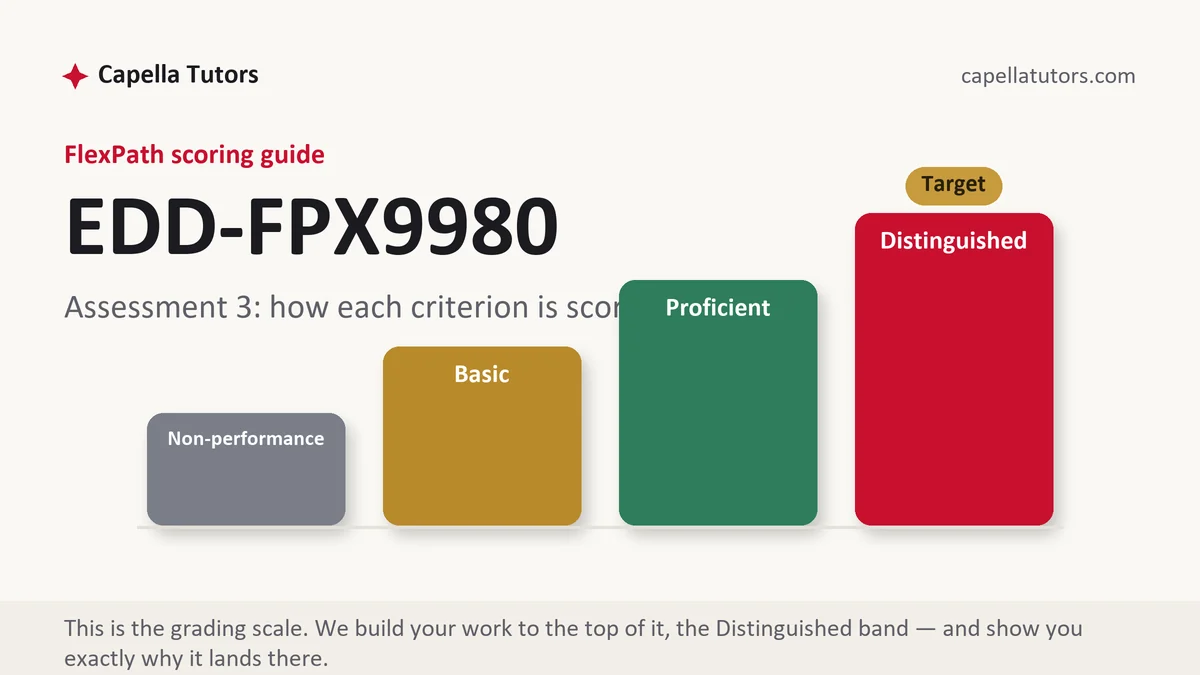
How EDD FPX 9980 Assessment 3 is scored
Each criterion resolves to one of four levels, and on a synthesis of unfinished work the top level rewards a claim you can say out loud:
| Level | What it means on a synthesis and re-entry plan |
|---|---|
| Distinguished | The project's current claim is stated in plain sentences without citations, every fragment is marked keep, revise or cut with a reason, the site relationship is accounted for, and the re-entry point names a deliverable already in draft. |
| Proficient | The remaining work synthesized and a route back into the sequence described. Solid, and short of the row above wherever fragments are inventoried without a keep or cut decision. |
| Basic | A summary of what has been written so far, with an intention to resume and no statement of what the project now claims. |
| Non-performance | A required element is absent, most often the account of the host site, or the plan for rejoining the sequence the criterion asked for. |
Material held through a delay carries obligations that do not pause with the project. Your determination set storage terms and a destruction date for identifiable data, and both apply while nothing is being written. Where the pause has pushed collection into a different school year, the cohort in your design may no longer exist, which is a protocol question rather than a wording one. And re-contacting a district is not re-consenting its staff: participants who consented eighteen months ago to a study that stopped are entitled to know it has resumed, and in some designs to decide again.
The handoff runs back into the numbered sequence, and it should be clean. Finish the term with the blocking item resolved, the audit updated, every outstanding comment answered in writing, and the next project course entered with a deliverable already drafted rather than with a fresh intention. Keep the shape of what you are rejoining in view: EDD FPX 9951 through EDD FPX 9956, with the reflective account and the dissemination obligation landing at the end of them.
The EDD FPX 9980 Assessment 3 method, step by step
-
Read every fragment in one sitting
Lay out the literature chapter, the design, the partial findings, the abandoned appendix and the notes, and read them in order as one document. You will find three things every time: passages better than you remember, passages arguing a position you no longer hold, and a gap smaller than the fear attached to it.
-
Mark each fragment keep, revise or cut
One word against every section, with a reason of no more than a clause. Cutting is the move learners avoid and the one that recovers the most time, because a paragraph defending an abandoned framework will otherwise be revised four times before somebody deletes it.
-
Write the one-page spine with no citations in it
State what the project now claims, in plain sentences, as though explaining it to a colleague in a corridor. No sources, no hedging, no methodological vocabulary. That page becomes the document you write against for the rest of the term, and it is the fastest way to show a chair your hands are back on the argument.
-
Restart the reflective log the same week
The reflective writing waiting at the close of the sequence is graded on instances, and instances do not survive in memory. Keep a dated line for every decision, reversal and surprise, including the ones from this term. An hour a fortnight now replaces a week of reconstruction later.
-
Re-contact the site before you need it
A district that has not heard from you in eight months may not still be available. Send a short update naming what you have, what remains and when you expect to return, and ask what has changed in leadership and in the program you studied. Warm access survives a delay; assumed access frequently does not.
-
Name the re-entry deliverable, then self-score
Rejoin the sequence with something already drafted, a findings section for one question or a revised methodology, rather than with an intention. Then mark each criterion honestly, confirm the spine and the fragments agree, and submit early, allowing the two business days faculty have to evaluate an attempt.
A structure that maps to the criteria
Our planning targets for a synthesis and re-entry deliverable, not Capella rules. The spine is short by design, and the fragment inventory is where the evidence sits.
| Section | What it must do | Guide |
|---|---|---|
| The spine | What the project now claims, in plain sentences, with no citations in it. | ~300 words |
| Fragment inventory | Every existing section marked keep, revise or cut, with a reason and a location. | ~350 words |
| What changed in my thinking | The positions abandoned during the delay, and what replaced them. | ~250 words |
| Site and participant status | What the host district has been told, what has changed there, and what consent now requires. | ~250 words |
| Reflective log | Dated entries for decisions, reversals and surprises, restarted this term. | ~200 words |
| Re-entry plan and references | The course you rejoin, the deliverable already drafted, and sources re-verified in current APA. | ~200 words |
Annotated sample excerpt
An original excerpt from our team showing a spine sentence and the cut it forces. Learn the moves, then write your own page.
What this project now claims is that principal supervisors in this district spend most of their scheduled coaching time on compliance review rather than on instructional feedback, that supervisors and principals both describe the visits as evaluative regardless of how the district labels them, and that the schedule rather than the training is what makes that so.1 That third clause is new, and it costs me eleven pages: the distributed leadership framing written two years ago argued that role clarity was the mechanism, my own partial findings point at calendar structure instead, and the framework section is marked revise while the two-page defense of role ambiguity as the central construct is marked cut.2 The findings for question one are marked keep and are two thirds drafted, so the re-entry deliverable is that section finished, which puts something on a chair's desk in week three rather than in week nine.3
- 1Three plain clauses, no citations, no methodological vocabulary. A claim you can say in a corridor is a claim you can write a chapter against.
- 2Identifies which clause is new, prices the change in pages, and records the keep and cut decisions with reasons. Naming the cost is what makes the cut survivable.
- 3Chooses the re-entry deliverable from what is already nearly done, so the next course opens with a submission rather than with an intention.
The full premium sample for your exact assessment, written fresh to your scoring guide and issue, is free to request. Study it, revise it into your own voice, and submit work you understand.
The five mistakes that cost Distinguished
- Inventory with no decisions. A list of what exists is not a synthesis, and the paragraphs you will not use get revised anyway.
- A spine written with citations. Sources in the spine let you hide behind other people's claims instead of stating your own.
- Reading instead of drafting. More sources feels like progress and is the most respectable available way to avoid finishing.
- Losing the site in silence. Access and goodwill decay on their own, and a short update costs an hour where a replacement site costs a term.
- Rejoining with an intention. Entering the next project course with nothing drafted repeats the conditions that produced the delay.
Pre-submission checklist
- Every fragment read in one sitting and marked keep, revise or cut with a reason
- A one-page spine stating the current claim in plain sentences, no citations
- The positions abandoned during the delay named, with what replaced them
- Storage terms, destruction date and cohort validity checked against the determination
- The host district updated in writing, with leadership and program changes noted
- A named re-entry deliverable already in draft, with a date it lands
Ready to restart?
Send every fragment you have, however partial, plus the guide and your last chair feedback. Eight people, including a research analyst and two QA reviewers, return a premium original sample in 24 to 48 hours with the spine written, the fragments triaged and a re-entry deliverable drafted, revised free until the guide is satisfied.