This manual is for EDD FPX 9980 Assessment 2, start to submission. Assessment 2 in a continuation term usually asks for movement you can show, so the graded object is a schedule with deliverables in it and a document answering whatever came back. The deliverable pairs a block plan with a response record: the term divided into units that can actually be finished, and every outstanding comment listed with the change it required and the date it was addressed. Your scoring guide decides the deliverable and its form. Below is our method, a criterion-mapped structure, and an annotated sample excerpt. Prefer to hand it off? A premium original sample comes back in 24 to 48 hours, revised free until it meets the guide. Capella's catalog lists the course as EDD-FPX9980, and some courserooms print EDD9980; both point to this same Assessment 2.
One honesty note before the manual: Capella revises courses and scoring guides over time, so always write to the exact scoring guide attached to your assessment in the courseroom. The course identity above is verified on capella.edu; the method and structure below are our tutors' approach to it, not Capella's official rubric text.
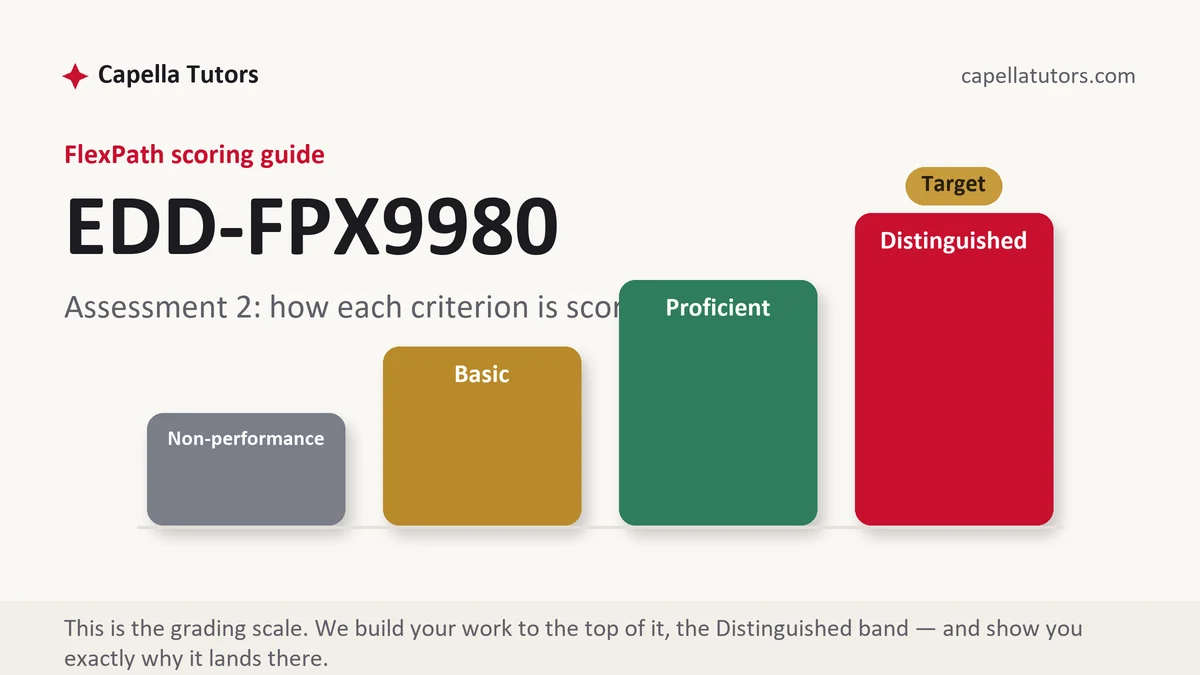
How EDD FPX 9980 Assessment 2 is scored
Each criterion resolves to one of four levels, and on a plan and response the top level buys finishable units and literal answers:
| Level | What it means on a block plan and response record |
|---|---|
| Distinguished | Every block carries one deliverable that can be finished inside it, blocks are ordered by dependency rather than by chapter number, and every comment is answered individually with the change made and the location of that change. |
| Proficient | A workable schedule and a considered reply to feedback. Solid, and short of the row above wherever a block holds a whole chapter or a comment is answered in general terms. |
| Basic | A term planned in chapters, with a paragraph thanking the reviewer for helpful feedback and no record of what actually changed. |
| Non-performance | A required element is absent, most often the response to a specific objection, or the dated schedule the criterion asked for. |
Where the objection concerns design, the review body is part of the audience and not only your chair. A change to sampling, to an instrument, to the consent language or to who is recruited is a protocol amendment, so the modification is filed and approved before collection resumes rather than described afterward. Adding a classroom observation to a study approved for teacher interviews changes what participants agreed to and can change the risk profile. Ask which of the requested changes require an amendment on the day you receive them, because that answer sets the order of your blocks.
The handoff is momentum, and it is the only thing a continuation term genuinely buys back. Each finished unit should unlock the next, so a codebook precedes the coding and the coding precedes the findings section for one question. Submit each unit as it is done, allow the two business days faculty have to evaluate a submission, and start the following unit inside that window rather than waiting on it.
The EDD FPX 9980 Assessment 2 method, step by step
-
Answer the comments literally, item by item
Number every objection, restate it in the reviewer's own terms, say what you changed, and give the page or section where the change now lives. A surprising number of stalls are a learner and a reviewer talking past one another, and that repair costs an evening rather than a quarter.
-
Separate what you will change from what you will argue
Some objections you accept and some you answer, and both are legitimate provided you say which is which. Where you disagree, give the reason and the source, and concede the part of the objection that is fair. Silent non-compliance is what turns one round of comments into three.
-
Ask which changes need an amendment
Sampling, instruments, recruitment, consent and the participant population are protocol matters rather than writing matters. Establish on the first day which requested changes require an amendment, since those go into the queue immediately and everything you can control gets scheduled around them.
-
Plan in the smallest complete unit
A findings section for one research question is a unit. A codebook is a unit. A two-page methodology revision answering three objections is a unit. Chapters are too large to finish inside two weeks, and a block ending with nothing finished teaches you that the plan does not work, which is the belief that ended the last term.
-
Order blocks by dependency, not by chapter number
Put the item everything else waits on in block one even if it belongs in chapter three. Then write the daily quantity beside each block, in words or transcripts or sections, so the plan can be checked against reality on a Wednesday rather than only at the end.
-
Attach a date to every block, then self-score
Real dates, not next month: the memo by the 12th, the codebook by the 26th, the first findings section by the 9th. Then mark each criterion honestly, confirm every comment carries a change and a location, and submit early, allowing the two business days for evaluation.
A structure that maps to the criteria
Planning targets from our tutors for a plan and response deliverable, not Capella requirements. The response table carries the criteria; the schedule carries the term.
| Section | What it must do | Guide |
|---|---|---|
| Where the project stands | One paragraph of status, with the blocking item named. | ~150 words |
| Response record | Every comment numbered, restated, answered, and located in the revised document. | ~400 words |
| Accepted and contested | Which objections produced changes and which produced arguments, with reasons. | ~250 words |
| Amendment items | Which requested changes are protocol matters, and when each was or will be filed. | ~200 words |
| Block plan | Two-week blocks, one finishable deliverable each, ordered by dependency, with dates. | ~300 words |
| Quantities and references | The daily or weekly count behind each block, with sources verified in current APA. | ~200 words |
Annotated sample excerpt
An original excerpt from our team showing a response entry that answers rather than acknowledges. Learn the moves, then write your own.
Comment 4 asked how a study of two co-teaching pairs could support any claim about the model, and the objection is fair as the design was written, so the sampling section now recruits six pairs across three buildings rather than two pairs in one, with the additional recruitment covered by the amendment filed on March 3 and the revised section appearing on pages 61 to 63.1 Comment 5 asked me to add a student outcome measure, and here I am arguing rather than changing: the research questions concern how co-teachers allocate instructional roles, the multilingual growth data for these grades reports annually and would not resolve inside the study window, and a measure that cannot answer the question adds risk to participants without adding evidence.2 I have instead added the growth data as descriptive context in the site description, which addresses the part of the objection I take to be sound, that a reader needs to know how these students are doing.3
- 1Restates the objection, concedes it, names the change, names the amendment and its date, and gives the page. Five facts in one sentence and no gratitude anywhere.
- 2Declines an objection and gives three reasons, one about alignment, one about timing, one about participant burden. Disagreement is allowed when it is reasoned and visible.
- 3Concedes the sound part of the objection and shows the partial change. This is what stops a contested comment from returning in the next round unchanged.
The full premium sample for your exact assessment, written fresh to your scoring guide and issue, is free to request. Study it, revise it into your own voice, and submit work you understand.
The five mistakes that cost Distinguished
- Comments acknowledged rather than answered. Thanking a reviewer for helpful feedback with no change and no location is the reply that guarantees another round.
- Silent disagreement. Ignoring an objection you think is wrong reads as non-compliance, while arguing it in writing reads as a doctoral learner.
- Planning in chapters. A unit too large to finish inside two weeks produces another block ending with nothing done.
- Amendments discovered late. A design change that needed approval, made and then reported, is a conduct problem rather than a scheduling one.
- Blocks in chapter order. Scheduling by table of contents leaves the blocking item until the term is nearly over.
Pre-submission checklist
- Every comment numbered, restated, answered, and located in the revised document
- Accepted and contested objections separated, with reasons given for each contest
- Requested changes screened for whether they require a protocol amendment
- Each block holds one deliverable that can actually be finished in two weeks
- Blocks ordered by dependency, with the blocking item first
- A real date and a daily or weekly quantity written against every block
Comments to answer, or a term to plan?
Send the guide, the feedback you received and the current draft. Eight people, including a research analyst and two QA reviewers, return a premium original sample in 24 to 48 hours with every comment answered and located, amendment items flagged, and the term blocked out by dependency, revised free until the guide is satisfied.