This manual is for EDD FPX 9956 Assessment 2, start to submission. Assessment 2 usually asks you to say the whole project out loud, so what is graded is an argument rather than a tour. The deliverable is a presentation, live or recorded: problem, question, what you did, what you found and what should change, in that order, with the evidence held ready for the questions you can predict. Your scoring guide decides the format and its length. Below is our method, a criterion-mapped structure, and an annotated sample excerpt. Prefer to hand it off? A premium original sample comes back in 24 to 48 hours, revised free until it meets the guide. Capella's catalog lists the course as EDD-FPX9956, and some courserooms print EDD9956; both point to this same Assessment 2.
One honesty note before the manual: Capella revises courses and scoring guides over time, so always write to the exact scoring guide attached to your assessment in the courseroom. The course identity above is verified on capella.edu; the method and structure below are our tutors' approach to it, not Capella's official rubric text.
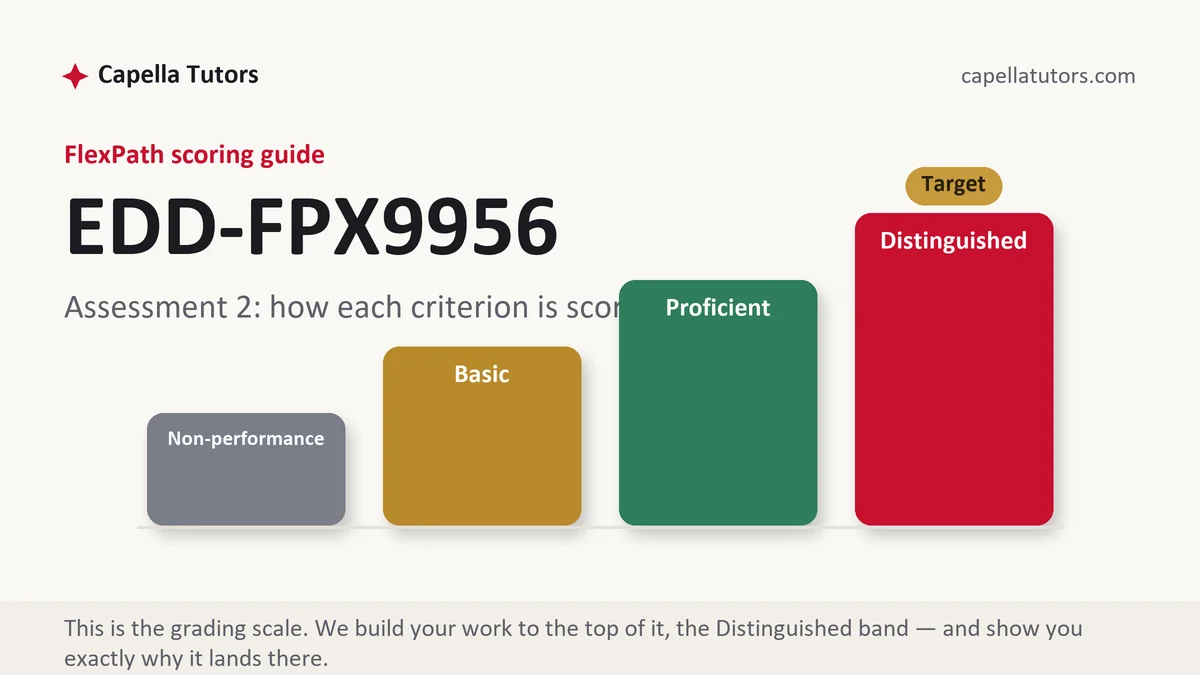
How EDD FPX 9956 Assessment 2 is scored
Each criterion resolves to one of four levels, and on a presentation the top level pays for compression and for conceding well:
| Level | What it means on a doctoral presentation |
|---|---|
| Distinguished | The argument arrives in the time allowed with the findings given the most of it, every figure carries its sample and its uncertainty on the same slide, and the predictable objections are answered by conceding what should be conceded. |
| Proficient | A clear and complete presentation of the project. Solid, and short of the row above wherever the design takes four slides that the findings needed, or a weakness is deflected. |
| Basic | The manuscript recited in order, with the literature review walked through and the recommendations reached after the time ran out. |
| Non-performance | A required element is absent, most often the recommendations, or the recorded submission the criterion asked for in the format it specified. |
A presentation is a disclosure event, which learners routinely forget. Slides showing a district logo, a building photograph, a named participant or a small-cell table release information your consent language may not cover, and a recording that will sit in a repository releases it permanently. Describe the site the way the manuscript describes it, suppress the same cells you suppressed in the tables, and use the same participant identifiers. Where the district has agreed in writing to be named, say so on the slide rather than leaving a listener to guess.
The handoff is outward. The materials that will reach a cabinet, a board or a faculty meeting are built from the same three sentences this presentation is built on, so a talk that compresses cleanly makes the practitioner brief nearly free to write. Keep the deck and the speaker notes, since the version you give the host site is this argument with the theory removed and the local numbers put back in.
The EDD FPX 9956 Assessment 2 method, step by step
-
Write the three sentences before the first slide
The problem in one sentence, the finding in one sentence, the recommendation in one sentence. If those three will not come, no deck rescues the talk and the difficulty is in the manuscript rather than in the slides. Everything else in the presentation is support for those three lines.
-
Build from the abstract rather than from the chapters
Chapters produce a tour; the abstract produces an argument. Give the design one slide, the framework one line inside another slide, and the findings the most time. Eight to ten slides is usually plenty for twenty minutes, and twenty slides is a signal that the argument has not converged.
-
Put the sample and the uncertainty beside the result
Every result slide carries the estimate, the sample and the interval or the participant count together, so the first question you get is about meaning rather than about arithmetic. A number alone on a slide invites a listener to spend your next two minutes asking where it came from.
-
Predict the three questions and rehearse the concessions
They are almost always the limits of your sample, the alternative explanation you did not test, and how you know the program was actually delivered. Write an answer to each that concedes precisely what should be conceded, since at this level a defended weakness reads better than a denied one and a rehearsed concession sounds like control.
-
Rehearse aloud against a timer
Talks that run long get cut at the recommendations, which is the only part a practice audience came for. Time the whole thing twice, out loud, then remove rather than compress. Recorded submissions have their own trap, so check the format, the length limit and the captioning your guide asks for before you record twice.
-
Strip the theory, then self-score
Cut the theoretical vocabulary to what a listener needs to follow the argument and leave the rest in the manuscript. Then mark each criterion honestly, confirm every slide figure matches the document, and submit early, allowing the two business days faculty have to evaluate an attempt.
A structure that maps to the criteria
Our planning shape for a twenty-minute doctoral presentation, not a Capella requirement. Adjust to whatever time your guide allows, and cut from the design rather than from the findings.
| Section | What it must do | Guide |
|---|---|---|
| Opening | The problem of practice and why this site, in about ninety seconds. | 1 slide |
| Question and framework | The questions as approved, with the framework named in a single line. | 1 slide |
| Design and data | What you did, from whom, when, and under what approval. | 1 slide |
| Findings | One slide per research question, each with sample and uncertainty beside the result. | 3 to 4 slides |
| Recommendations | Actor, action, cost and indicator for each, at the altitude of the decision. | 1 to 2 slides |
| Limits and questions | The conceded weaknesses, then the floor, with backup evidence held in reserve. | 1 slide |
Annotated sample excerpt
An original excerpt from our team, written as speaker notes for a findings slide. Learn the moves, then write your own.
Mentored first-year teachers reported 0.38 standard deviations higher instructional self-efficacy than the prior cohort, on 47 respondents out of 61, with an interval running from 0.09 to 0.67, and I want to be careful about that lower bound because it includes effects small enough that a district would not notice them.1 The pattern is stronger where mentoring actually happened: 22 of 47 pairs met at least twice a month, and among those the difference is 0.61, while among the pairs meeting less often it is 0.11, which is the finding I would build a recommendation on rather than the headline number.2 What I cannot tell you is whether the pairs who met twice a month were already the more confident teachers, because assignment to mentors was not random and I have no baseline measure from August.3
- 1Estimate, sample and interval in one breath, then an honest reading of the lower bound. Naming the uninteresting end of your own interval buys credibility for the rest of the talk.
- 2Splits the result by delivered dose and says which figure the recommendation rests on. This is the sentence a practitioner audience actually needs.
- 3Concedes the alternative explanation before anybody asks it, and names the exact missing measurement rather than gesturing at limitations.
The full premium sample for your exact assessment, written fresh to your scoring guide and issue, is free to request. Study it, revise it into your own voice, and submit work you understand.
The five mistakes that cost Distinguished
- A presentation that recites the manuscript. Walking an audience through the literature review spends the minutes the findings needed.
- Four slides on the design. Nobody in the room doubts you can describe a method, and the time comes straight out of the recommendations.
- Numbers with no sample beside them. A bare estimate on a slide turns your next two minutes into a question about arithmetic.
- Weaknesses deflected. A denied limitation invites three follow-ups, while a conceded one usually ends the exchange.
- Rehearsed silently. A talk timed in your head runs long out loud, and what gets cut is always the part you were building toward.
Pre-submission checklist
- Problem, finding and recommendation each stated in one sentence
- Design held to a single slide, findings given the most time
- Every result shown with its sample and its interval or count
- Three predictable objections answered with rehearsed, precise concessions
- Timed aloud twice, inside the limit, with the recommendations reached
- No site logo, photograph, small cell or participant name that the consent language does not cover
Presentation due?
Send the guide, the manuscript and the time limit. Eight people, including an editor and two QA reviewers, return a premium original sample in 24 to 48 hours as an eight to ten slide argument with speaker notes, uncertainty on the result slides and answers drafted for the three questions you will get, revised free until the guide is satisfied.