This manual is for EDD FPX 9956 Assessment 3, start to submission. Assessment 3 usually closes the sequence, so the graded object is what the work changed rather than what it found. The deliverable pairs a reflective account with the release of the findings: an argument about change in your own practice, evidenced by dated instances, and the artifacts that put the results into the hands of the people who hosted the study. Your scoring guide decides the deliverable and its length. Below is our method, a criterion-mapped structure, and an annotated sample excerpt. Prefer to hand it off? A premium original sample comes back in 24 to 48 hours, revised free until it meets the guide. Capella's catalog lists the course as EDD-FPX9956, and some courserooms print EDD9956; both point to this same Assessment 3.
One honesty note before the manual: Capella revises courses and scoring guides over time, so always write to the exact scoring guide attached to your assessment in the courseroom. The course identity above is verified on capella.edu; the method and structure below are our tutors' approach to it, not Capella's official rubric text.
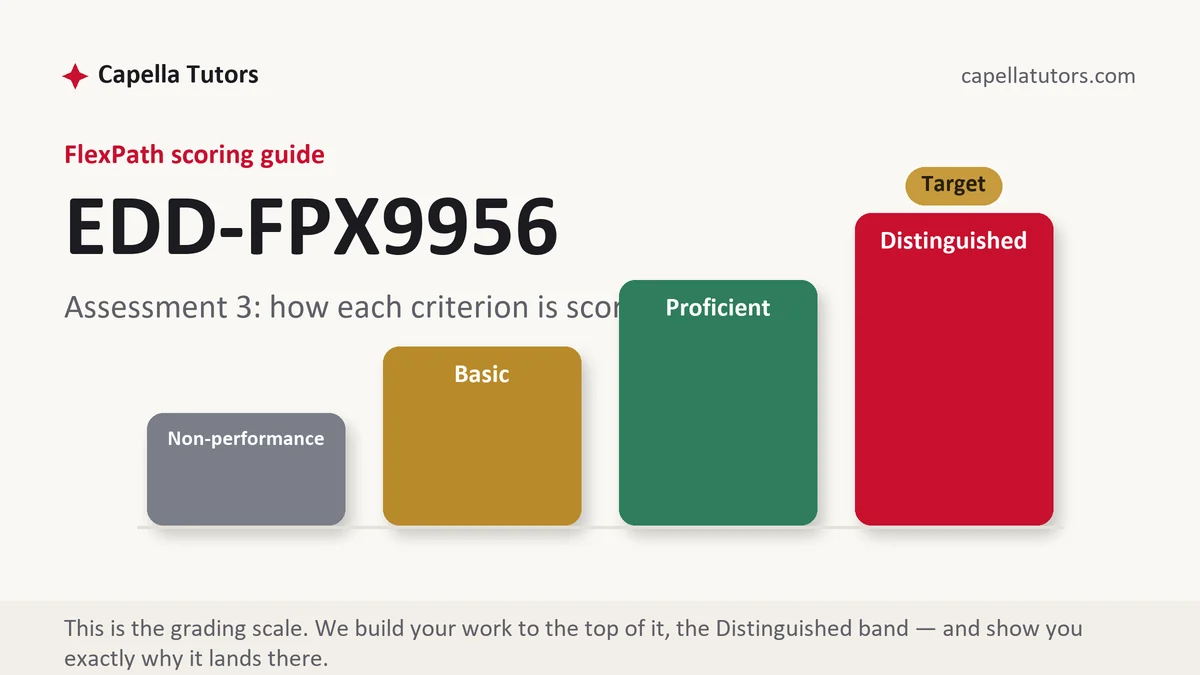
How EDD FPX 9956 Assessment 3 is scored
Each criterion resolves to one of four levels, and on a reflection the top level is scored on specificity exactly like everything else:
| Level | What it means on a reflection and release of findings |
|---|---|
| Distinguished | Named, dated decisions show what changed in your practice, the positionality you declared at the start is revisited with what it actually did, and the findings have reached the host site and the participants in artifacts written for them. |
| Proficient | A thoughtful reflection with the professional growth described, and sharing under way. Solid, and short of the row above wherever a claim of change carries no instance. |
| Basic | An appreciative essay about a demanding journey, with the reflection generalized and the dissemination still in the future tense. |
| Non-performance | A required element is absent, most often the link to the leadership standards, or the dissemination artifact the criterion asked for. |
Closing a study has approval consequences that a reflection is a good place to have already handled. Your determination set terms for how long identifiable material may be held and how it must be destroyed, and that date is now rather than someday. A district report drawn from your data is a new document with a new audience, so check that the consent language and the data agreement cover it, and give the site a version whose small cells are suppressed the way the manuscript's were, since a building leader can identify a teacher from a cell of three without trying.
There is no next course to hand this to, which is the point, and the obligation that outlives the degree runs to the site. A district that opened its data and its staff to you is owed the finding in a form its leaders can use, ahead of any external audience. Where the project is not finished when the session ends, that is ordinary rather than alarming, and EDD FPX 9980, Doctoral Project Development, exists for exactly that situation.
The EDD FPX 9956 Assessment 3 method, step by step
-
Structure the reflection around change, not gratitude
What you believed about the problem before, what the evidence did to that belief, what you did differently as a result, and what you still do not know. Gratitude documents effort rather than change, and change is what gets scored. Four movements is enough shape for a section this size.
-
Attach a dated instance to every claim
The meeting where you asked for the denominator before agreeing to an initiative, the improvement plan you sent back because it carried no indicator, the interview that made you reverse a recommendation you had already drafted. One instance with a date outweighs a page of general growth.
-
Revisit the positionality you declared
You wrote at the start what your role might do to the work. Say now what it actually did: whose candor your position bought, whose it cost, which interview went differently because the participant reported to somebody who reports to you. That paragraph is usually the most persuasive thing in the section.
-
Tie at least one instance to the standards
Programs frequently make the connection to professional leadership standards a criterion of its own. Pick one standard, name the instance that shows it, and resist the temptation to claim all of them. A single well-evidenced connection scores above a table mapping ten standards to nothing in particular.
-
Build the site artifact at the reader's altitude
Two pages with the ask on page one for a cabinet, three slides for a board committee, a faculty session using the school's own figures for the teachers who ran the pilot. Suppress the cells you suppressed in the manuscript, drop the theoretical vocabulary, and put the recommendation before the method.
-
Serve the site first, then self-score
The host site sees its version before anybody else, and the participants get a paragraph telling them what came of their hour. Then confirm the retention and destruction terms you agreed to have been honored, mark each criterion honestly, and submit early, allowing the two business days for evaluation.
A structure that maps to the criteria
Planning targets from our tutors for a reflection and release deliverable, not Capella requirements. Where your guide gives no length, two to four pages of specific material beats eight pages of general material.
| Section | What it must do | Guide |
|---|---|---|
| What I believed before | The assumption you carried into the work, stated plainly enough to be wrong. | ~250 words |
| What the evidence did to it | The finding that changed your mind, and the moment you noticed it changing. | ~300 words |
| What I did differently | Dated decisions in your own practice, with what each one cost or changed. | ~350 words |
| Positionality revisited | What your role actually did to access, candor and interpretation. | ~250 words |
| Standards and forward question | One standard evidenced by an instance, and the practice question you are carrying on. | ~200 words |
| Release record | What each audience received, on what date, and what the site got first. | ~200 words |
Annotated sample excerpt
An original excerpt from our team showing reflective writing with evidence in it. Learn the moves, then write your own.
I went into this project believing that resistance to standards-based grading was a communication problem, which is what I had been telling principals for two years.1 On February 9 a veteran mathematics teacher walked me through her gradebook and showed me that the reporting system could not hold a reassessment without overwriting the first attempt, which meant that the practice I was asking for was not available in the tool I had given her, and I had read that as reluctance in three prior building visits.2 I withdrew the professional learning recommendation I had already drafted and replaced it with a system configuration request, and in the two cabinet meetings since I have asked what a change requires of the software before I have asked what it requires of the staff.3
- 1States the prior belief in one sentence and admits it was being taught to others. A belief specific enough to be wrong is what makes the rest of the paragraph mean something.
- 2One dated instance with a named artifact, the gradebook, and an admission of what it had been misread as three times. Specificity is the whole criterion.
- 3Names the recommendation reversed and the changed behavior that followed, in the writer's own practice rather than in general. Reversal is the strongest evidence of change available.
The full premium sample for your exact assessment, written fresh to your scoring guide and issue, is free to request. Study it, revise it into your own voice, and submit work you understand.
The five mistakes that cost Distinguished
- Reflection written as thanks. An account of how hard the work was documents effort, and the criterion is scoring what your practice now does differently.
- Growth claimed with no instance. A paragraph about becoming a more data-informed leader cannot be checked and therefore cannot be credited.
- Positionality declared once and forgotten. Saying at the start what your role might do, and never saying what it did, leaves the honest half unwritten.
- Ten standards mapped to nothing. A table claiming every leadership standard reads as compliance, while one evidenced standard reads as practice.
- Dissemination still in the future tense. A promise to share findings with the district is not a release, and the site has been waiting longer than you have.
Pre-submission checklist
- The reflection organized around change rather than around effort
- Every claim of change carrying a dated, named instance
- The positionality declared at the start revisited with what it actually did
- One leadership standard evidenced by one instance
- The host site served first, with small cells suppressed in its version
- Retention and destruction terms honored, and participants told what came of their hour
Reflection or release materials due?
Send the guide, your manuscript and whatever notes you kept while your thinking changed. Eight people, including an editor and two QA reviewers, return a premium original sample in 24 to 48 hours with the reflection built from dated instances and a practice brief written for readers who will never open the document, revised free until the guide is satisfied.