This manual is for EDD FPX 9956 Assessment 1, start to submission. Assessment 1 usually opens the closing stage, so almost nothing new is written and almost everything is verified. The deliverable is a reconciled manuscript: research questions worded identically everywhere, constructs traced from framework to instrument to finding, counts and dates agreeing across chapters, references matched in both directions, and formatting leveled to your program's template. Your scoring guide decides the deliverable and its checks. Below is our method, a criterion-mapped structure, and an annotated sample excerpt. Prefer to hand it off? A premium original sample comes back in 24 to 48 hours, revised free until it meets the guide. Capella's catalog lists the course as EDD-FPX9956, and some courserooms print EDD9956; both point to this same Assessment 1.
One honesty note before the manual: Capella revises courses and scoring guides over time, so always write to the exact scoring guide attached to your assessment in the courseroom. The course identity above is verified on capella.edu; the method and structure below are our tutors' approach to it, not Capella's official rubric text.
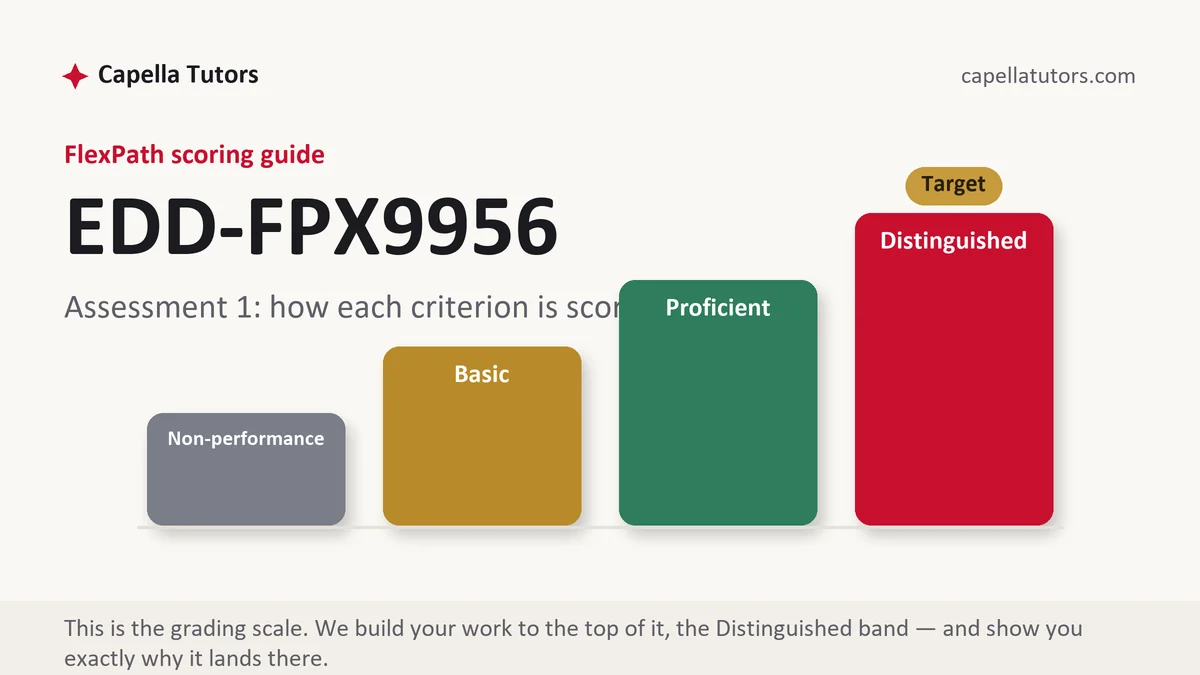
How EDD FPX 9956 Assessment 1 is scored
Each criterion resolves to one of four levels, and on a reconciliation the top level rewards consistency, which is duller and worth more than eloquence:
| Level | What it means on a whole-manuscript reconciliation |
|---|---|
| Distinguished | The document reads as one argument written once, with identical question wording, one name per construct, counts and dates agreeing everywhere, no orphan citations in either direction, and template compliance a reader never notices. |
| Proficient | A clean and coherent manuscript with the obvious inconsistencies resolved. Sound, and short of the row above wherever a construct carries two names or a table disagrees with its narrative. |
| Basic | Chapters corrected individually and never read against each other, so the project still answers a slightly different question at the end than it asked at the start. |
| Non-performance | A required element is absent, most often the front matter or the abstract, or the template conformance the criterion asked for. |
One verification here is about ethics rather than about format. The methodology chapter has to describe the study that was actually approved, which means the determination, its date, every modification filed during the work and the consent language you really used all appear in the document and in its appendix. A manuscript describing a focus group that a later modification authorized, while the methodology still describes the original design, is internally false rather than merely untidy. Confirm the retention and destruction terms you agreed to are stated, since a document living in a repository outlives your memory of them.
What this deliverable hands to the rest of the stage is a document you can present from without hedging. A presentation built on a manuscript that contradicts itself produces the one committee question nobody recovers gracefully from, which is why the participant count disagrees between two chapters. Do the mechanical pass first and the deck afterward, because the reconciliation takes a day and reclaims criteria that no amount of good writing later can.
The EDD FPX 9956 Assessment 1 method, step by step
-
Collect every instance of the research questions
Search the file for your questions, paste every occurrence into one document, and make them identical to the approved wording. Five courses of drafting routinely produce four versions, and a reader comparing chapter one with chapter four will find them faster than you did. Then fix the abstract to match.
-
Give every construct exactly one name
Self-efficacy in the framework and confidence in the findings are two words for one thing, and a reviewer cannot tell whether you measured one construct or two. Trace each construct from the framework through the instrument, the analysis and the interpretation, and standardize the term everywhere including in table headings.
-
Reconcile counts, dates and site descriptors
Participants, records, sites, windows and rates all drift. A methodology reading 14 participants and a findings chapter reading 13 because somebody withdrew is one unedited sentence, and it undermines everything a reader cannot check. Build a one-page fact sheet of every number in the document, then correct the document against the sheet.
-
Compare references in both directions mechanically
Export the reference list and the in-text citations separately and match them by list rather than by eye. A manuscript of this length routinely carries a few entries cited nowhere and a few citations with no entry. Confirm each framework and method traces to a primary source rather than to your own earlier summary.
-
Level the template before the final read
Heading levels, table and figure numbering, front matter, pagination, margins, appendix labels. Template compliance is the cheapest criterion available and the one most often dropped, because it gets left for a night when there is no night left. Do it while the writing is still open to correction.
-
Read it once end to end, then self-score
Read the whole document in one sitting, on paper if you can, checking whether the problem named at the start is the problem the recommendations address. Then mark each criterion honestly, keep a change log so nothing moved silently, and submit early, allowing the two business days for evaluation.
A structure that maps to the criteria
These are our planning targets for the reconciliation deliverable, not Capella rules. Most of the effort is verification rather than composition, so the word counts matter less here than the checks do.
| Section | What it must do | Guide |
|---|---|---|
| Question and purpose alignment | One wording for every research question, matched in the abstract and every chapter. | as needed |
| Construct trace | Each construct followed from framework to instrument to analysis under one name. | as needed |
| Fact sheet | Every count, date, rate and site descriptor in the document, reconciled on one page. | ~200 words |
| Ethics record | Determination, modifications, consent language and retention terms as described in the appendix. | ~250 words |
| Reference integrity | Citations matched to entries both ways, primary sources behind every framework and method. | as needed |
| Template and front matter | Headings, numbering, pagination, abstract and appendix labels to your program's template. | as needed |
Annotated sample excerpt
An original excerpt from our team showing how a reconciled paragraph reads once the numbers have been squared. Learn the moves, then run the same pass on your own document.
Fourteen counselors and pathway coordinators consented, of whom 13 completed both interviews after one coordinator transferred to another district in January, and the analysis therefore draws on 13 participants and 26 interviews.1 The withdrawal was logged on January 14 and reported to the review body under the terms of the approved protocol, and the partial data from the departing participant was destroyed rather than analyzed, which is why no case identifier 07 appears in the findings.2 The number 13 now appears in the abstract, the methodology, the findings and every table heading, and the fact sheet records the consented count, the completing count and the interview total so that a reader meeting any one of the three can locate the others.3
- 1Consented and completing counts reported as two numbers with the reason for the difference, so neither figure looks like a typographical error.
- 2Dates the withdrawal, names what was reported, and explains the gap in the case identifiers before a reader notices it and wonders.
- 3States where the corrected figure now appears. Naming the locations is what turns a fix into evidence of a reconciliation pass.
The full premium sample for your exact assessment, written fresh to your scoring guide and issue, is free to request. Study it, revise it into your own voice, and submit work you understand.
The five mistakes that cost Distinguished
- Chapters corrected in isolation. Editing each chapter well and never reading them against one another leaves every inconsistency exactly where it was.
- Two names for one construct. A reviewer cannot tell whether you measured one thing twice or two things once, and the doubt spreads.
- References checked by eye. Orphan entries and missing entries survive visual review and are found in seconds by anybody who exports both lists.
- A methodology describing the original design. Where a modification changed the study, a chapter still describing the first plan is inaccurate rather than merely stale.
- Formatting left to the final night. Template conformance is the easiest criterion on the rubric to satisfy and the most common one to lose.
Pre-submission checklist
- One wording for every research question, matched in the abstract and every chapter
- One name per construct, traced from framework through instrument to finding
- A fact sheet of every count, date and rate, with the document corrected against it
- Determination, modifications and consent language described as they actually stood
- Citations and entries matched in both directions, primary sources behind every framework
- Template, numbering, front matter and pagination checked before the final read
Reconciliation pass due?
Send the full manuscript, your guide and your program's template. Eight people, including an editor and two QA reviewers, return a premium original sample and a change log in 24 to 48 hours with questions aligned, constructs traced, numbers squared and references matched both ways, revised free until the guide is satisfied.