This manual is for EDD FPX 9955 Assessment 2, start to submission. Assessment 2 usually turns judgment into advice, so what is graded is whether somebody could act on what you wrote. The deliverable pairs limitations with recommendations: the design consequences that bound your claim, each followed by what a reader may still conclude, and then recommendations carrying an actor, an action, a resource, a timeline and an indicator. Your scoring guide sets the deliverable and who it is written for. Below is our method, a criterion-mapped structure, and an annotated sample excerpt. Prefer to hand it off? A premium original sample comes back in 24 to 48 hours, revised free until it meets the guide. Capella's catalog lists the course as EDD-FPX9955, and some courserooms print EDD9955; both point to this same Assessment 2.
One honesty note before the manual: Capella revises courses and scoring guides over time, so always write to the exact scoring guide attached to your assessment in the courseroom. The course identity above is verified on capella.edu; the method and structure below are our tutors' approach to it, not Capella's official rubric text.
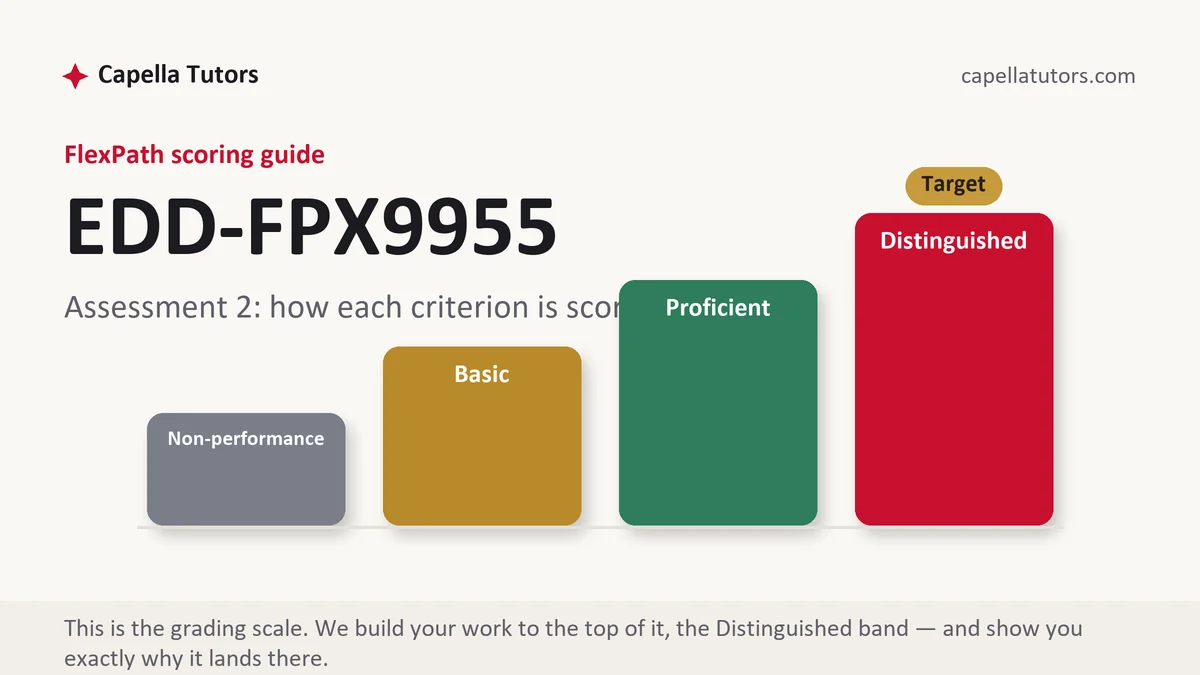
How EDD FPX 9955 Assessment 2 is scored
Each criterion resolves to one of four levels, and on recommendations the top level buys ownership rather than ambition:
| Level | What it means on limitations and recommendations |
|---|---|
| Distinguished | Every recommendation names who acts, what changes, what it costs, when it starts and how it will be monitored, and every limitation constrains the claim precisely rather than disclaiming it in general. |
| Proficient | Recommendations that follow from the findings and limitations honestly stated. Solid, and short of the row above wherever a resource or an indicator is missing. |
| Basic | Advice written as wishes, increase collaboration and provide more support, with limitations listed as regrets about sample size. |
| Non-performance | A required element is absent, most often the link from a recommendation back to a finding, or the limitations section itself. |
Two review realities constrain the advice. A recommendation is not a permission to act, so a plan that redirects staff or changes a student experience inside the study site is a district decision and, if you intend to evaluate it, a new determination rather than an extension of the one you hold. And where recommendations reach beyond your site, check that your consent and data agreement allow the underlying figures to travel that far, because a district-level table assembled from records released for one study is a new use of those records.
The handoff is the dissemination work that follows, and it will test every recommendation by asking whether it fits on one page for the person who can approve it. Sort the recommendations now by the altitude of the decision, classroom, building, cabinet and board, since that sort is what the next deliverable turns into audiences and artifacts. A recommendation that cannot be assigned an altitude usually has no owner, and it will not survive being said out loud.
The EDD FPX 9955 Assessment 2 method, step by step
-
Write limitations as design consequences
Each limitation is something your chosen design cannot do, followed by what a reader may still conclude. Four schools cannot speak for a state, and they can speak for schools of this size with this vacancy history. Written that way limitations demonstrate control; written as apologies they invite a reader to discount the chapter.
-
Trace every recommendation to a finding
Put the finding and the recommendation in the same sentence at least once, so the link is visible rather than assumed. A recommendation with no finding behind it is a preference, and evaluators are practiced at spotting the ones that arrived from your own convictions rather than from your data.
-
Give each recommendation the five parts
Actor, action, resource, timeline, indicator. Improve retention is a wish. Continuing the stipend at 4,000 dollars for the 38 teachers in the two highest-vacancy buildings, funded from the existing recruitment line, beginning with the next contract cycle and tracked by August vacancy counts, is a recommendation a board can vote on.
-
Cost what you can and say what you cannot
Thirty-eight stipends at 4,000 dollars is 152,000 dollars, and naming that figure makes the recommendation serious even to the people who decline it. Where you cannot cost something, say which quantity is unknown and who holds it, because an uncosted recommendation with an identified owner still moves.
-
Sort by the altitude of the decision
Classroom changes go to instructional leaders and cost time, building changes go to principals and cost schedule, reallocation and policy go to a cabinet or a board and cost money and political capital. Where a change needs two altitudes to move together, say so, since the hidden dependency is what quietly kills agreed recommendations.
-
Name the monitoring measure, then self-score
Attach one indicator per recommendation, with a baseline, a reporting interval and the person who reports it. Then read the guide criterion by criterion, mark yourself honestly, confirm every dollar figure and count matches the chapter it came from, and submit early, allowing two business days for evaluation.
A structure that maps to the criteria
Our planning targets for a limitations and recommendations deliverable, not Capella requirements. Weight the recommendations row, since that is where the criteria concentrate.
| Section | What it must do | Guide |
|---|---|---|
| Opening | What the chapter does, and the findings the advice will rest on. | ~150 words |
| Limitations | Each design consequence, followed by what a reader may still conclude from the study. | ~300 words |
| Recommendations | Each one with actor, action, resource, timeline and indicator, traced to its finding. | ~600 words |
| Cost and feasibility | What each change costs in money, time or schedule, and what remains unknown. | ~250 words |
| Decision altitude | Which recommendation belongs to whom, and where two levels must move together. | ~200 words |
| Monitoring and references | Indicators with baselines and reporting intervals, standards cited in current APA. | ~200 words |
Annotated sample excerpt
An original excerpt from our team showing a recommendation written so somebody could act on it. Study the moves, then write your own.
Because the stipend cohort retained 31 of 38 teachers against 22 of 36 in the comparison buildings, a difference of 20.4 percentage points, the recommendation is that the assistant superintendent for human resources continue the stipend at 4,000 dollars for teachers in the two buildings whose three-year vacancy rate exceeds 15 percent.1 The cost is 152,000 dollars annually, which is within the existing recruitment and advertising line rather than requiring new money, and the change would begin with the contract cycle opening in February so that offers precede the regional hiring season.2 Retention would be reported to the board each August as the share of returning classroom teachers in both building pairs, with the comparison buildings kept in the report, since a single rising number tells nobody whether the stipend or the labor market moved it.3
- 1Finding and recommendation in one sentence, with the actor named by role and the eligibility rule stated as a threshold rather than as a list of favored schools.
- 2Costs the recommendation, identifies the funding line, and times the start to a real hiring calendar rather than to the beginning of a school year.
- 3Names the indicator, the reporting interval and the audience, and keeps the comparison group in the report so the measure can still be interpreted next year.
The full premium sample for your exact assessment, written fresh to your scoring guide and issue, is free to request. Study it, revise it into your own voice, and submit work you understand.
The five mistakes that cost Distinguished
- Recommendations with no owner. Where nobody is named, nobody is responsible, and the section reads as commentary on the district.
- Limitations written as apologies. A list of regrets invites a reader to discount the interpretation you just spent a chapter building.
- Advice untraceable to a finding. A recommendation with no finding behind it is a personal preference wearing doctoral clothing.
- No indicator, no baseline. A change nobody will measure cannot be evaluated, and the criterion is asking how you would know.
- Overreach past the sample. Four schools cannot speak for a state, and the sentence attempting it costs the limitations criterion twice.
Pre-submission checklist
- Every limitation followed by what a reader may still conclude
- Every recommendation traced to a named finding in the same sentence
- Actor, action, resource, timeline and indicator present in each recommendation
- Costs stated where possible, with unknown quantities named and assigned
- Recommendations sorted by the level of the person who can approve them
- Each indicator carries a baseline, an interval and a named reporter
Recommendations due?
Send the guide, your findings and whatever you know about budgets and staffing. Eight people, including a research analyst and two QA reviewers, return a premium original sample in 24 to 48 hours with limitations written as design consequences and recommendations costed, scheduled and monitored, revised free until the guide is satisfied.