This manual is for EDD FPX 9955 Assessment 3, start to submission. Assessment 3 usually pushes the work outward, so the graded question is whether the project reaches anybody. The deliverable is implications plus a dissemination plan: what the finding means for sites like yours and for leadership practice more widely, then the audience, artifact, channel and date for each act of sharing. Your scoring guide decides the deliverable and its audiences. Below is our method, a criterion-mapped structure, and an annotated sample excerpt. Prefer to hand it off? A premium original sample comes back in 24 to 48 hours, revised free until it meets the guide. Capella's catalog lists the course as EDD-FPX9955, and some courserooms print EDD9955; both point to this same Assessment 3.
One honesty note before the manual: Capella revises courses and scoring guides over time, so always write to the exact scoring guide attached to your assessment in the courseroom. The course identity above is verified on capella.edu; the method and structure below are our tutors' approach to it, not Capella's official rubric text.
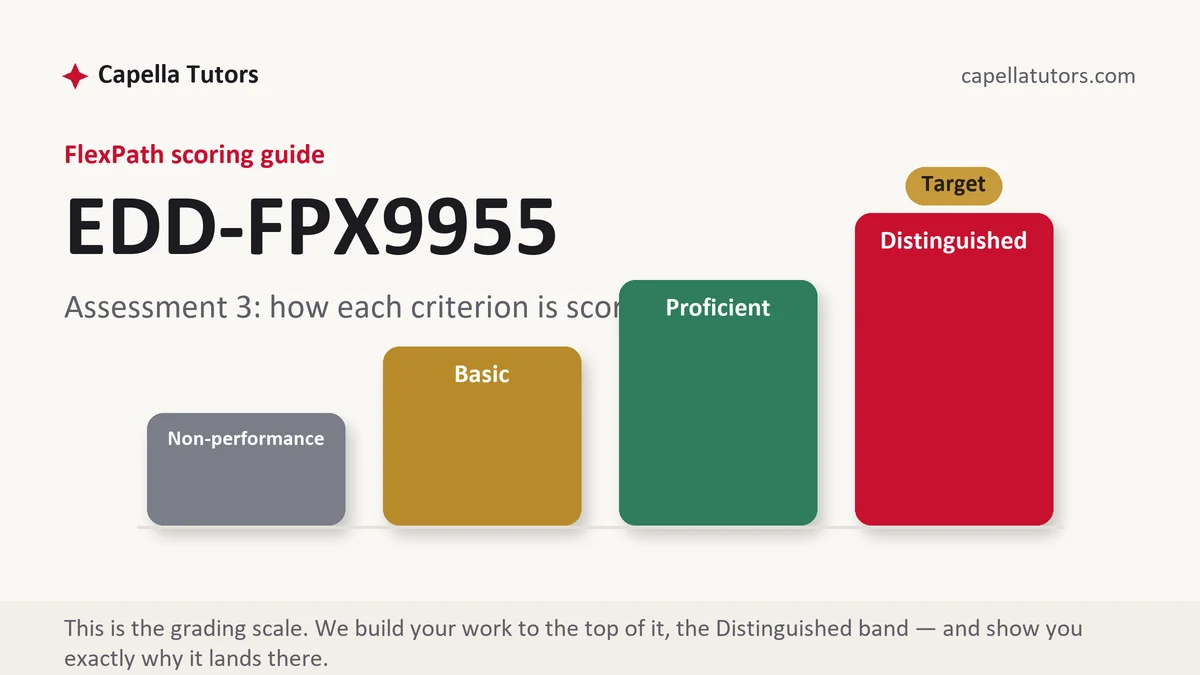
How EDD FPX 9955 Assessment 3 is scored
Each criterion resolves to one of four levels, and on a dissemination plan the top level pays for dates rather than for intentions:
| Level | What it means on implications and a dissemination plan |
|---|---|
| Distinguished | Transfer is argued through described context rather than asserted, and every act of sharing names a recipient, an artifact written at that reader's altitude, a channel and a date, beginning with the site that hosted the study. |
| Proficient | Implications drawn soundly and a plan for sharing described. Solid, and short of the row above wherever an audience has no artifact or a date is missing. |
| Basic | A paragraph promising to share findings with stakeholders, and implications generalized past anything the study could support. |
| Non-performance | A required element is absent, most often the dissemination plan itself, or the implications for practice the criterion asked for. |
Sharing has an approval boundary and most learners meet it here for the first time. Your determination covered a study, and it may or may not have covered publication, a conference session or a public board presentation, so check the language you agreed to before a date goes on a calendar. Anything reaching an audience outside the district needs the site described so it cannot be identified by elimination, and where the district wants to be named that is a decision for the district in writing rather than a courtesy you extend.
The handoff is into the closing stage, where these materials get built rather than planned. EDD FPX 9956 asks for the reconciled manuscript, the presentation and the artifacts themselves, so write this plan with the drafting cost in mind and put the host site first in the order. Drafting the two-page brief now, while the argument is live, is also the cheapest way to discover which recommendations cannot survive being compressed onto one page.
The EDD FPX 9955 Assessment 3 method, step by step
-
Argue transfer through context, not through scale
A single district cannot support a claim about districts in general, and a richly described district can support a claim about districts resembling it. Give the reader enrollment, poverty rate, staffing pattern, prior performance and governance, then say which of those a receiving school would need to share for your finding to travel.
-
Separate implications for practice from implications for research
Practice implications tell a leader what to do differently on Monday. Research implications tell the field what to test next. Mixing them produces a section that reads as a list of leftovers, and the criterion usually rewards the practice half far more heavily than learners expect.
-
Name the audience before the artifact
List the people who could use this: the host principal, the assistant superintendent, the board, the association that runs your state conference, the participants themselves. Only then decide what each one gets, because artifacts chosen first tend to be the ones you enjoy making rather than the ones somebody will read.
-
Match the artifact to the reader's altitude
A board will not read a chapter and a practitioner journal will not print a dissertation. A cabinet gets two pages with the ask on page one. A board committee gets three slides and ten minutes. A faculty meeting gets a twenty-minute session with the local numbers in it. A journal gets 3,000 words and no appendices.
-
Put a real date against every line
Not next fall, but the first week of August for the brief, a September work session for the board item, and a proposal filed before a December conference deadline. Dates are what convert this section from an intention into a plan, and they are the part an evaluator can check without knowing your district.
-
Serve the site first, then self-score
The district carried the cost of your study in time and access, so its version goes out before anybody else receives anything, and the participants get a paragraph telling them what came of their hour. Then mark each criterion honestly and submit early, allowing the two business days faculty have to evaluate an attempt.
A structure that maps to the criteria
Planning targets from our tutors for an implications and dissemination deliverable, not Capella requirements. The dissemination table should be the most concrete thing in the chapter.
| Section | What it must do | Guide |
|---|---|---|
| Opening | What the chapter does and which findings carry beyond the site. | ~150 words |
| Implications for practice | What a leader in a comparable setting should do differently, and under what conditions. | ~350 words |
| Transferability | The context described precisely enough for a reader to judge whether it resembles theirs. | ~250 words |
| Implications for research | What the field still needs to test, framed from your own limitations. | ~200 words |
| Dissemination plan | Audience, artifact, channel and date for each act of sharing, host site first. | ~350 words |
| Closing and references | The argument condensed, standards and sources verified in current APA. | ~200 words |
Annotated sample excerpt
An original excerpt from our team showing a dissemination line written as a plan rather than as a promise. Learn the moves, then write your own.
The board receives a ten-minute item on the September 16 work session agenda, built as three slides: the ask, which is protecting the advisory block from the two scheduling changes proposed for next year, the finding behind it, which is that students in the fully implemented advisory reported 0.42 standard deviations higher connectedness with 6 of 9 teams sustaining weekly meetings, and one slide on how the study was done.1 The building faculty who hosted the work see it first, on August 22, in a twenty-minute session using their own team-level figures rather than district aggregates, because the people who ran the advisory are entitled to the detail before the governing body sees the summary.2 Participants receive a one-paragraph note in the first week of September saying what the study found and what has been recommended, which almost nobody sends and which is the reason the next doctoral learner at that school gets a yes.3
- 1A real date, a real agenda slot, a slide count and the ask stated first. Board audiences want the decision before the reasoning, and the item is sized to what an agenda allows.
- 2Puts the host site ahead of the board and gives it a different artifact at a different grain, which is both an ethical order and a practical one.
- 3Closes the loop with the participants, on a date, in one paragraph. It costs nothing and it is what keeps a site open to the next study.
The full premium sample for your exact assessment, written fresh to your scoring guide and issue, is free to request. Study it, revise it into your own voice, and submit work you understand.
The five mistakes that cost Distinguished
- Sharing promised in the future tense. A sentence about disseminating findings to stakeholders is not yet a plan and earns nothing.
- One artifact for every audience. The manuscript sent to a board, a principal and a journal serves none of the three.
- Generalization instead of transfer. Claiming your finding applies to middle schools nationally costs the criterion that transferability was meant to satisfy.
- The host site served last. A district that opened its data and its staff to you is owed the finding before anybody outside it.
- Research implications crowding out practice. A list of studies somebody else should run is the easiest section to write and the least of what this degree is for.
Pre-submission checklist
- Transfer argued through described context rather than asserted from sample size
- Practice implications separated from research implications
- Every audience paired with one artifact written at that reader's altitude
- A real date against every line of the plan
- The host site and the participants served before any external audience
- Consent and approval language checked against every audience outside the district
Dissemination plan due?
Send the guide, your findings and the audiences you can reach. Eight people, including a research analyst and two QA reviewers, return a premium original sample in 24 to 48 hours with transfer argued from context and every audience given an artifact and a date, revised free until the guide is satisfied.